Thank you for visiting SNEWPapers!
Sign up free
Story
November 20, 1877
The Wheeling Daily Register
Wheeling, Ohio County, West Virginia
What is this article about?
The grand jury's report on the July Pittsburgh riots blames state officials and military for the violence, exonerates citizens who restored order, criticizes military blunders leading to massacre, and notes indictments against nearly 100 rioters.
Clipping
OCR Quality
95%
Excellent
Full Text
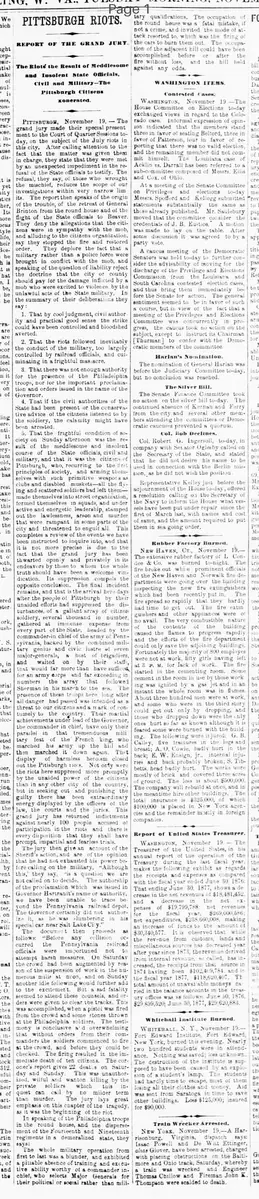
PITTSBURGH RIOTS.
REPORT OF THE GRAND JURY.
The Riots the Result of Meddlesome and Insolent State Officials, Civil and Military—The Pittsburgh Citizens Exonerated.
Pittsburgh, November 19.—The grand jury made their special presentment to the Court of Quarter Sessions to-day, on the subject of the July riots in this city. After calling attention to the fact that the matter was given them in charge, they state that they were met by an unexpected impediment in the refusal of the State officials to testify. The refusal, they say, of those who wrought the mischief, reduces the scope of our investigations within very narrow limits. The report then speaks of the origin of the trouble, of the retreat of General Brinton from the round house and of the flight of the State officials to Beaver. They deny the allegations that the citizens were in sympathy with the mob and alluding to the citizens organization, say they stopped the fire and restored order.
They deplore the fact that a military rather than a police force were brought in conflict with the mob, and speaking of the question of liability reject the doctrine that the city or county should pay for the damage inflicted by a mob who were excited to violence by the unlawful acts of the State military. In the summary of their deliberations they say:
1. That by cool judgment, civil authority and practical good sense the strike could have been controlled and bloodshed averted.
2. That the riots followed inevitably the conduct of the military, too largely controlled by railroad officials, and culminating in a frightful massacre.
3. That there was not enough authority for the presence of the Philadelphia troops, nor for the important proclamation and orders issued in the name of the Governor.
4. That if the civil authorities of the State had been present or the conservative advice of the citizens listened to by the soldiery, the calamity might have been arrested.
5. That the frightful condition of society on Sunday afternoon was the result of the meddlesome and insolent course of the State officials, civil and military, and that it was the citizens of Pittsburgh, who, recurring to the first principles of society, and arming themselves with such primitive weapons as clubs and disabled muskets—all the flying and scattered soldiers had left them—made themselves into street organizations, formed themselves in squads, and under active and energetic leadership, stamped out the lawlessness, arson and murder that were rampant in some parts of the city and threatened to engulf all. This completes a review of the events we have been instructed to inquire into, and that it is not more precise is due to the fact that the grand jury has been thwarted openly and privately in its endeavors by those to whom the whole truth should have been a welcome vindication. Its suppression compels the opposite conclusion. The final incident remains, and that is the arrival here days after the people of Pittsburgh by their unaided efforts had suppressed the disturbances, of a gallant array of citizen soldiery, several thousand in number, gathered at immense expense from every part of the State, headed by the commander-in-chief of the army of Pennsylvania, backed by the combined military genius and civic lustre of seven major-generals, a host of brigadiers and waited on by their staff that would far more than have sufficed for an army corps and far exceeding in numbers the array that followed Sherman in his march to the sea. The presence of these troops here long after all danger had passed was intended as a threat to our citizens and a mark of contumely to the country. Their martial achievements under lead of the Governor, the commander in chief, have only their parallel in that tremendous military feat of the French king, who marched his army up the hill and then marched it down again. That display of harmless heroism closed out the Pittsburgh riots. Not only were the riots here suppressed more promptly by the unaided power of the citizens than in any other city of the country but in seeking out and punishing the guilty there has been extraordinary energy displayed by the officers of the law, the courts and the juries. This grand jury has returned indictments against nearly 100 people accused of participation in the riots and there is every disposition that they shall have prompt, impartial and fearless trials.
The jury then give an account of the Sheriff's action, and are of the opinion that he had not exhausted his power before calling on the military, "Although this," they say, "is a question we are not called on to decide." The authorship of the proclamation which was issued in Governor Hartranft's name or authority, we have been unable to trace beyond the Pennsylvania railroad depot. The Governor certainly did not authorize it, as he was slumbering in his special car near Salt Lake City."
The document then proceeds as follows: "Before any collision occurred the Pennsylvania railroad officials were importuned not to attempt harsh measures. On Saturday the crowd had been augmented by reason of the suspension of work in the numerous mills at noon, and on Sunday another idle following would further add to the excitement. But a sad fatality seemed to attend these counsels, and orders were given to clear the tracks. This was accomplished, when a pistol was fired from the crowd and some stones thrown at the Philadelphia soldiers. The testimony is conclusive and overwhelming that without orders from their commanders the soldiers commenced to fire at the crowd, and before they could be checked. The firing resulted in the immediate death of ten citizens. The coroner's report gives 22 deaths on Saturday and Sunday. This was unauthorized, wilful and wanton killing by the private soldiers which this inquest can call by no milder term than murder. The jury lays great emphasis on this chapter of the tragedy, as it was the beginning of the riot.
In speaking of the Philadelphia troops in the round house, and the dispersion of the Fourteenth and Nineteenth regiments in a demoralized state, they say:
The whole military operation from first to last was a blunder, and exhibited a pitiable absence of training and executive ability worthy of a commander-in-chief, who selects Major Generals for their political or social rather than military qualifications. The occupation of the round house was a fatal mistake, if not a crime, and invited the mode of attack resorted to, which was the firing of the cars to burn them out. The occupation of the adjacent hill could have been accomplished before or after the fire without loss, and the hill held against any odds.
REPORT OF THE GRAND JURY.
The Riots the Result of Meddlesome and Insolent State Officials, Civil and Military—The Pittsburgh Citizens Exonerated.
Pittsburgh, November 19.—The grand jury made their special presentment to the Court of Quarter Sessions to-day, on the subject of the July riots in this city. After calling attention to the fact that the matter was given them in charge, they state that they were met by an unexpected impediment in the refusal of the State officials to testify. The refusal, they say, of those who wrought the mischief, reduces the scope of our investigations within very narrow limits. The report then speaks of the origin of the trouble, of the retreat of General Brinton from the round house and of the flight of the State officials to Beaver. They deny the allegations that the citizens were in sympathy with the mob and alluding to the citizens organization, say they stopped the fire and restored order.
They deplore the fact that a military rather than a police force were brought in conflict with the mob, and speaking of the question of liability reject the doctrine that the city or county should pay for the damage inflicted by a mob who were excited to violence by the unlawful acts of the State military. In the summary of their deliberations they say:
1. That by cool judgment, civil authority and practical good sense the strike could have been controlled and bloodshed averted.
2. That the riots followed inevitably the conduct of the military, too largely controlled by railroad officials, and culminating in a frightful massacre.
3. That there was not enough authority for the presence of the Philadelphia troops, nor for the important proclamation and orders issued in the name of the Governor.
4. That if the civil authorities of the State had been present or the conservative advice of the citizens listened to by the soldiery, the calamity might have been arrested.
5. That the frightful condition of society on Sunday afternoon was the result of the meddlesome and insolent course of the State officials, civil and military, and that it was the citizens of Pittsburgh, who, recurring to the first principles of society, and arming themselves with such primitive weapons as clubs and disabled muskets—all the flying and scattered soldiers had left them—made themselves into street organizations, formed themselves in squads, and under active and energetic leadership, stamped out the lawlessness, arson and murder that were rampant in some parts of the city and threatened to engulf all. This completes a review of the events we have been instructed to inquire into, and that it is not more precise is due to the fact that the grand jury has been thwarted openly and privately in its endeavors by those to whom the whole truth should have been a welcome vindication. Its suppression compels the opposite conclusion. The final incident remains, and that is the arrival here days after the people of Pittsburgh by their unaided efforts had suppressed the disturbances, of a gallant array of citizen soldiery, several thousand in number, gathered at immense expense from every part of the State, headed by the commander-in-chief of the army of Pennsylvania, backed by the combined military genius and civic lustre of seven major-generals, a host of brigadiers and waited on by their staff that would far more than have sufficed for an army corps and far exceeding in numbers the array that followed Sherman in his march to the sea. The presence of these troops here long after all danger had passed was intended as a threat to our citizens and a mark of contumely to the country. Their martial achievements under lead of the Governor, the commander in chief, have only their parallel in that tremendous military feat of the French king, who marched his army up the hill and then marched it down again. That display of harmless heroism closed out the Pittsburgh riots. Not only were the riots here suppressed more promptly by the unaided power of the citizens than in any other city of the country but in seeking out and punishing the guilty there has been extraordinary energy displayed by the officers of the law, the courts and the juries. This grand jury has returned indictments against nearly 100 people accused of participation in the riots and there is every disposition that they shall have prompt, impartial and fearless trials.
The jury then give an account of the Sheriff's action, and are of the opinion that he had not exhausted his power before calling on the military, "Although this," they say, "is a question we are not called on to decide." The authorship of the proclamation which was issued in Governor Hartranft's name or authority, we have been unable to trace beyond the Pennsylvania railroad depot. The Governor certainly did not authorize it, as he was slumbering in his special car near Salt Lake City."
The document then proceeds as follows: "Before any collision occurred the Pennsylvania railroad officials were importuned not to attempt harsh measures. On Saturday the crowd had been augmented by reason of the suspension of work in the numerous mills at noon, and on Sunday another idle following would further add to the excitement. But a sad fatality seemed to attend these counsels, and orders were given to clear the tracks. This was accomplished, when a pistol was fired from the crowd and some stones thrown at the Philadelphia soldiers. The testimony is conclusive and overwhelming that without orders from their commanders the soldiers commenced to fire at the crowd, and before they could be checked. The firing resulted in the immediate death of ten citizens. The coroner's report gives 22 deaths on Saturday and Sunday. This was unauthorized, wilful and wanton killing by the private soldiers which this inquest can call by no milder term than murder. The jury lays great emphasis on this chapter of the tragedy, as it was the beginning of the riot.
In speaking of the Philadelphia troops in the round house, and the dispersion of the Fourteenth and Nineteenth regiments in a demoralized state, they say:
The whole military operation from first to last was a blunder, and exhibited a pitiable absence of training and executive ability worthy of a commander-in-chief, who selects Major Generals for their political or social rather than military qualifications. The occupation of the round house was a fatal mistake, if not a crime, and invited the mode of attack resorted to, which was the firing of the cars to burn them out. The occupation of the adjacent hill could have been accomplished before or after the fire without loss, and the hill held against any odds.
What sub-type of article is it?
Historical Event
Disaster
Crime Story
What themes does it cover?
Justice
Misfortune
Bravery Heroism
What keywords are associated?
Pittsburgh Riots
Grand Jury Report
Military Blunders
Citizen Restoration
Railroad Strike
Massacre
Indictments
What entities or persons were involved?
Pittsburgh Citizens
General Brinton
Governor Hartranft
State Officials
Where did it happen?
Pittsburgh
Story Details
Key Persons
Pittsburgh Citizens
General Brinton
Governor Hartranft
State Officials
Location
Pittsburgh
Event Date
July Riots, November 19
Story Details
Grand jury report attributes Pittsburgh riots to meddlesome state officials and military blunders, exonerates citizens who restored order with improvised weapons, criticizes unauthorized military actions leading to massacre, notes lack of authority for troop presence, and reports indictments against nearly 100 riot participants.