Thank you for visiting SNEWPapers!
Sign up free
The Virginia Gazette
Richmond, Williamsburg, Richmond County, Virginia
What is this article about?
This historical essay recounts Philip II of Spain's tyrannical efforts to strip the Low Countries of their liberties through oppression, the Inquisition, and military force under the Duke of Alva, leading to rebellion, the execution of leaders like Egmont and Horn, and eventual independence for seven provinces after decades of war, drawing parallels to contemporary colonial crises.
Merged-components note: Image bbox overlaps spatially with the text block of the literary component, indicating the image is embedded or part of the same historical essay.
Clipping
OCR Quality
Full Text
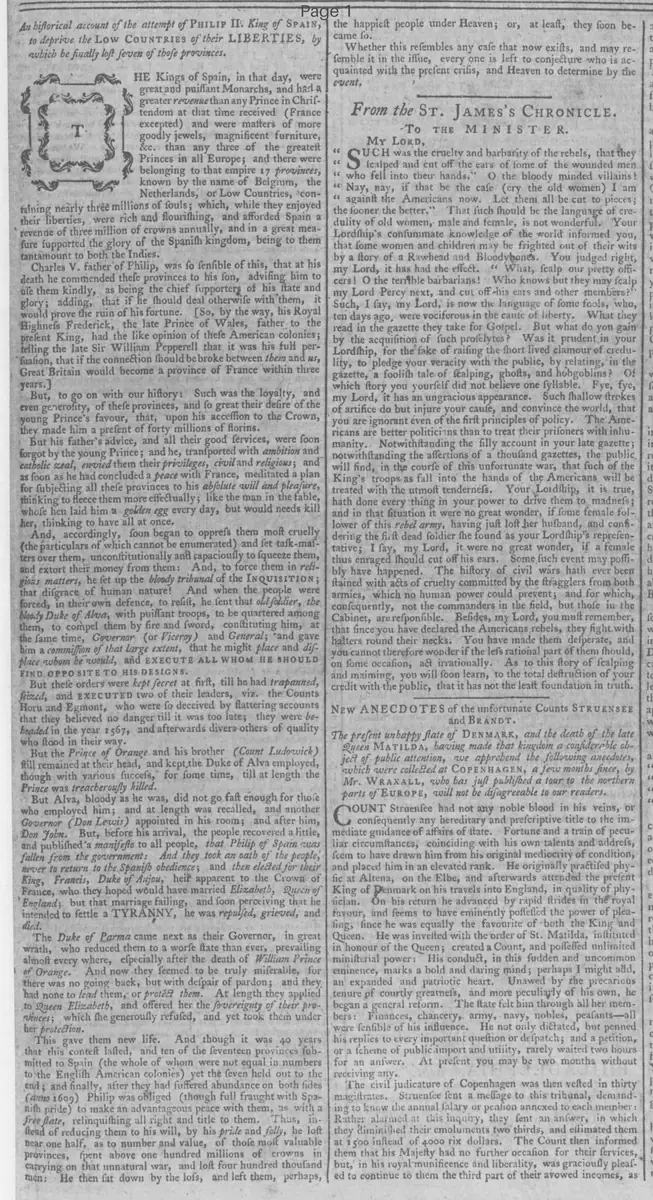
THE Kings of Spain, in that day, were great and puissant Monarchs, and had a greater revenue than any Prince in Christendom at that time received (France excepted) and were masters of more goodly jewels, magnificent furniture, &c. than any three of the greatest Princes in all Europe; and there were belonging to that empire 17 provinces, known by the name of Belgium, the Netherlands, or Low Countries, containing nearly three millions of souls; which, while they enjoyed their liberties, were rich and flourishing, and afforded Spain a revenue of three million of crowns annually, and in a great measure supported the glory of the Spanish kingdom, being to them tantamount to both the Indies.
Charles V. father of Philip, was so sensible of this, that at his death he commended these provinces to his son, advising him to use them kindly, as being the chief supporters of his state and glory; adding, that if he should deal otherwise with them, it would prove the ruin of his fortune. [So, by the way, his Royal Highness Frederick, the late Prince of Wales, father to the present King, had the like opinion of these American colonies; telling the late Sir William Pepperell that it was his full persuasion, that if the connection should be broke between them and us, Great Britain would become a province of France within three years.]
But, to go on with our history: Such was the loyalty, and even generosity, of these provinces, and so great their desire of the young Prince's favour, that, upon his accession to the Crown, they made him a present of forty millions of florins.
But his father's advice, and all their good services, were soon forgot by the young Prince; and he, transported with ambition and catholic zeal, envied them their privileges, civil and religious; and as soon as he had concluded a peace with France, meditated a plan for subjecting all these provinces to his absolute will and pleasure, thinking to fleece them more effectually; like the man in the fable, whose hen laid him a golden egg every day, but would needs kill her, thinking to have all at once.
And, accordingly, soon began to oppress them most cruelly (the particulars of which cannot be enumerated) and set task-masters over them, unconstitutionally and rapaciously to squeeze them, and extort their money from them: And, to force them in religious matters, he set up the bloody tribunal of the INQUISITION; that disgrace of human nature! And when the people were forced, in their own defence, to resist, he sent that old soldier, the bloody Duke of Alva, with puissant troops, to be quartered among them, to compel them by fire and sword, constituting him, at the same time, Governor (or Viceroy) and General; and gave him a commission of that large extent, that he might place and displace whom he would, and EXECUTE ALL WHOM HE SHOULD FIND OPPOSITE TO HIS DESIGNS.
But these orders were kept secret at first, till he had trapanned, seized, and EXECUTED two of their leaders, viz. the Counts Horn and Egmont, who were so deceived by flattering accounts that they believed no danger till it was too late; they were beheaded in the year 1567, and afterwards divers others of quality who stood in their way.
But the Prince of Orange and his brother (Count Ludowick) still remained at their head, and kept the Duke of Alva employed, though with various success, for some time, till at length the Prince was treacherously killed.
But Alva, bloody as he was, did not go far enough for those who employed him; and at length was recalled, and another Governor (Don Lewis) appointed in his room; and after him, Don John. But, before his arrival, the people recovered a little, and published a manifesto to all people, that Philip of Spain was fallen from the government: And they took an oath of the people, never to return to the Spanish obedience; and then elected for their King, Francis, Duke of Anjou, heir apparent to the Crown of France, who they hoped would have married Elizabeth, Queen of England; but that marriage failing, and soon perceiving that he intended to settle a TYRANNY, he was repulsed, grieved, and died.
The Duke of Parma came next as their Governor, in great wrath, who reduced them to a worse state than ever, prevailing almost every where, especially after the death of William Prince of Orange. And now they seemed to be truly miserable, for there was no going back, but with despair of pardon; and they had none to lead them, or protect them. At length they applied to Queen Elizabeth, and offered her the sovereignty of their provinces; which she generously refused, and yet took them under her protection.
This gave them new life. And though it was 40 years that this contest lasted, and ten of the seventeen provinces submitted to Spain (the whole of whom were not equal in numbers to the English American colonies) yet the Seven held out to the end; and finally, after they had suffered abundance on both sides (anno 1609) Philip was obliged (though full fraught with Spanish pride) to make an advantageous peace with them, as with a free state, relinquishing all right and title to them. Thus, instead of reducing them to his will, by his pride and folly, he lost near one half, as to number and value, of those most valuable provinces, spent above one hundred millions of crowns in carrying on that unnatural war, and lost four hundred thousand men; He then sat down by the loss, and left them, perhaps, the happiest people under Heaven; or, at least, they soon became so.
Whether this resembles any case that now exists, and may resemble it in the issue, every one is left to conjecture who is acquainted with the present crisis, and Heaven to determine by the event.
What sub-type of article is it?
What themes does it cover?
What keywords are associated?
Literary Details
Title
An Historical Account Of The Attempt Of Philip Ii. King Of Spain, To Deprive The Low Countries Of Their Liberties, By Which He Finally Lost Even Of Those Provinces.
Key Lines