Thank you for visiting SNEWPapers!
Sign up free
Story
July 10, 1806
Lynchburg Star
Lynchburg, Virginia
What is this article about?
Eyewitness account of a total solar eclipse in Boston on Monday last, describing gradual dimming, chill in air, bird behavior, temperature drop, visibility of moon's edge, stars, and Venus, shadow passage from Albany, and sudden changes in light.
Clipping
OCR Quality
98%
Excellent
Full Text
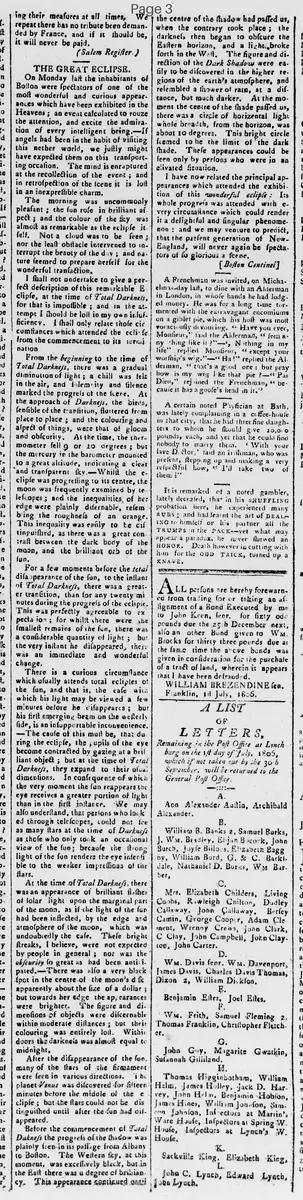
THE GREAT ECLIPSE.
On Monday last the inhabitants of Boston were spectators of one of the most wonderful and curious appearances which have been exhibited in the heavens; an event calculated to rouse the attention, and excite the admiration of every intelligent being. If angels had been in the habit of visiting this nether world, we justly might have expected them on this transporting occasion. The mind is enraptured at the recollection of the event; and in retrospection of the scene it is lost in an inexpressible charm.
The morning was uncommonly pleasant: the sun rose in brilliant aspect; and the colour of the sky was almost as remarkable as the eclipse itself. Not a cloud was to be seen: nor the least obstacle intervened to interrupt the beauty of the day; and nature seemed to prepare herself for the wonderful transaction.
I shall not undertake to give a perfect description of this remarkable Eclipse, at the time of Total Darkness, for that is impossible: and in the attempt I should be lost in my own insufficiency. I shall only relate those circumstances which attended the eclipse from the commencement to its termination.
From the beginning to the time of Total Darkness, there was a gradual diminution of light: a chill was felt in the air, and solemnity and silence marked the progress of the scene. At the approach of Darkness, the birds, sensible of the transition, fluttered from place to place; and the colouring and aspect of things, were that of gloom and obscurity. At the time, the thermometer fell 8 or 10 degrees; but the mercury in the barometer mounted to a great altitude, indicating a clear and transparent sky. Whilst the eclipse was progressing to its centre, the moon was frequently examined by telescopes; and the inequalities of her edge were plainly discernible, resembling the roughness of an orange. This inequality was easily to be distinguished, as there was a great contrast between the dark body of the moon, and the brilliant orb of the sun.
For a few moments before the total disappearance of the sun, to the instant of Total Darkness, there was a greater transition, than for any twenty minutes during the progress of the eclipse. This was perfectly agreeable to expectation; for whilst there were the smallest remains of the sun, there was a considerable quantity of light; but the very instant he disappeared, there was an immediate and wonderful change.
There is a curious circumstance which usually attends total eclipses of the sun, and that is, the ease with which his light may be viewed a few minutes before he disappears; but his first emerging beam on the westerly side, is an insupportable inconvenience. The cause of this must be, that during the eclipse, the pupils of the eye become contracted by gazing at a brilliant object: but at the time of Total Darkness, they expand to their usual dimensions. In consequence of which the very moment the sun reappears the eye receives a greater portion of light than in the first instance. We may also understand, that persons who looked through telescopes, could not see as many stars at the time of Darkness as those who only took an occasional view of the sun; because the strong light of the sun renders the eye insensible to the weaker impressions of the stars.
At the time of Total Darkness, there was an appearance of brilliant flashes of solar light upon the marginal part of the moon, as if the light of the sun had been refracted, by the edge and atmosphere of the moon, which was undoubtedly the case. These bright streaks, I believe, were not expected by people in general; nor was the obscurity so great as had been anticipated. There was also a very black spot in the centre of the moon's disk, apparently about the size of a dollar; but towards her edge the appearances were brighter. The figure and dimensions of objects were discernible within moderate distances; but their colouring was entirely lost. Within doors the darkness was almost equal to midnight.
After the disappearance of the sun, many of the stars of the firmament were seen in various directions. The planet Venus was discovered for fifteen minutes before the middle of the eclipse; but the stars could not be distinguished until after the sun had disappeared.
Before the commencement of Total Darkness the progress of the shadow was plainly seen—in its passage from Albany to Boston. The Western sky, at this moment, was excessively black, but in the East there was a degree of brilliancy. This appearance continued until the centre of the shadow had passed us. When the contrary took place; the darkness then began to obscure the Eastern horizon, and a light broke forth in the West. The figure and direction of the Dark Shadow were easily to be discovered in the higher regions of the earth's atmosphere, and resembled a shower of rain, at a distance, but much darker. At the moment the centre of the shade passed us, there was a circle of horizontal light whose breadth, from the horizon, was about 10 degrees. This bright circle seemed to be the limit of the dark Shade. These appearances could be seen only by persons who were in an elevated situation.
I have now related the principal appearances which attended the exhibition of this wonderful eclipse: Its whole progress was attended with every circumstance which could render it a delightful and singular phenomenon: and we may venture to predict, that the present generation of New-England, will never again be spectators of so glorious a scene.
On Monday last the inhabitants of Boston were spectators of one of the most wonderful and curious appearances which have been exhibited in the heavens; an event calculated to rouse the attention, and excite the admiration of every intelligent being. If angels had been in the habit of visiting this nether world, we justly might have expected them on this transporting occasion. The mind is enraptured at the recollection of the event; and in retrospection of the scene it is lost in an inexpressible charm.
The morning was uncommonly pleasant: the sun rose in brilliant aspect; and the colour of the sky was almost as remarkable as the eclipse itself. Not a cloud was to be seen: nor the least obstacle intervened to interrupt the beauty of the day; and nature seemed to prepare herself for the wonderful transaction.
I shall not undertake to give a perfect description of this remarkable Eclipse, at the time of Total Darkness, for that is impossible: and in the attempt I should be lost in my own insufficiency. I shall only relate those circumstances which attended the eclipse from the commencement to its termination.
From the beginning to the time of Total Darkness, there was a gradual diminution of light: a chill was felt in the air, and solemnity and silence marked the progress of the scene. At the approach of Darkness, the birds, sensible of the transition, fluttered from place to place; and the colouring and aspect of things, were that of gloom and obscurity. At the time, the thermometer fell 8 or 10 degrees; but the mercury in the barometer mounted to a great altitude, indicating a clear and transparent sky. Whilst the eclipse was progressing to its centre, the moon was frequently examined by telescopes; and the inequalities of her edge were plainly discernible, resembling the roughness of an orange. This inequality was easily to be distinguished, as there was a great contrast between the dark body of the moon, and the brilliant orb of the sun.
For a few moments before the total disappearance of the sun, to the instant of Total Darkness, there was a greater transition, than for any twenty minutes during the progress of the eclipse. This was perfectly agreeable to expectation; for whilst there were the smallest remains of the sun, there was a considerable quantity of light; but the very instant he disappeared, there was an immediate and wonderful change.
There is a curious circumstance which usually attends total eclipses of the sun, and that is, the ease with which his light may be viewed a few minutes before he disappears; but his first emerging beam on the westerly side, is an insupportable inconvenience. The cause of this must be, that during the eclipse, the pupils of the eye become contracted by gazing at a brilliant object: but at the time of Total Darkness, they expand to their usual dimensions. In consequence of which the very moment the sun reappears the eye receives a greater portion of light than in the first instance. We may also understand, that persons who looked through telescopes, could not see as many stars at the time of Darkness as those who only took an occasional view of the sun; because the strong light of the sun renders the eye insensible to the weaker impressions of the stars.
At the time of Total Darkness, there was an appearance of brilliant flashes of solar light upon the marginal part of the moon, as if the light of the sun had been refracted, by the edge and atmosphere of the moon, which was undoubtedly the case. These bright streaks, I believe, were not expected by people in general; nor was the obscurity so great as had been anticipated. There was also a very black spot in the centre of the moon's disk, apparently about the size of a dollar; but towards her edge the appearances were brighter. The figure and dimensions of objects were discernible within moderate distances; but their colouring was entirely lost. Within doors the darkness was almost equal to midnight.
After the disappearance of the sun, many of the stars of the firmament were seen in various directions. The planet Venus was discovered for fifteen minutes before the middle of the eclipse; but the stars could not be distinguished until after the sun had disappeared.
Before the commencement of Total Darkness the progress of the shadow was plainly seen—in its passage from Albany to Boston. The Western sky, at this moment, was excessively black, but in the East there was a degree of brilliancy. This appearance continued until the centre of the shadow had passed us. When the contrary took place; the darkness then began to obscure the Eastern horizon, and a light broke forth in the West. The figure and direction of the Dark Shadow were easily to be discovered in the higher regions of the earth's atmosphere, and resembled a shower of rain, at a distance, but much darker. At the moment the centre of the shade passed us, there was a circle of horizontal light whose breadth, from the horizon, was about 10 degrees. This bright circle seemed to be the limit of the dark Shade. These appearances could be seen only by persons who were in an elevated situation.
I have now related the principal appearances which attended the exhibition of this wonderful eclipse: Its whole progress was attended with every circumstance which could render it a delightful and singular phenomenon: and we may venture to predict, that the present generation of New-England, will never again be spectators of so glorious a scene.
What sub-type of article is it?
Curiosity
Extraordinary Event
What themes does it cover?
Nature
What keywords are associated?
Solar Eclipse
Total Darkness
Boston
Astronomical Phenomenon
Shadow Passage
Venus Sighting
Temperature Drop
Where did it happen?
Boston
Story Details
Location
Boston
Event Date
Monday Last
Story Details
Detailed eyewitness account of a total solar eclipse, including gradual light diminution, chill in air, bird fluttering, temperature drop, moon's edge visibility through telescopes, total darkness effects, star and Venus sightings, shadow passage from Albany to Boston, and re-emerging sun's brightness.