Thank you for visiting SNEWPapers!
Sign up free
Alexandria Gazette & Daily Advertiser
Alexandria, Virginia
What is this article about?
On March 9, 1820, the U.S. House debated the Military Appropriation Bill, approving $800,000 for fortifications despite concerns over executive contracts exceeding prior appropriations. Other actions included rejecting a powder contract renewal, striking West Point and Augusta Arsenal funds, and approving surveys for river navigation and Indian land treaties in Georgia.
Merged-components note: Continuation of congressional proceedings story across pages, as the text flows directly from one component to the next.
Clippings
1 of 2
OCR Quality
Full Text
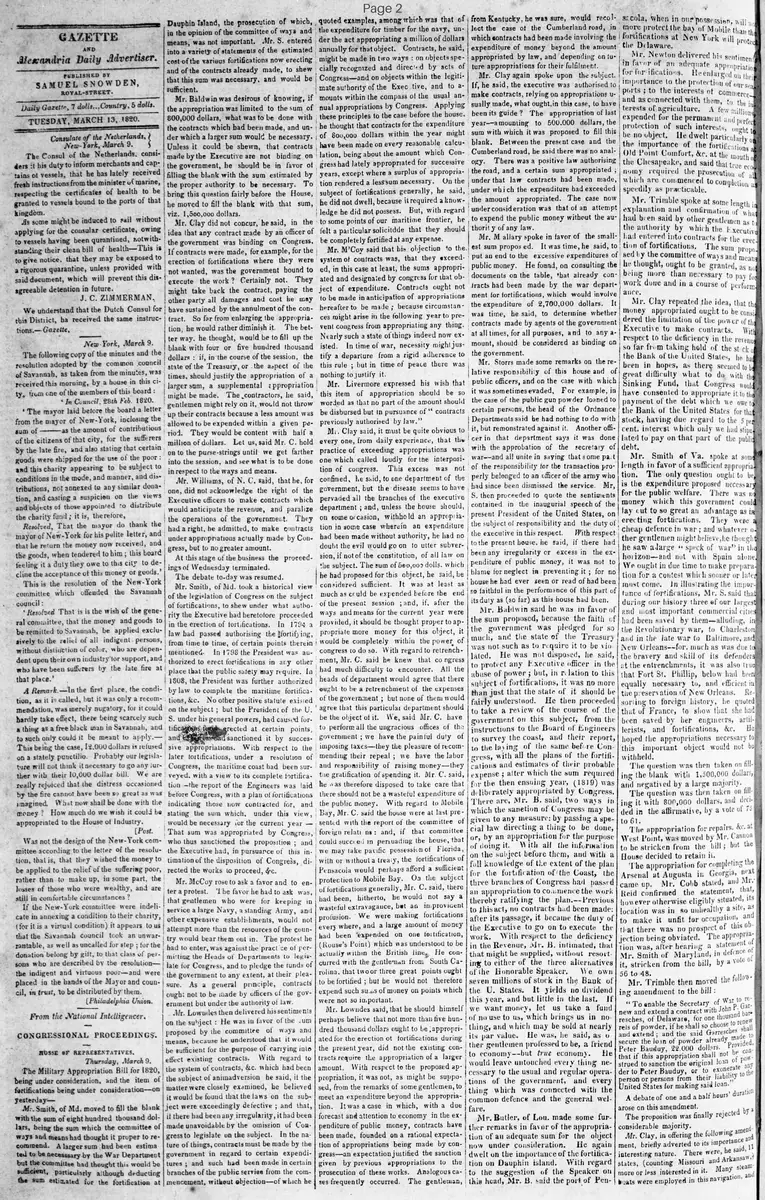
CONGRESSIONAL PROCEEDINGS.
HOUSE OF REPRESENTATIVES.
Thursday, March 9.
The Military Appropriation Bill for 1820, being under consideration, and the item of fortifications being under consideration--on yesterday
Mr. Smith, of Md. moved to fill the blank with the sum of eight hundred thousand dollars, being the sum which the committee of ways and means had thought it proper to recommend. A larger sum had been estimated to be necessary by the War Department but the committee had thought this would be sufficient, particularly although deducting the sum estimated for the fortification at Dauphin Island, the prosecution of which, in the opinion of the committee of ways and means, was not important. Mr. S. entered into a variety of statements of the estimated cost of the various fortifications now erecting and of the contracts already made, to shew that this sum was necessary. and would be sufficient.
Mr. Baldwin was desirous of knowing, if the appropriation was limited to the sum of 800,000 dollars, what was to be done with the contracts which had been made, and under which a larger sum would be necessary. Unless it could be shewn, that contracts made by the Executive are not binding on the government, he should be in favor of filling the blank with the sum estimated by the proper authority to be necessary. To bring this question fairly before the House, he moved to fill the blank with that sum, viz. 1,500,000 dollars.
Mr. Clay did not concur, he said. in the idea that any contract made by an officer of the government was binding on Congress. If contracts were made, for example, for the erection of fortifications where they were not wanted, was the government bound to execute the work? Certainly not. They might take back the contract, paying the other party all damages and cost he may have sustained by the annulment of the contract. So far from enlarging the appropriation, he would rather diminish it. The better way. he thought, would be to fill up the blank with four or five hundred thousand dollars : if, in the course of the session, the state of the Treasury, or the aspect of the times, should justify the appropriation of a larger sum, a supplemental appropriation might be made. The contractors, he said. gentlemen might rely on it, would not throw up their contracts because a less amount was allowed to be expended within a given period. They would be content with half a million of dollars. Let us, said Mr. C. hold on to the purse-strings until we get farther into the session, and see what is to be done in respect to the ways and means.
Mr. Williams, of N. C. said, that he, for one, did not acknowledge the right of the Executive officers to make contracts which would anticipate the revenue, and paralyze the operations of the government. They had a right, he admitted, to make contracts under appropriations actually made by Congress, but to no greater amount.
At this stage of the business the proceedings of Wednesday terminated.
The debate to-day was resumed.
Mr. Smith. of Md. took a historical view of the legislation of Congress on the subject of fortifications. to shew under what authority the Executive had heretofore proceeded in the erection of fortifications. In 1794 a law had passed authorising the fortifying. from time to time, of certain points therein mentioned. In 1798 the President was authorized to erect fortifications in any other place that the public safety may require. In 1808, the President was further authorized by law to complete the maritime fortifications. &c. No other positive statute existed on the subject ; but the President of the U. S. under his general powers, had caused fortifications to be erected at certain points, and Congress had sanctioned it by successive appropriations. With respect to the later fortifications, under a resolution of Congress, the maritime coast had been surveyed. with a view to its complete fortification -the report of the Engineers was laid before Congress, with a plan of fortifications indicating those now contracted for, and stating the sum which. under this view, would be necessary for the current year - That sum was appropriated by Congress, who thus sanctioned the proposition; and the Executive had, in pursuance of this intimation of the disposition of Congress, directed the works to proceed, &c.
Mr. McCoy rose to ask a favor and to enter a protest. The favor he had to ask was, that gentlemen who were for keeping in service a large Navy, a standing Army, and other expensive establishments, would not attempt more than the resources of the country would bear them out in. The protest he had to enter, was against the practice of permitting the Heads of Departments to legislate for Congress, and to pledge the funds of the government to any extent, at their pleasure. As a general principle, contracts ought not to be made by officers of the government but under the authority of law.
Mr. Lowndes then delivered his sentiments on the subject : He was in favor of the sum proposed by the committee of ways and means, because he understood that it would be sufficient for the purpose of carrying into effect existing contracts. With regard to the system of contracts, &c. which had been the subject of animadversion he said, if the matter were closely examined, he believed it would be found that the laws on the subject were exceedingly defective ; and that if there had been any irregularity, it had been made unavoidable by the omission of Congress to legislate on the subject. In the nature of things, contracts must be made by the government in regard to certain expenditures; and such had been made in certain branches of the public service from the commencement, without objection-of which he quoted examples, among which was that of the expenditure for timber for the navy, under the act appropriating a million of dollars annually for that object. Contracts, he said, might be made in two ways : on objects specially recognized and directed by acts of Congress-and on objects within the legitimate authority of the Executive, and to amounts within the compass of the usual annual appropriations by Congress. Applying these principles to the case before the house. he thought that contracts for the expenditure of 800,000 dollars within the year might have been made on every reasonable calculation, being about the amount which Congress had lately appropriated for successive years, except where a surplus of appropriation rendered a less sum necessary. On the subject of fortifications generally, he said, he did not dwell, because it required a knowledge he did not possess. But, with regard to some points of our maritime frontier, he felt a particular solicitude that they should be completely fortified at any expense.
Mr. M'Coy said that his objection to the system of contracts was, that they exceeded, in this case at least, the sums appropriated and designated by congress for that object of expenditure. Contracts ought not to be made in anticipation of appropriations hereafter to be made; because circumstances might arise in the following year to prevent congress from appropriating any thing. Nearly such a state of things indeed now existed. In time of war, necessity might justify a departure from a rigid adherence to this rule ; but in time of peace there was nothing to justify it.
Mr. Livermore expressed his wish that this item of appropriation should be so worded as that no part of the amount should be disbursed but in pursuance of "contracts previously authorised by law."
Mr. Clay said, it must be quite obvious to every one, from daily experience, that the practice of exceeding appropriations was one which called loudly for the interposition of congress. This excess was not confined, he said, to one department of the government, but the disease seems to have pervaded all the branches of the executive department ; and, unless the house should, on some occasion, withhold an appropriation in some case wherein an expenditure had been made without authority, he had no doubt the evil would go on to utter subversion, if not of the constitution, of all law on the subject. The sum of 800,000 dolls. which he had proposed for this object, he said, he considered sufficient. It was at least as much as could be expended before the end of the present session ;and, if. after the ways and means for the current year were provided, it should be thought proper to appropriate more money for this object, it would be completely within the power of congress to do so. With regard to retrenchment. Mr. C. said he knew that congress had much difficulty to encounter. All the heads of department would agree that there ought to be a retrenchment of the expenses of the government ; but none of them would agree that this particular department should be the object of it. We, said Mr. C. have to perform all the ungracious offices of the government; we have the painful duty of imposing taxes--they the pleasure of recommending their repeal : we have the labor and responsibility of raising money--they the gratification of spending it. Mr. C. said. he was therefore disposed to take care that there should not be a wasteful expenditure of the public money. With regard to Mobile Bay, Mr. C. said the house were at last presented with the report of the committee of foreign relations: and, if that committee could succeed in persuading the house, that we may take pacific possession of Florida, with or without a treaty, the fortifications of Pensacola would perhaps afford a sufficient protection to Mobile Bay. On the subject of fortifications generally, Mr. C. said. there had been, hitherto, he would not say a wasteful extravagance, but an improvident profusion. 'We were making fortifications every where, and a large amount of money had been expended on one fortification, (Rouse's Point) which was understood to be actually within the British line. He concurred with the gentleman from South Carolina, that two or three great points ought to be fortified ; but he would not therefore expend such sums of money on points which were not so important.
Mr. Lowndes said, that he should himself perhaps believe that not more than five hundred thousand dollars ought to be appropriated for the erection of fortifications during the present year, did not the existing contracts require the appropriation of a larger amount, With respect to the proposed appropriation, it was not, as might be supposed, from the remarks of some gentlemen, to meet an expenditure beyond the appropriation. It was a case in which, with a due forecast and attention to economy in the expenditure of public money, contracts have been made, founded on a rational expectation of appropriations being made by congress-an expectation justified the sanction given by previous appropriations to the prosecution of these works. Analogous cases frequently occurred. The gentleman, from Kentucky, he was sure, would recollect the case of the Cumberland road, in which contracts had been made involving the expenditure of money beyond the amount appropriated by law, and depending on future appropriations for their fulfilment.
Mr. Clay again spoke upon the subject. If. he said, the executive was authorised to make contracts, relying on appropriations usually made, what ought, in this case, to have been its guide? The appropriation of last year--amounting to 500,000 dollars, the sum with which it was proposed to fill this blank, Between the present case and the Cumberland road, he said there was no analogy. There was a positive law authorising the road, and a certain sum appropriated ; under that law contracts had been made, under which the expenditure had exceeded the amount appropriated. The case now under consideration was that of an attempt to expend the public money without the authority of any law.
Mr, Mallary spoke in favor of the smallest sum proposed. It was time, he said, to put an end to the excessive expenditures of public money. He found, on consulting the documents on the table, that already contracts had been made by the war department for fortifications. which would involve the expenditure of 2,700,000 dollars. It was time, he said, to determine whether contracts made by agents of the government at all times, for all purposes, and to any amount, should be considered as binding on the government.
Mr. Storrs made some remarks on the relative responsibility of this house and of public officers, and on the case with which it was sometimes evaded, For example, in the case of the public gun powder loaned to certain persons, the head of the Ordnance Departments said he had nothing to do with it, but remonstrated against it. Another officer in that department says it was done with the approbation of the secretary of war--and all unite in saying that some part of the responsibility for the transaction properly belonged to an officer of the army who had since been dismissed the service. Mr, S. then proceeded to quote the sentiments contained in the inaugurial speech of the present President of the United States, on the subject of responsibility and the duty of the executive in this respect. With respect to the present house. he said, if there had been any irregularity or excess in the expenditure of public money, it was not to blame for neglect in preventing it; for no house he had ever seen or read of had been so faithful in the performance of this part of its duty as (so far) as this house had been.
Mr. Baldwin said he was in favor of the sum proposed, because the faith of the government was pledged for so much, and the state of the Treasury was not such as to require it to be violated. He was not disposed, he said, to protect any Executive officer in the abuse of power ; but, in relation to this subject of fortifications, it was no more than just that the state of it should be fairly understood. He then proceeded to take a review of the course of the government on this subject, from the instructions to the Board of Engineers to survey the coast, and their report, to the laying of the same before Congress, with all the plans of the fortifications and estimates of their probable expense ; after which the sum required for the then ensuing year, (1819) was deliberately appropriated by Congress. There are, Mr. B. said, two ways in which the sanction of Congress may be given to any measure: by passing a special law directing a thing to be done, or, by an appropriation for the purpose of doing it. With all the information on the subject before them, and with a full knowledge of the extent of the plan for the fortification of the Coast, the three branches of Congress had passed an appropriation to commence the work thereby ratifying the plan.--Previous to this act, no contracts had been made: after its passage, it became the duty of the Executive to go on to execute the work. With respect to the deficiency in the Revenue, Mr. B. intimated, that that might be supplied, without resorting to either of the three alternatives of the Honorable Speaker. We own seven millions of stock in the Bank of the U. States. It yields no dividend this year, and but little in the last, If we want money, let us take a fund of no use to us, which brings us in nothing, and which may be sold at nearly its par value. He was, he said, as other gentlemen professed to be, a friend to economy--but true economy. He would leave untouched every thing necessary to the usual and regular operations of the government, and every thing which was connected with the common defence and the general welfare.
Mr. Butler, of Lou. made some further remarks in favor of the appropriation of an adequate sum for the object now under consideration. He again dwelt on the importance of the fortification on Dauphin island. With regard to the suggestion of the Speaker on this head, Mr. B. said the port of Pensacola, when in our possession, will be no more protect the bay of Mobile than the fortifications at New York will protect the Delaware.
Mr. Newton delivered his sentiments in favor of an adequate appropriation for fortifications. He enlarged on their importance to the protection of our sea ports ; to the interests of commerce- and as connected with them, to the interests of agriculture. A few millions expended for the permanent and perfect protection of such interests, ought to be no object. He dwelt particularly on the importance of the fortifications at Old Point Comfort, &c. at the mouth of the Chesapeake, and said that true economy required the prosecution of all which are commenced to completion as speedily as practicable.
Mr. Trimble spoke at some length in explanation and confirmation of what had been said by other gentlemen as to the authority by which the Executive had entered into contracts for the erection of fortifications. The sum proposed by the committee of ways and means he thought, ought to be granted, as no more than necessary to pay for work done and in a course of performance.
Mr. Clay repeated the idea, that the money appropriated ought to be considered the limitation of the power of the Executive to make contracts. With respect to the deficiency in the revenue so far from taking hold of the stock of the Bank of the United States, he had been in hopes, as there seemed to be great difficulty what to do with the Sinking Fund, that Congress would have consented to appropriate it to the payment of the debt which we owe to the Bank of the United States for that stock, having due regard to the 5 per cent. interest which only we had stipulated to pay on that part of the public debt.
Mr. Smith of Va. spoke at some length in favor of a sufficient appropriation. The only question ought to be is the expenditure proposed necessary for the public welfare. There was no money which this government could lay out to so great an advantage as in erecting fortifications. They were a cheap defence in war ; and whatever other gentlemen might believe, he thought he saw a large "speck of war" in the horizon-and not with Spain alone We ought in due time to make preparation for a contest which sooner or later must come. In illustrating the importance of fortifications, Mr. S. said that during our history three of our largest and most important commercial cities had been saved by them-alluding, in the Revolutionary war, to Charleston and in the late war to Baltimore, and New Orleans--for, much as was due to the bravery and skill of its defenders at the entrenchments, it was also true that Fort St. Phillip, below had been equally necessary to, and efficient in the preservation of New Orleans. Resorting to foreign history, he quoted that of France, to show that she had been saved by her engineers, artillerists, and fortifications, &c. He hoped the appropriations necessary to this important object would not be withheld.
The question was then taken on filling the blank with 1,500,000 dollars, and negatived by a large majority.
The question was then taken on filling it with 800,000 dollars, and decided in the affirmative, by a vote of 78 to 61.
The appropriation for repairs. &c. at West Point, was moved by Mr. Cannon to be stricken from the bill : but the House decided to retain it.
The appropriation for completing the Arsenal at Augusta in Georgia, next came up. Mr. Cobb stated, and Mr. Reid confirmed the statement, that, however otherwise eligibly situated, its location was in so unhealthy a site, as to make it unfit for occupation, and that there was no prospect of this objection being obviated. The appropriation was, after hearing a statement of it, stricken from the bill, by a vote of 56 to 48.
Mr. Smith of Maryland, in defence of Mr. Trimble then moved the following amendment to the bill :
" To enable the Secretary of War to renew and extend a contract with John P. Garresches, of Delaware, for one thousand barrels of powder and extend; and the said Garresches shall choose Peter Bauduy, $22,000 dollars. Provided,
this appropriation shall not be construed to sanction the original loan of powder already
made, or to release any person or persons from their liability to the
United States for making said loan.
A debate of one and a half hours' duration arose on this amendment.
The proposition was finally rejected by a considerable majority.
Mr. Clay, in offering the following amendment, briefly adverted to its importance and interesting nature.
There were, he said, 11 states, (counting Missouri and Arkansaw,) more or less interested in it. Many steam-
boats were employed in this navigation, and
many more would be: and he did verily believe, that, by an expenditure of a hundred or a hundred and fifty thousand dollars, and an annual expenditure thereafter of 10 or 15 thousand dollars, the navigation could be made perfectly safe. He hoped, as this appropriation was analogous to one or more contemplated for the Ohio and Mississippi rivers, from the Rapids of the Ohio at Louisville, to the Balize, there would be no objection to it.
"For making a survey, maps and charts of the most practicable mode of improving the navigation of those rivers, five thousand dollars."
The motion was agreed to, without a division.
Mr. Cobb then offered the following amendment to the bill:
"For the purpose of holding Treaties with the Creek and Cherokee tribes of Indians, for the extinguishment of the Indian title to all the lands within the state of Georgia, pursuant to the fourth condition of the 1st article of the Articles of Agreement and Cession concluded between the United States and the state of Georgia, on the 24th day of April, 1802, the sum of thirty thousand dollars."
When the committee rose, and reported progress; and the House adjourned.
What sub-type of article is it?
What keywords are associated?
What entities or persons were involved?
Where did it happen?
Domestic News Details
Primary Location
Washington
Event Date
Thursday, March 9, 1820
Key Persons
Outcome
approved $800,000 for fortifications (78-61); rejected $1,500,000 proposal; retained west point repairs; struck augusta arsenal appropriation (56-48); rejected powder contract amendment; approved $5,000 for river navigation survey; proposed $30,000 for indian treaties in georgia.
Event Details
The House of Representatives debated the 1820 Military Appropriation Bill, focusing on fortifications funding, executive contracts, historical legislation, and economy. Speakers discussed authority for contracts, necessity of fortifications at sites like Dauphin Island and Mobile Bay, and broader fiscal responsibility. Additional items included West Point repairs, Augusta Arsenal, a powder contract renewal, river navigation improvements, and Indian treaties.