Thank you for visiting SNEWPapers!
Sign up free
The Catholic Times
Columbus, Franklin County, Ohio
What is this article about?
The 10th anniversary of the Discalced Carmelite nuns' monastery in Columbus, Ohio, founded in 1947 by six nuns from Pennsylvania at Bishop Ready's request. The community, now 20 strong, observes a cloistered life of prayer and penance, with an open house on September 15, 1957.
Merged-components note: This is a continuation of the Carmel anniversary story from page 1 to page 2.
Clippings
1 of 2
OCR Quality
Full Text
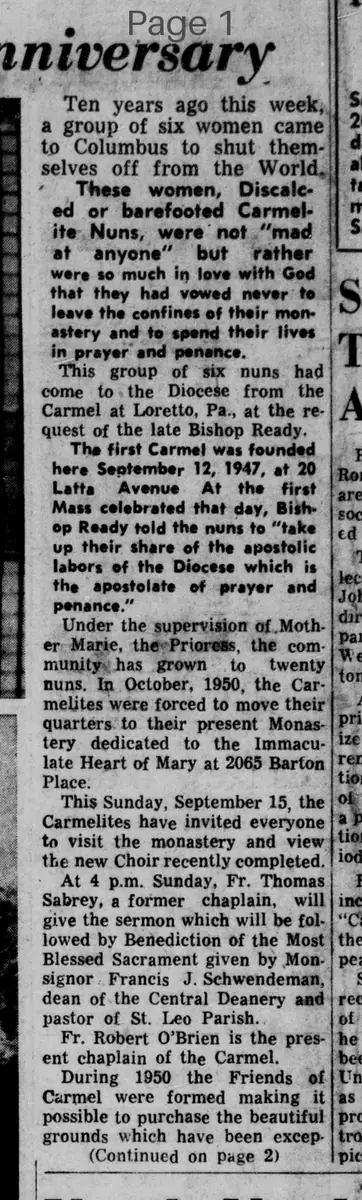
Ten years ago this week, a group of six women came to Columbus to shut themselves off from the World.
These women, Discalced or barefooted Carmelite Nuns, were not "mad at anyone" but rather were so much in love with God that they had vowed never to leave the confines of their monastery and to spend their lives in prayer and penance.
This group of six nuns had come to the Diocese from the Carmel at Loretto, Pa., at the request of the late Bishop Ready.
The first Carmel was founded here September 12, 1947, at 20 Latta Avenue. At the first Mass celebrated that day, Bishop Ready told the nuns to "take up their share of the apostolic labors of the Diocese which is the apostolate of prayer and penance."
Under the supervision of Mother Marie, the Prioress, the community has grown to twenty nuns. In October, 1950, the Carmelites were forced to move their quarters to their present Monastery dedicated to the Immaculate Heart of Mary at 2065 Barton Place.
This Sunday, September 15, the Carmelites have invited everyone to visit the monastery and view the new Choir recently completed.
At 4 p.m. Sunday. Fr. Thomas Sabrey, a former chaplain, will give the sermon which will be followed by Benediction of the Most Blessed Sacrament given by Monsignor Francis J. Schwendeman, dean of the Central Deanery and pastor of St. Leo Parish.
Fr. Robert O'Brien is the present chaplain of the Carmel.
During 1950 the Friends of Carmel were formed making it possible to purchase the beautiful grounds which have been exceptionally adaptable for monastic use, providing the seclusion necessary for the contemplative life.
(Continued on page 2)
Carmel Here Ten Years
(Continued from page 1)
Through the continued co-operation of this organization there has also been added living quarters for a Chaplain, and recently the Choir was finished.
The latter is a chapel for the use of the cloistered nuns. It is built at a right angle to the Sanctuary of the public chapel and is separated from the Sanctuary by an iron grille.
Bishop Ready had blessed the Choir just three weeks before his death.
Throughout the years the local Carmel has been blessed with numerous applications, seven of whom are Ohioans and five of these are members of the Diocese.
The life of the Discalced Carmelite nun is governed chiefly by the Rule of St. Albert and the Constitutions written by St. Teresa of Avila, the great reformer.
There are now more than 600 monasteries housing more than 12,000 nuns.
Each cloister is independent of the others and is directly subject to the Ordinary of the Diocese, or the Father General of the Order.
The prioress, elected for a term of three years, is the superior of the Carmel which has three divisions, the Choir Nuns, who recite the Divine Office and control the operation of the Monastery as well as the election of the prioress; the lay-sisters, who wear white veils and take care of the domestic tasks of the monastery and the out-sisters or Externs who are not bound to the cloister and take care of the external matters under the direction of the prioress.
The extern nuns have care of the Chapel which is open to the public each day at 7 a.m. when Mass is offered, until 8 p.m. Benediction is given on Sunday and Thursday afternoons.
One of the Externs is Sister Mary of the Cross (Eulalia Gordon who is a former president of the Legion of Mary in New Lexington. She will make her first vows this Sunday.
(All of the nuns, however, are true Carmelites and follow the same Rule, differing only in their daily tasks.)
Each day the Divine office is recited solemnly according to the Roman Breviary. Two one-hour periods of mental prayer are observed in common every day, morning and evening.
After dinner and supper the nuns participate in an hour's recreation. Except during this latter period, silence is constant in the community.
With the exception of the recitation of the Office and meals and recreation, the nuns remain in their cells, working, reading or praying. Those in the cloister never eat meat and fast every day from September 14 to Easter, except on Sunday and the great feasts.
The nuns must exist by alms. They cannot beg unless they are in extreme necessity.
These Carmelite nuns are not trying to shirk the difficulties of Christian life in the world but by their unceasing prayer and penance hope to bring the love of Christ to all men.
This is really an active, a truly missionary life.
What sub-type of article is it?
What themes does it cover?
What keywords are associated?
What entities or persons were involved?
Where did it happen?
Story Details
Key Persons
Location
Columbus, Ohio
Event Date
September 12, 1947
Story Details
Six Discalced Carmelite nuns founded a monastery in Columbus at Bishop Ready's request on September 12, 1947, dedicating their lives to prayer and penance. The community grew to twenty under Mother Marie, moved to 2065 Barton Place in 1950. On their 10th anniversary, they invite the public to visit the new Choir on September 15, 1957.