Thank you for visiting SNEWPapers!
Sign up free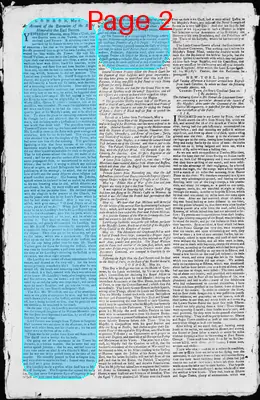
Story
July 11, 1760
The New Hampshire Gazette
Portsmouth, Rockingham County, New Hampshire
What is this article about?
Detailed account of the execution of Lord Ferrers at Tyburn on May 5, following his conviction for murdering Mr. Johnson. Describes the procession from the Tower, his demeanor, religious sentiments, the hanging, and aftermath including body delivery to Surgeons Hall.
Clipping
OCR Quality
98%
Excellent
Full Text
LONDON, May 6.
An Account of the Execution of the Right Honorable the Late Lord Ferrers.
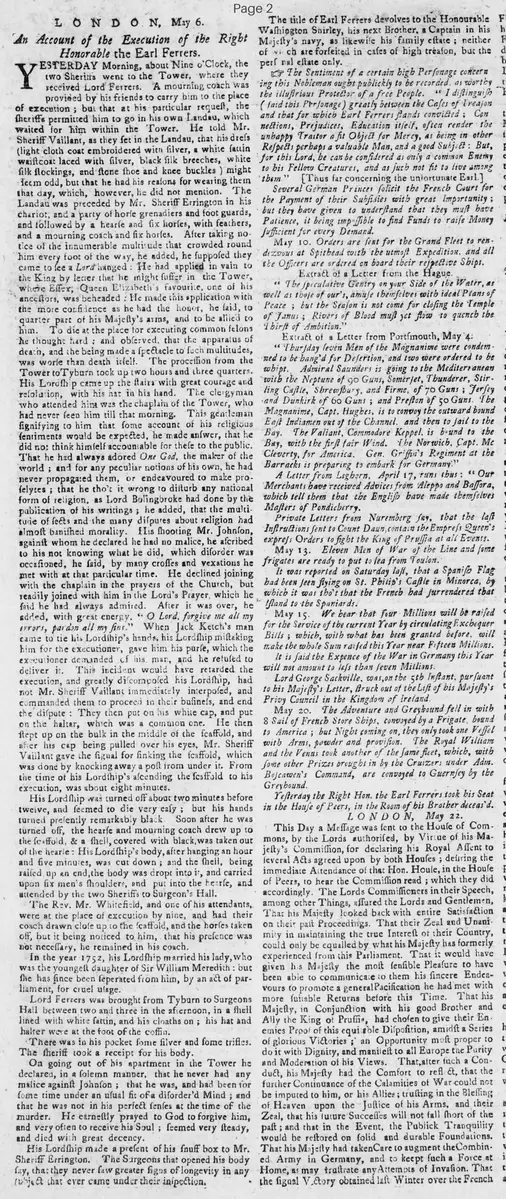
YESTERDAY Morning, about Nine o'Clock, the two Sheriffs went to the Tower, where they received Lord Ferrers. A mourning coach was provided by his friends to carry him to the place of execution; but that at his particular request, the sheriffs permitted him to go in his own Landau, which waited for him within the Tower. He told Mr. Sheriff Vaillant, as they set in the Landau, that his dress (light cloth coat embroidered with silver, a white satin waistcoat laced with silver, black silk breeches, white silk stockings, and stone shoe and knee buckles) might seem odd, but that he had his reasons for wearing them that day, which, however, he did not mention. The Landau was preceded by Mr. Sheriff Errington in his chariot, and a party of horse grenadiers and foot guards, and followed by a hearse and six horses, with feathers, and a mourning coach and six horses. After taking notice of the innumerable multitude that crowded round him every foot of the way, he added, he supposed they came to see a Lord hanged: He had applied in vain to the King by letter that he might suffer in the Tower, where Essex, Queen Elizabeth's favourite, one of his ancestors, was beheaded: He made this application with the more confidence as he had the honor, he said, to quarter part of his Majesty's arms, and to be allied to him. To die at the place for executing common felons he thought hard: and observed, that the apparatus of death, and the being made a spectacle to such multitudes, was worse than death itself. The procession from the Tower to Tyburn took up two hours and three quarters. His Lordship came up the stairs with great courage and resolution, with his hat in his hand. The clergyman who attended him was the chaplain of the Tower, who had never seen him till that morning. This gentleman signifying to him that some account of his religious sentiments would be expected, he made answer, that he did not think himself accountable for these to the public. That he had always adored One God, the maker of the world; and for any peculiar notions of his own, he had never propagated them, or endeavoured to make proselytes; that he thought it wrong to disturb any national form of religion, as Lord Bolingbroke had done by the publication of his writings; he added, that the multitude of sects and the many disputes about religion had almost banished morality. His shooting Mr. Johnson, against whom he declared he had no malice, he ascribed to his not knowing what he did, which disorder was occasioned, he said, by many crosses and vexations he met with at that particular time. He declined joining with the chaplain in the prayers of the Church, but readily joined with him in the Lord's Prayer, which he said he had always admired. After it was over, he added, with great energy, "O Lord, forgive me all my errors, pardon all my sins." When Jack Ketch's man came to tie his Lordship's hands, his Lordship mistaking him for the executioner, gave him his purse, which the executioner demanded of his man, and he refused to deliver it. This incident would have retarded the execution, and greatly discomposed his Lordship, had not Mr. Sheriff Vaillant immediately interposed, and commanded them to proceed in their business, and end the dispute: They then put on his white cap, and put on the halter, which was a common one. He then stepped up on the block in the middle of the scaffold, and after his cap being pulled over his eyes, Mr. Sheriff Vaillant gave the signal for sinking the scaffold, which was done by knocking away a post from under it. From the time of his Lordship's ascending the scaffold to his execution, was about eight minutes. His Lordship was turned off about two minutes before twelve, and seemed to die very easy; but his hands turned presently remarkably black. Soon after he was turned off, the hearse and mourning coach drew up to the scaffold, & a shell, covered with black, was taken out of the hearse: His Lordship's body, after hanging an hour and five minutes, was cut down; and the shell, being raised up an end, the body was dropt into it, and carried upon six men's shoulders, and put into the hearse, and attended by the two Sheriffs to Surgeon's Hall. The Rev. Mr. Whitefield, and one of his attendants, were at the place of execution by nine, and had their coach drawn close up to the scaffold, and the horses taken off, but it being noticed to him, that his presence was not necessary, he remained in his coach. In the year 1752, his Lordship married his lady, who was the youngest daughter of Sir William Meredith: but she has since been separated from him, by an act of parliament, for cruel usage. Lord Ferrers was brought from Tyburn to Surgeons Hall between two and three in the afternoon, in a shell lined with white satin, and his clothes on; his hat and halter were at the foot of the coffin. There was in his pocket some silver and some trifles. The sheriff took a receipt for his body. On going out of his apartment in the Tower he declared, in a solemn manner, that he never had any malice against Johnson; that he was, and had been for some time under an usual fit of a disordered Mind; and that he was not in his perfect senses at the time of the murder. He earnestly prayed to God to forgive him, and very often to receive his Soul; seemed very steady, and died with great decency. His Lordship made a present of his snuff box to Mr. Sheriff Errington. The Surgeons that opened his body say, that they never saw greater signs of longevity in any subject that ever came under their inspection. The title of Earl Ferrers devolves to the Honourable Washington Shirley, his next Brother, a Captain in his Majesty's navy, as likewise his family estate; neither of which are forfeited in cases of high treason, but the personal estate only. The Sentiment of a certain high Personage concerning this Nobleman ought publicly to be recorded, as worthy the illustrious Protector of a free People. "I distinguish (Said this Personage) greatly between the Cases of Treason and that for which Earl Ferrers stands convicted; Connections, Prejudices, Education itself, often render the unhappy Traitor a fit Object for Mercy, as being in other Respects perhaps a valuable Man, and a good Subject: But, for this Lord, he can be considered as only a common Enemy to his Fellow Creatures, and as such not fit to live among them." [Thus far concerning the unfortunate Earl.]
An Account of the Execution of the Right Honorable the Late Lord Ferrers.
YESTERDAY Morning, about Nine o'Clock, the two Sheriffs went to the Tower, where they received Lord Ferrers. A mourning coach was provided by his friends to carry him to the place of execution; but that at his particular request, the sheriffs permitted him to go in his own Landau, which waited for him within the Tower. He told Mr. Sheriff Vaillant, as they set in the Landau, that his dress (light cloth coat embroidered with silver, a white satin waistcoat laced with silver, black silk breeches, white silk stockings, and stone shoe and knee buckles) might seem odd, but that he had his reasons for wearing them that day, which, however, he did not mention. The Landau was preceded by Mr. Sheriff Errington in his chariot, and a party of horse grenadiers and foot guards, and followed by a hearse and six horses, with feathers, and a mourning coach and six horses. After taking notice of the innumerable multitude that crowded round him every foot of the way, he added, he supposed they came to see a Lord hanged: He had applied in vain to the King by letter that he might suffer in the Tower, where Essex, Queen Elizabeth's favourite, one of his ancestors, was beheaded: He made this application with the more confidence as he had the honor, he said, to quarter part of his Majesty's arms, and to be allied to him. To die at the place for executing common felons he thought hard: and observed, that the apparatus of death, and the being made a spectacle to such multitudes, was worse than death itself. The procession from the Tower to Tyburn took up two hours and three quarters. His Lordship came up the stairs with great courage and resolution, with his hat in his hand. The clergyman who attended him was the chaplain of the Tower, who had never seen him till that morning. This gentleman signifying to him that some account of his religious sentiments would be expected, he made answer, that he did not think himself accountable for these to the public. That he had always adored One God, the maker of the world; and for any peculiar notions of his own, he had never propagated them, or endeavoured to make proselytes; that he thought it wrong to disturb any national form of religion, as Lord Bolingbroke had done by the publication of his writings; he added, that the multitude of sects and the many disputes about religion had almost banished morality. His shooting Mr. Johnson, against whom he declared he had no malice, he ascribed to his not knowing what he did, which disorder was occasioned, he said, by many crosses and vexations he met with at that particular time. He declined joining with the chaplain in the prayers of the Church, but readily joined with him in the Lord's Prayer, which he said he had always admired. After it was over, he added, with great energy, "O Lord, forgive me all my errors, pardon all my sins." When Jack Ketch's man came to tie his Lordship's hands, his Lordship mistaking him for the executioner, gave him his purse, which the executioner demanded of his man, and he refused to deliver it. This incident would have retarded the execution, and greatly discomposed his Lordship, had not Mr. Sheriff Vaillant immediately interposed, and commanded them to proceed in their business, and end the dispute: They then put on his white cap, and put on the halter, which was a common one. He then stepped up on the block in the middle of the scaffold, and after his cap being pulled over his eyes, Mr. Sheriff Vaillant gave the signal for sinking the scaffold, which was done by knocking away a post from under it. From the time of his Lordship's ascending the scaffold to his execution, was about eight minutes. His Lordship was turned off about two minutes before twelve, and seemed to die very easy; but his hands turned presently remarkably black. Soon after he was turned off, the hearse and mourning coach drew up to the scaffold, & a shell, covered with black, was taken out of the hearse: His Lordship's body, after hanging an hour and five minutes, was cut down; and the shell, being raised up an end, the body was dropt into it, and carried upon six men's shoulders, and put into the hearse, and attended by the two Sheriffs to Surgeon's Hall. The Rev. Mr. Whitefield, and one of his attendants, were at the place of execution by nine, and had their coach drawn close up to the scaffold, and the horses taken off, but it being noticed to him, that his presence was not necessary, he remained in his coach. In the year 1752, his Lordship married his lady, who was the youngest daughter of Sir William Meredith: but she has since been separated from him, by an act of parliament, for cruel usage. Lord Ferrers was brought from Tyburn to Surgeons Hall between two and three in the afternoon, in a shell lined with white satin, and his clothes on; his hat and halter were at the foot of the coffin. There was in his pocket some silver and some trifles. The sheriff took a receipt for his body. On going out of his apartment in the Tower he declared, in a solemn manner, that he never had any malice against Johnson; that he was, and had been for some time under an usual fit of a disordered Mind; and that he was not in his perfect senses at the time of the murder. He earnestly prayed to God to forgive him, and very often to receive his Soul; seemed very steady, and died with great decency. His Lordship made a present of his snuff box to Mr. Sheriff Errington. The Surgeons that opened his body say, that they never saw greater signs of longevity in any subject that ever came under their inspection. The title of Earl Ferrers devolves to the Honourable Washington Shirley, his next Brother, a Captain in his Majesty's navy, as likewise his family estate; neither of which are forfeited in cases of high treason, but the personal estate only. The Sentiment of a certain high Personage concerning this Nobleman ought publicly to be recorded, as worthy the illustrious Protector of a free People. "I distinguish (Said this Personage) greatly between the Cases of Treason and that for which Earl Ferrers stands convicted; Connections, Prejudices, Education itself, often render the unhappy Traitor a fit Object for Mercy, as being in other Respects perhaps a valuable Man, and a good Subject: But, for this Lord, he can be considered as only a common Enemy to his Fellow Creatures, and as such not fit to live among them." [Thus far concerning the unfortunate Earl.]
What sub-type of article is it?
Historical Event
Crime Story
Tragedy
What themes does it cover?
Crime Punishment
Tragedy
Justice
What keywords are associated?
Lord Ferrers Execution
Tyburn Hanging
Murder Conviction
Sheriffs Procession
Mental Disorder
Surgeons Hall
Earl Ferrers Title
What entities or persons were involved?
Lord Ferrers
Mr. Sheriff Vaillant
Mr. Sheriff Errington
Mr. Johnson
Rev. Mr. Whitefield
Washington Shirley
Where did it happen?
London, Tower, Tyburn, Surgeon's Hall
Story Details
Key Persons
Lord Ferrers
Mr. Sheriff Vaillant
Mr. Sheriff Errington
Mr. Johnson
Rev. Mr. Whitefield
Washington Shirley
Location
London, Tower, Tyburn, Surgeon's Hall
Event Date
May 5
Story Details
Lord Ferrers, convicted of murdering Mr. Johnson due to mental disorder, is executed by hanging at Tyburn after procession from the Tower. He expresses religious views, regrets the crime without malice, dies composedly; body taken to Surgeons Hall for dissection.