Thank you for visiting SNEWPapers!
Sign up free
New York Tribune
New York, New York County, New York
What is this article about?
In 1881, six bright comets appeared, discovered by astronomers like Lewis Swift, Dr. Gould, Watson, Barnard, and others across the US. They were visible to the naked eye, with spectra indicating carbon and reflected light.
Clipping
OCR Quality
Full Text
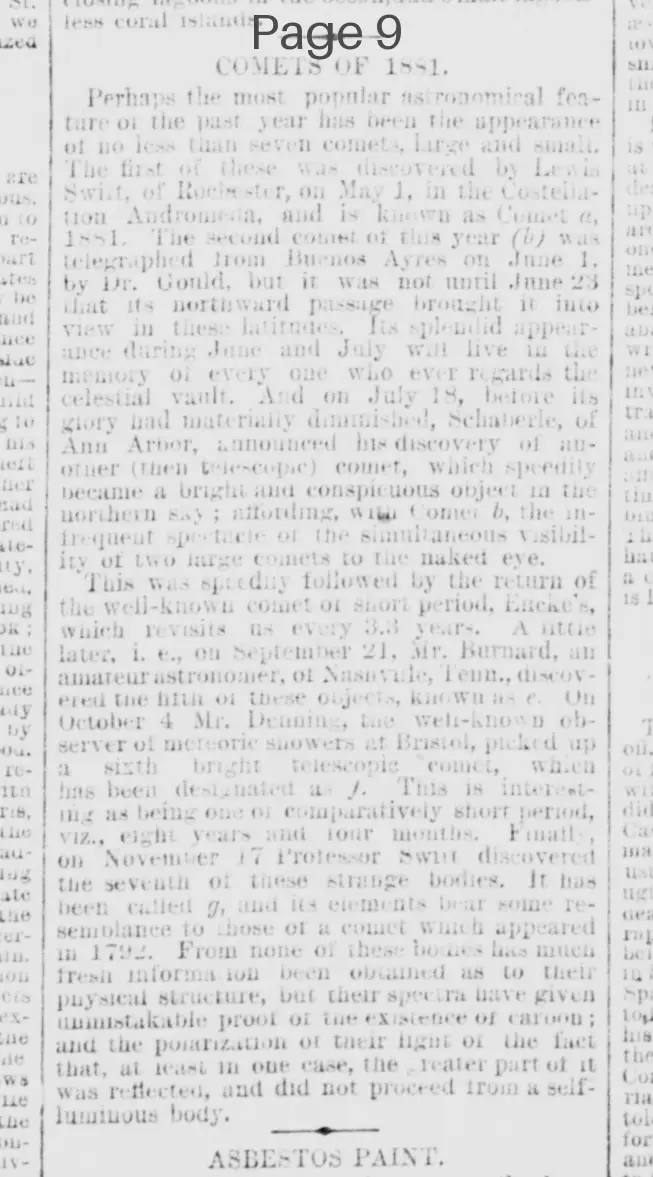
Perhaps the most popular astronomical feature of the past year has been the appearance of no less than six bright comets, but did so. The first of these was discovered by Lewis Swift, of Holmesville, on May 1, in the constellation Andromeda and is known as Comet 1881 I. The second comet of this year was telegraphed from Hon. Hinckos Ayaes on June 1, by Dr. Gould, but it was not until June 23 that its nucleus became visible to the naked eye in this latitude. Its splendid appearance during June and July will remain in the memory of everyone who ever glances at the celestial vault. And on July 1, before its glory had materially diminished, Watson, of Ann Arbor, announced his discovery of another (then telescopic) comet, which especially became a bright and conspicuous object in the northern sky at twilight, with one of the most beautiful trains of the season visible to the naked eye. This was soon followed by the return of the well-known comet of short period, which visits us every year. A date later, i.e., on September 21, Mr. Barnard, an amateur astronomer, of Nashville, Tenn., discovered the fifth on the edge of the Great Square. On October 14 Mr. Daniel, the well-known observer of meteor showers at Bristol, picked up a sixth bright telescopic comet, which has been designated as J. This is interesting as being comparatively short period, viz., eight years and four months. Meantime on November 17 Professor Swift discovered the seventh of these strange bodies. It has been called G, and its elements bear some resemblance to those of a comet which appeared in 1774. From none of these bodies much information concerning their physical structure has been obtained, but their spectra have given unmistakable proof of the presence of carbon; and the polarization of their light of the fact that, at least in one case, the greater part of it was reflected, and did not proceed from a self-luminous body.
What sub-type of article is it?
What themes does it cover?
What keywords are associated?
What entities or persons were involved?
Where did it happen?
Story Details
Key Persons
Location
Various Locations Including Ann Arbor, Nashville Tenn., Bristol
Event Date
1881
Story Details
The year 1881 saw the appearance of six bright comets, discovered by astronomers including Lewis Swift on May 1 in Andromeda, Dr. Gould on June 1 visible from June 23, Watson on July 1, the return of a short-period comet, Barnard on September 21, Mr. Daniel on October 14 (period 8 years 4 months), and Professor Swift on November 17 resembling one from 1774. Their spectra showed carbon and reflected light.