Thank you for visiting SNEWPapers!
Sign up free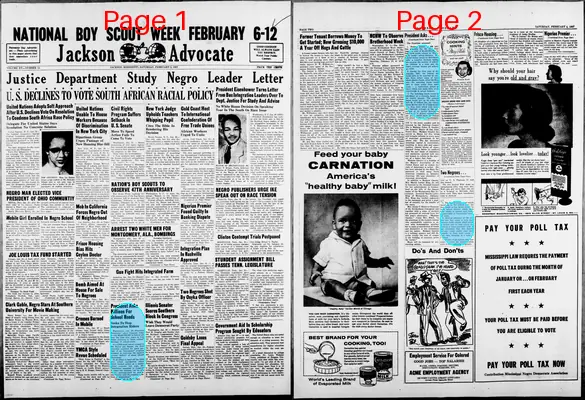
Jackson Advocate
Jackson, Hinds County, Mississippi
What is this article about?
President Eisenhower requests $2.22 billion in federal aid over four years from Congress to address U.S. classroom shortages, advocating passage without integration clauses amid segregation debates. Details include grants, matching funds, and bond purchases for needy districts.
Merged-components note: Merged continuation across pages for school aid proposal.
Clippings
1 of 2
OCR Quality
Full Text
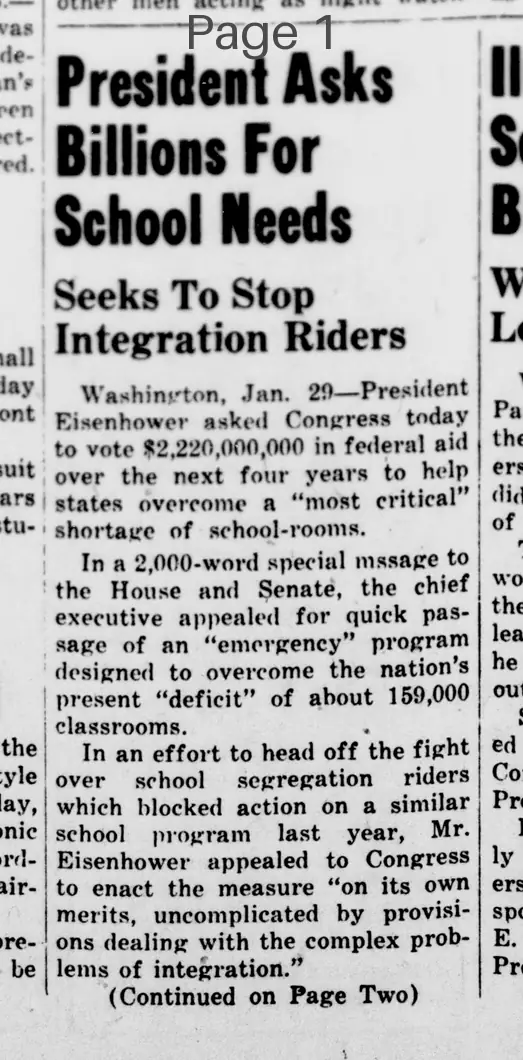
Washington, Jan. 29 President Eisenhower asked Congress today to vote $2,220,000,000 in federal aid over the next four years to help states overcome a "most critical" shortage of school-rooms.
In a 2,000-word special message to the House and Senate, the chief executive appealed for quick passage of an "emergency" program designed to overcome the nation's present "deficit" of about 159,000 classrooms.
In an effort to head off the fight over school segregation riders which blocked action on a similar school program last year, Mr. Eisenhower appealed to Congress to enact the measure "on its own merits, uncomplicated by provisions dealing with the complex problems of integration."
(Continued on Page Two)
1. Federal grants of $325 million annually for the next four years, a total of $1,300,000,000, to help build public schools in "financially needy" school districts. The federal money would be distributed under a complex formula taking into account the number of school-age children in a state and the state's average income per school-age child.
2. During the first year of the program, 1957, the federal aid would have to be matched by outlays from either state or local school district funds. After the first year, the matching funds would have to come solely from state funds—a requirement aimed at states which now make little or no contribution to school budgets.
3. The matching funds would be calculated on a formula based on the state's income. The poorest states would put up 50 cents for each $1 of federal aid, the richest states $2 for each $1 of federal aid.
4. Any state which falls below the national average in the proportion of its income devoted to schools, or in dollars expenditures per pupil, would have its federal aid grant "reduced proportionately."
5. The federal government would spend up to $750 million over the four years to buy bonds issued by local school districts which have been unable to market their bonds commercially at "reasonable" interest rates.
6. Federal advances of $150 million over four years to help state agencies build schools which would be turned over to local school districts on a "lease-purchase" plan. It was estimated that this federal nest-egg would enable such state agencies to float bond issues of their own, bringing in a total of $6 billion.
7. Grants of $20 million over four years to cover the administrative costs of state planning programs.
What sub-type of article is it?
What keywords are associated?
What entities or persons were involved?
Where did it happen?
Domestic News Details
Primary Location
Washington
Event Date
Jan. 29
Key Persons
Event Details
President Eisenhower asked Congress to vote $2,220,000,000 in federal aid over the next four years to help states overcome a shortage of school-rooms. In a special message, he appealed for quick passage of an emergency program to overcome the nation's deficit of about 159,000 classrooms. He urged enactment on its own merits without provisions dealing with integration. The program includes: 1. Federal grants of $325 million annually for four years, total $1,300,000,000, to build public schools in financially needy districts, distributed by formula. 2. Matching funds required, from state or local in first year, then state only. 3. Matching based on state income, poorest 50 cents per $1 federal, richest $2 per $1. 4. Aid reduced for states below national average in school spending. 5. Up to $750 million to buy local school bonds. 6. $150 million advances for state agencies to build schools on lease-purchase, enabling $6 billion bonds. 7. $20 million grants for administrative costs.