Thank you for visiting SNEWPapers!
Sign up free
Gazette Of The United States
New York, New York County, New York
What is this article about?
Joseph Mifflin advises Pennsylvania farmers on late sowing of yellow-bearded wheat on buckwheat stubble to mitigate drought effects and potential Hessian Fly damage, based on his successful 1788-1789 experiment yielding a fine crop despite delayed planting.
Clipping
OCR Quality
Full Text
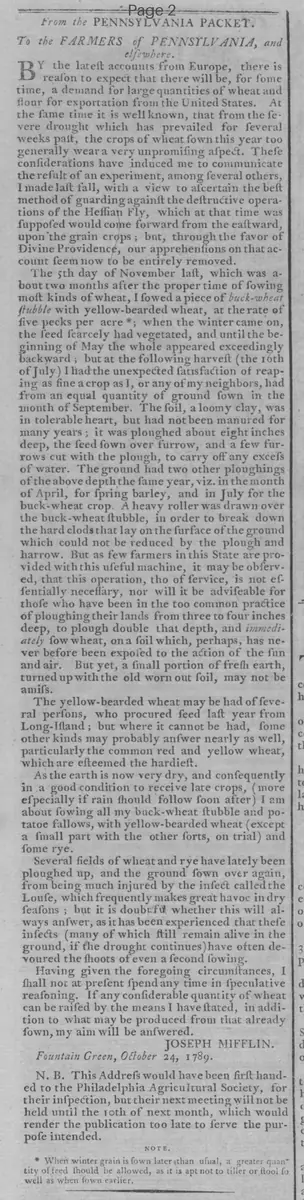
To the FARMERS of PENNSYLVANIA, and elsewhere.
BY the latest accounts from Europe, there is reason to expect that there will be, for some time, a demand for large quantities of wheat and flour for exportation from the United States. At the same time it is well known, that from the severe drought which has prevailed for several weeks past, the crops of wheat sown this year too generally wear a very unpromising aspect. These considerations have induced me to communicate the result of an experiment, among several others, I made last fall, with a view to ascertain the best method of guarding against the destructive operations of the Hessian Fly, which at that time was supposed would come forward from the eastward, upon the grain crops; but, through the favor of Divine Providence, our apprehensions on that account seem now to be entirely removed.
The 5th day of November last, which was about two months after the proper time of sowing most kinds of wheat, I sowed a piece of buck-wheat stubble with yellow-bearded wheat, at the rate of five pecks per acre*; when the winter came on, the seed scarcely had vegetated, and until the beginning of May the whole appeared exceedingly backward; but at the following harvest (the 16th of July) I had the unexpected satisfaction of reaping as fine a crop as I, or any of my neighbors, had from an equal quantity of ground sown in the month of September. The soil, a loamy clay, was in tolerable heart, but had not been manured for many years; it was ploughed about eight inches deep, the seed sown over furrow, and a few furrows cut with the plough, to carry off any excess of water. The ground had two other ploughings of the above depth the same year, viz. in the month of April, for spring barley, and in July for the buck-wheat crop. A heavy roller was drawn over the buck-wheat stubble, in order to break down the hard clods that lay on the surface of the ground which could not be reduced by the plough and harrow. But as few farmers in this State are provided with this useful machine, it may be observed, that this operation, tho of service, is not essentially necessary, nor will it be advisable for those who have been in the too common practice of ploughing their lands from three to four inches deep, to plough double that depth, and immediately sow wheat, on a soil which, perhaps, has never before been exposed to the action of the sun and air. But yet, a small portion of fresh earth turned up with the old worn out soil, may not be amiss.
The yellow-bearded wheat may be had of several persons, who procured seed last year from Long-Island; but where it cannot be had, some other kinds may probably answer nearly as well, particularly the common red and yellow wheat, which are esteemed the hardiest.
As the earth is now very dry, and consequently in a good condition to receive late crops, (more especially if rain should follow soon after) I am about sowing all my buck-wheat stubble and potatoe fallows, with yellow-bearded wheat (except a small part with the other sorts, on trial) and some rye.
Several fields of wheat and rye have lately been ploughed up, and the ground sown over again, from being much injured by the insect called the Louse, which frequently makes great havoc in dry seasons; but it is doubtful whether this will always answer, as it has been experienced that these insects (many of which still remain alive in the ground, if the drought continues) have often devoured the shoots of even a second sowing.
Having given the foregoing circumstances, I shall not at present spend any time in speculative reasoning. If any considerable quantity of wheat can be raised by the means I have stated, in addition to what may be produced from that already sown, my aim will be answered.
JOSEPH MIFFLIN.
Fountain Green, October 24, 1789.
N. B. This Address would have been first handed to the Philadelphia Agricultural Society, for their inspection, but their next meeting will not be held until the 10th of next month, which would render the publication too late to serve the purpose intended.
NOTE.
*When winter grain is sown later than usual, a greater quantity of seed should be allowed, as it is apt not to tiller or stool so well as when sown earlier.
What sub-type of article is it?
What keywords are associated?
What entities or persons were involved?
Where did it happen?
Domestic News Details
Primary Location
Fountain Green, Pennsylvania
Event Date
October 24, 1789
Key Persons
Event Details
Joseph Mifflin communicates results of an experiment sowing yellow-bearded wheat on buck-wheat stubble on November 5 last at five pecks per acre, which yielded a fine crop by July 16 despite backward growth, on loamy clay soil ploughed eight inches deep; advises similar late sowing now due to drought and European demand for wheat and flour, noting alternatives like common red and yellow wheat if unavailable.