Thank you for visiting SNEWPapers!
Sign up free
West Jersey Pioneer
Bridgeton, Cumberland County, New Jersey
What is this article about?
Impending 1848 Irish famine from potato blight destroys most crop in three provinces; blames landlords exporting food to England, leaving peasants destitute despite ample grain production. References 1846 crisis with ongoing exports amid starvation.
Clipping
OCR Quality
Full Text
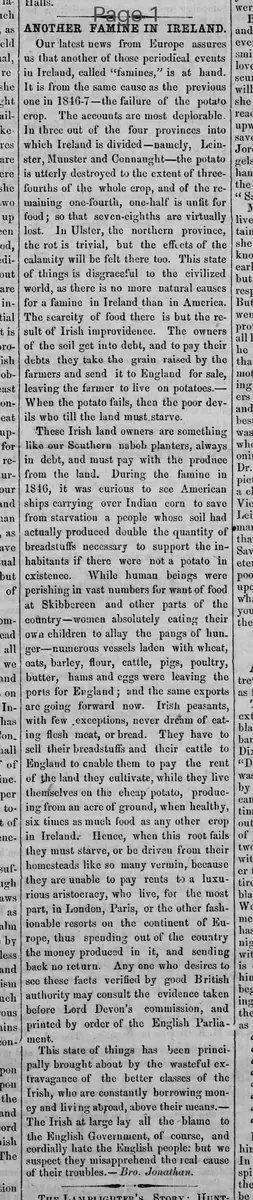
Our latest news from Europe assures us that another of those periodical events in Ireland, called "famines," is at hand. It is from the same cause as the previous one in 1846-7-the failure of the potato crop. The accounts are most deplorable. In three out of the four provinces into which Ireland is divided-namely, Leinster, Munster and Connaught--the potato is utterly destroyed to the extent of three-fourths of the whole crop, and of the remainder one-fourth, one-half is unfit for food; so that seven-eighths are virtually lost. In Ulster, the northern province, the rot is trivial, but the effects of the calamity will be felt there too. This state of things is disgraceful to the civilized world, as there is no more natural causes for a famine in Ireland than in America. The scarcity of food there is but the result of Irish improvidence. The owners of the soil get into debt, and to pay their debts they take the grain raised by the farmers and send it to England for sale, leaving the farmer to live on potatoes.—When the potato fails, then the poor devils who till the land must starve.
These Irish land owners are something like our Southern nabob planters, always in debt, and must pay with the produce from the land. During the famine in 1846, it was curious to see American ships carrying over Indian corn to save from starvation a people whose soil had actually produced double the quantity of breadstuffs necessary to support the inhabitants if there were not a potato in existence. While human beings were perishing in vast numbers for want of food at Skibbereen and other parts of the country-women absolutely eating their own children to allay the pangs of hunger--numerous vessels laden with wheat, oats, barley, flour, cattle, pigs, poultry, butter, hams and eggs were leaving the ports for England; and the same exports are going forward now. Irish peasants, with few exceptions, never dream of eating flesh meat, or bread. They have to sell their breadstuffs and their cattle to England to enable them to pay the rent of the land they cultivate, while they live themselves on the cheap potato, producing from an acre of ground, when healthy, six times as much food as any other crop in Ireland. Hence, when this root fails they must starve, or be driven from their homesteads like so many vermin, because they are unable to pay rents to a luxurious aristocracy, who live, for the most part, in London, Paris, or the other fashionable resorts on the continent of Europe, thus spending out of the country the money produced in it, and sending back no return. Any one who desires to see these facts verified by good British authority may consult the evidence taken before Lord Devon's commission, and printed by order of the English Parliament.
This state of things has been principally brought about by the wasteful extravagance of the better classes of the Irish, who are constantly borrowing money and living abroad, above their means. The Irish at large lay all the blame to the English Government, of course, and cordially hate the English people: but we suspect they misapprehend the real cause of their troubles.- Bro. Jonathan.
What sub-type of article is it?
What themes does it cover?
What keywords are associated?
What entities or persons were involved?
Where did it happen?
Story Details
Key Persons
Location
Ireland (Provinces: Leinster, Munster, Connaught, Ulster)
Event Date
Following 1846 7
Story Details
Another famine looms in Ireland due to widespread potato crop failure, destroying three-fourths and rendering half the remainder unfit, leaving seven-eighths lost. Ulster less affected. Blames improvidence: landowners export grain to England to pay debts, forcing peasants to rely on potatoes; when they fail, starvation ensues despite sufficient breadstuffs produced. Parallels 1846 famine with exports continuing amid deaths.