Thank you for visiting SNEWPapers!
Sign up free
The Kentucky Gazette
Lexington, Fayette County, Kentucky
What is this article about?
A letter advocating for a Bill of Rights in the U.S. Constitution, refuting objections that it is useless, dangerous, or absurd in a republican government. The author argues it protects liberties from potential abuses by rulers, referencing Virginia's Bill of Rights and the Federal Constitution, and warns of scenarios like unequal taxation or cruel punishments.
Merged-components note: This is a continuation of the same letter to the editor across pages, as indicated by the text flow and the cutoff at the end of the first part matching the start of the second.
Clippings
1 of 2
OCR Quality
Full Text
MR. PRINTER,
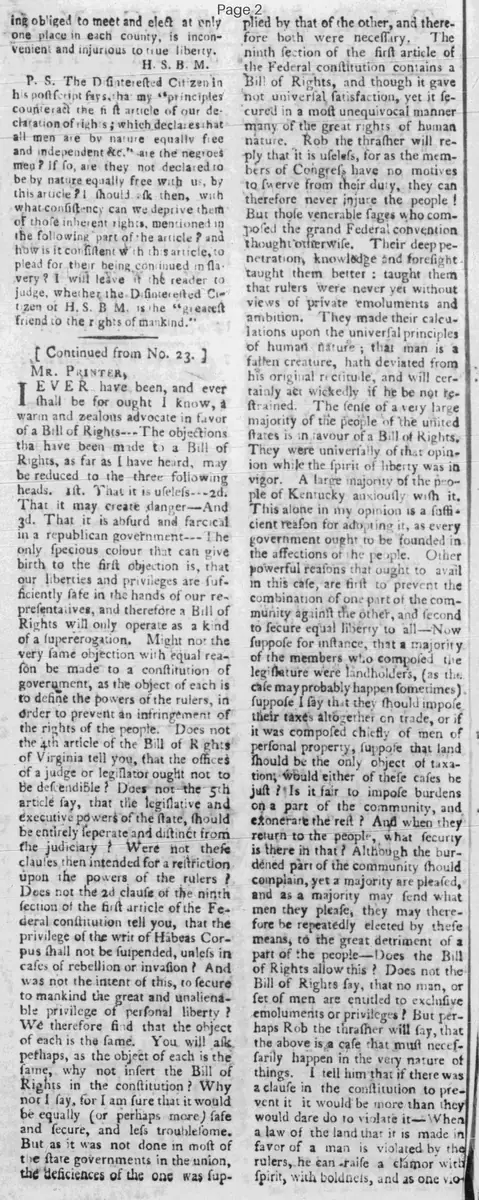
I never have been, and ever shall be for ought I know, a warm and zealous advocate in favor of a Bill of Rights. The objections that have been made to a Bill of Rights, as far as I have heard, may be reduced to the three following heads. 1st. That it is useless---2d. That it may create danger--And 3d. That it is absurd and farcical in a republican government. The only specious colour that can give birth to the first objection is, that our liberties and privileges are sufficiently safe in the hands of our representatives, and therefore a Bill of Rights will only operate as a kind of a supererogation. Might not the very same objection with equal reason be made to a constitution of government, as the object of each is to define the powers of the rulers, in order to prevent an infringement of the rights of the people. Does not the 4th article of the Bill of Rights of Virginia tell you, that the offices of a judge or legislator ought not to be descendible? Does not the 5th article say, that the legislative and executive powers of the state, should be entirely separate and distinct from the judiciary? Were not these clauses then intended for a restriction upon the powers of the rulers? Does not the 2d clause of the ninth section of the first article of the Federal constitution tell you, that the privilege of the writ of Habeas Corpus shall not be suspended, unless in cases of rebellion or invasion? And was not the intent of this, to secure to mankind the great and unalienable privilege of personal liberty?
We therefore find that the object of each is the same. You will ask perhaps, as the object of each is the same, why not insert the Bill of Rights in the constitution? Why not I say, for I am sure that it would be equally (or perhaps more) safe and secure, and less troublesome. But as it was not done in most of the state governments in the union, the deficiencies of the one was supplied by that of the other, and therefore both were necessary. The ninth section of the first article of the Federal constitution contains a Bill of Rights, and though it gave not universal satisfaction, yet it secured in a most unequivocal manner many of the great rights of human nature. Rob the thrasher will reply that it is useless, for as the members of Congress have no motives to swerve from their duty, they can therefore never injure the people! But those venerable sages who composed the grand Federal convention thought otherwise. Their deep penetration, knowledge and foresight taught them better: taught them that rulers were never yet without views of private emoluments and ambition. They made their calculations upon the universal principles of human nature; that man is a fallen creature, hath deviated from his original rectitude, and will certainly act wickedly if he be not restrained. The sense of a very large majority of the people of the united states is in favour of a Bill of Rights. They were universally of that opinion while the spirit of liberty was in vigor. A large majority of the people of Kentucky anxiously wish it. This alone in my opinion is a sufficient reason for adopting it, as every government ought to be founded in the affections of the people. Other powerful reasons that ought to avail in this case, are first to prevent the combination of one part of the community against the other, and second to secure equal liberty to all. Now suppose for instance, that a majority of the members who composed the legislature were landholders, (as the case may probably happen sometimes) suppose I say that they should impose their taxes altogether on trade. or if it was composed chiefly of men of personal property, suppose that land should be the only object of taxation: would either of these cases be just? Is it fair to impose burdens on a part of the community, and exonerate the rest? And when they return to the people, what security is there in that? Although the burdened part of the community should complain, yet a majority are pleased. and as a majority may send what men they please, they may therefore be repeatedly elected by these means, to the great detriment of a part of the people. Does the Bill of Rights allow this? Does not the Bill of Rights say, that no man, or set of men are entitled to exclusive emoluments or privileges? But perhaps Rob the thrasher will say, that the above is a case that must necessarily happen in the very nature of things. I tell him that if there was a clause in the constitution to prevent it it would be more than they would dare do to violate it. When a law of the land that is made in favor of a man is violated by the rulers, he can raise a clamor with spirit, with boldness, and as one vio
Formation of a constitution sets a precedent for another. A majority of the community will clearly see that it is dangerous, and will therefore concur in opposing it. Or suppose that the legislature should, in order to stop the progress of some very prevalent offence, inflict cruel and unusual punishments upon the perpetrators thereof, would not this reflect a stigma upon a Christian people? Would it not violate the Virginia Bill of Rights? And yet this is what they must do, if they be not restrained, as men are often transported beyond the bounds of reason even when they have right on their side. Or if Rob the trash r should unhappily incur the odium of the legislature, and they should take it in their heads to put him to death (though innocent) would he not then think of a Bill of Rights? If they should even kick him in the breech or punch him in the guts, I imagine he would then cry out for a Bill of Rights. Or suppose that a majority of the house should be composed of men who have no slaves & these should impose so high a tax upon that species of property, as virtually to amount to an emancipation. what would become of the holders of slaves in that case? They would elect other men who would abolish so enormous a tax: Even allowing that to be the case, what would become of these poor oppressed people in the mean time? I suppose he deems these intermediate grievances an advantage, as they are transient, and as they may teach men the difference between prosperity and adversity. But if the legislature should command one man to murder another, or to ravish another's wife, and should for refusal order him to be hanged, it is my firm belief that it would avail more than whole volumes of arguments in favor of a Bill of Rights. This is a wicked and improbable act, but as it might possibly happen, if I was the framer of a constitution, I would provide against it. Therefore in order to avert evils of such magnitude as the cases above mentioned and a thousand others of the like nature that might possibly happen, I think a Bill of Rights or constitutional provisions at least not useless, but absolutely necessary.
2d. The Second objection goes to the supposition that a Bill of Rights is dangerous in a commonwealth. The ground of this objection is, that as a Bill of Rights and a constitution of government may contradict each other, it may be productive of danger; by creating violent and perilous disputes. Some will say that the constitution is paramount, and others that the Bill of Rights is so. And here I must candidly acknowledge, that if this was the case, it would be dangerous, as it would be productive of a scene of confusion and perplexity. But from whence do they get the ground of their objection? Is it the case in any of our sister states? I have not seen all their Bills of Rights, but I can hardly believe it is the case: But if it should be, so far it is wrong and every rational man would object to it on that ground. But this is not what I want: I wish it to be consistent with the constitution, or otherwise inserted in the constitution, and would prefer the latter. And is this difficult to be done? It would be productive of the most salutary consequences. It would be one of the strongest bulwarks of virtue and liberty. It would command respect and attention.
The Disinterested Citizen
What sub-type of article is it?
What themes does it cover?
What keywords are associated?
What entities or persons were involved?
Letter to Editor Details
Author
The Disinterested Citizen
Recipient
Mr. Printer
Main Argument
a bill of rights is necessary to protect liberties from potential abuses by rulers, refuting objections that it is useless, dangerous, or absurd in a republican government; it should be consistent with or inserted into the constitution to secure rights like habeas corpus and prevent unequal taxation or cruel punishments.
Notable Details