Thank you for visiting SNEWPapers!
Sign up free
Daily National Intelligencer
Washington, District Of Columbia
What is this article about?
Letter from London, April 3, details British society's war fervor against Napoleon's France despite financial woes, driven by elites' interests. Notes policy-driven abolition of African slave trade, suspects Castlereagh orchestrated Napoleon's return, and laments disgraceful end to recent war with America, including failed plunder of New Orleans.
Clipping
OCR Quality
Full Text
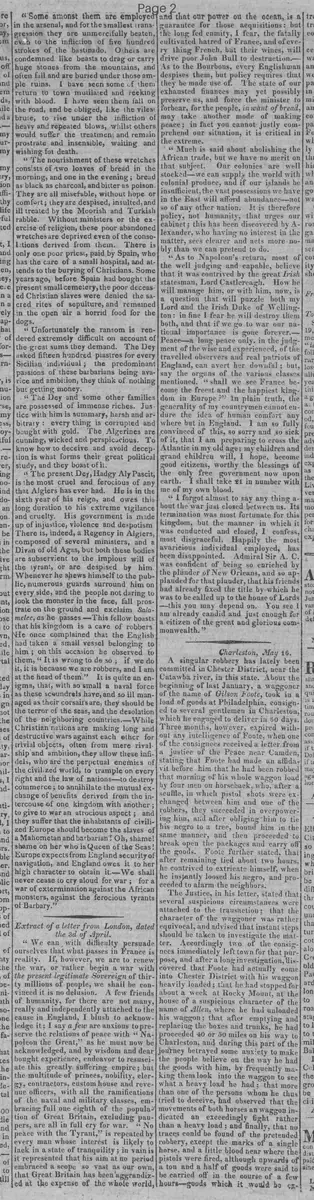
"We can with difficulty persuade ourselves that what passes in France is reality. If, however, we are to renew the war, or rather begin a war with the present legitimate Sovereign of thirty millions of people, we shall be convinced it is no delusion. A few friends of humanity, for there are not many, really and independently attached to the cause in England, I blush to acknowledge it; I say a few are anxious to preserve the relations of peace with "Napoleon the Great," as he must now be acknowledged, and by wisdom and dear bought experience, endeavor to resuscitate this greatly suffering empire; but the multitude of princes, nobility, clergy, contractors, custom house and revenue officers, with all the ramifications of the naval and military classes, embracing full one eighth of the population of Great Britain, excluding paupers, are all in full cry for war. "No peace with the Tyrant," is repeated by every man whose interest is likely to lack in a state of tranquility; in vain is it represented that his aim at no period embraced a scope so vast as our own, that Great Britain has been aggrandized at the expense of the whole world, and that our power on the ocean is a guarantee for those acquisitions: but the long fed enmity, I fear, the fatally cultivated hatred of France, and of every thing French, but their wines, will drive poor John Bull to destruction. As to the Bourbons, every Englishman despises them, but policy requires that they be made use of. The state of our exhausted finances may yet possibly preserve us, and force the minister to forbear, for the people, in want of bread, may take another mode of making peace; in fact you cannot justly comprehend our situation, it is critical in the extreme.
"Much is said about abolishing the African trade, but we have no merit on that subject. Our colonies are well stocked we can supply the world with colonial produce, and if our islands be insufficient, the vast possessions we have in the East will afford abundance—not so of any other nation. It is therefore policy, not humanity, that urges our cabinet; this has been discovered by Alexander, who having no interest in the matter, sees clearer and acts more nobly than we can pretend to do.
"As to Napoleon's return, most of the well judging and capable, believe that it was contrived by the great Irish statesman, Lord Castlereagh. How he will manage him, or with him, now, is a question that will puzzle both my Lord and the Irish Duke of Wellington: in fine I fear he will destroy them both, and that if we go to war our national importance is gone forever. Peace—a long peace only, in the judgment of the wise and experienced, of the travelled observers and real patriots of England, can avert her downfall; but, say the organs of the various classes mentioned, "shall we see France become the freest and the happiest kingdom in Europe?" In plain truth, the generality of my countrymen cannot endure the idea of human comfort any where but in England. I am so fully convinced of this, so sorry and so sick of it, that I am preparing to cross the Atlantic in my old age; my children and grand children will, I hope, become good citizens, worthy the blessings of the only free government now upon earth. I shall take 21 in number with me of my own blood.
"I forgot almost to say any thing about the war just closed between us. Its termination was most fortunate for this kingdom, but the manner in which it was conducted and closed, I confess, most disgraceful, Happily the most avaricious individual employed, has been disappointed. Admiral Sir A. C. was confident of being so enriched by the plunder of New Orleans, and so applauded for that plunder, that his friends had already fixed the title by which he was to be called up to the house of Lords—this you may depend on. You see I am already candid and just enough for a citizen of the great and glorious commonwealth."
What sub-type of article is it?
What keywords are associated?
What entities or persons were involved?
Where did it happen?
Foreign News Details
Primary Location
London
Event Date
The 3d Of April
Key Persons
Outcome
exhausted british finances may prevent war; disgraceful conduct and failed plunder in recent war with america; potential destruction if war with france resumes.
Event Details
British society, driven by princes, nobility, clergy, contractors, and military classes, clamors for war against Napoleon's France despite financial exhaustion and public disdain for Bourbons. Writer advocates peace, attributes slave trade abolition to policy not humanity, suspects Castlereagh contrived Napoleon's return, and criticizes the recent war's end, including Admiral Sir A. C.'s disappointed plunder of New Orleans.