Thank you for visiting SNEWPapers!
Sign up free
Editorial
December 11, 1823
The Wilmingtonian
Wilmington, New Castle County, Delaware
What is this article about?
The editorial corrects a prior description of J. P. Fairlamb's invention for saving and reusing water in canal locks via a partitioned reservoir with valves, enabling faster and safer operation compared to common methods and European side locks.
Clipping
OCR Quality
98%
Excellent
Full Text
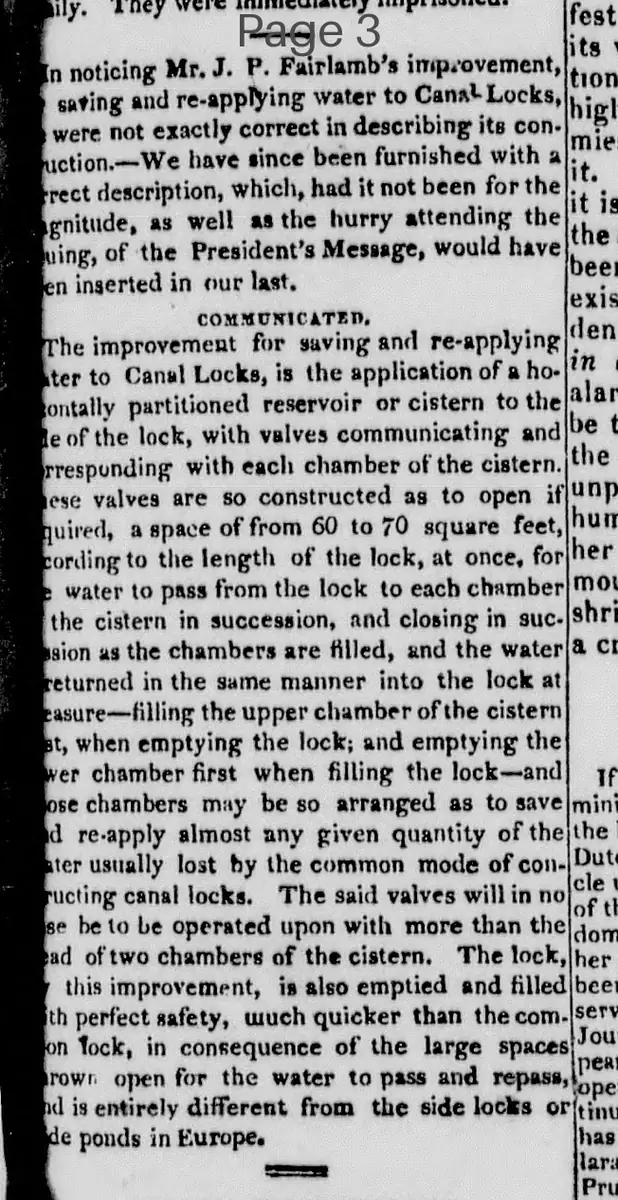
In noticing Mr. J. P. Fairlamb's improvement in saving and re-applying water to Canal Locks, we were not exactly correct in describing its construction.—We have since been furnished with a correct description, which, had it not been for the magnitude, as well as the hurry attending the printing, of the President's Message, would have been inserted in our last.
COMMUNICATED.
The improvement for saving and re-applying water to Canal Locks, is the application of a horizontally partitioned reservoir or cistern to the side of the lock, with valves communicating and corresponding with each chamber of the cistern. These valves are so constructed as to open, if required, a space of from 60 to 70 square feet, according to the length of the lock, at once, for water to pass from the lock to each chamber of the cistern in succession, and closing in succession as the chambers are filled, and the water returned in the same manner into the lock at pleasure—filling the upper chamber of the cistern first, when emptying the lock; and emptying the lower chamber first when filling the lock—and those chambers may be so arranged as to save and re-apply almost any given quantity of the water usually lost by the common mode of constructing canal locks. The said valves will in no case be to be operated upon with more than the head of two chambers of the cistern. The lock, with this improvement, is also emptied and filled with perfect safety, much quicker than the common lock, in consequence of the large spaces thrown open for the water to pass and repass, and is entirely different from the side locks or side ponds in Europe.
COMMUNICATED.
The improvement for saving and re-applying water to Canal Locks, is the application of a horizontally partitioned reservoir or cistern to the side of the lock, with valves communicating and corresponding with each chamber of the cistern. These valves are so constructed as to open, if required, a space of from 60 to 70 square feet, according to the length of the lock, at once, for water to pass from the lock to each chamber of the cistern in succession, and closing in succession as the chambers are filled, and the water returned in the same manner into the lock at pleasure—filling the upper chamber of the cistern first, when emptying the lock; and emptying the lower chamber first when filling the lock—and those chambers may be so arranged as to save and re-apply almost any given quantity of the water usually lost by the common mode of constructing canal locks. The said valves will in no case be to be operated upon with more than the head of two chambers of the cistern. The lock, with this improvement, is also emptied and filled with perfect safety, much quicker than the common lock, in consequence of the large spaces thrown open for the water to pass and repass, and is entirely different from the side locks or side ponds in Europe.
What sub-type of article is it?
Infrastructure
What keywords are associated?
Canal Locks
Water Saving
Fairlamb Improvement
Cistern Valves
Infrastructure Innovation
What entities or persons were involved?
J. P. Fairlamb
Editorial Details
Primary Topic
J. P. Fairlamb's Canal Lock Water Saving Improvement
Stance / Tone
Informative Correction
Key Figures
J. P. Fairlamb
Key Arguments
Valves Open Large Spaces (60 70 Sq Ft) For Water Passage Between Lock And Cistern Chambers
Water Fills Upper Chamber First When Emptying Lock, Empties Lower First When Filling
Saves Nearly All Water Lost In Common Locks
Operates With Head Of Only Two Chambers
Empties And Fills Faster And Safer Than Common Locks
Distinct From European Side Locks Or Ponds