Thank you for visiting SNEWPapers!
Sign up free
Daily National Intelligencer
Washington, District Of Columbia
What is this article about?
The London Examiner praises the U.S. Congress for commissioning four large historical paintings to commemorate American independence, contrasting this liberal patronage with England's neglect of its artists, citing examples of British painters like Stothard, Northcote, and Haydon who suffered without government support.
Clipping
OCR Quality
Full Text
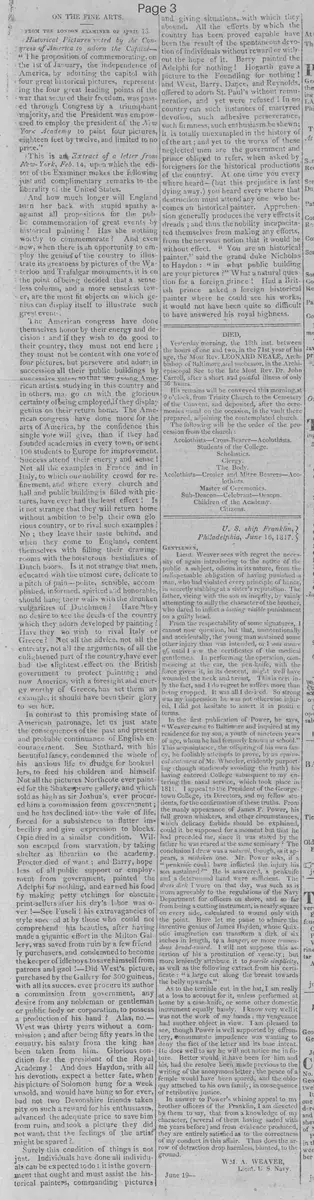
FROM THE LONDON EXAMINER OF APRIL 13.
Historical Pictures voted by the Congress of America to adorn the Capitol.
"The proposition of commemorating, on the 1st of January, the independence of America, by adorning the capitol with four great historical pictures, representing the four great leading points of the war that secured their freedom, was passed through Congress by a triumphant majority, and the President was empowered to employ the president of the New York Academy to paint four pictures, eighteen feet by twelve, and limited to no price."
This is an Extract of a letter from New York, Feb. 14, upon which the editor of the Examiner makes the following just and complimentary remarks to the liberality of the United States.
And how much longer will England turn her back with stupid apathy against all propositions for the public commemoration of great events by historical painting? Has she nothing worthy to commemorate? And even now, when there is an opportunity to employ the genius of the country to illustrate its greatness by pictures of the Waterloo and Trafalgar monuments, it is on the point of being decided that a senseless column and a more senseless tower, are the most fit objects on which genius can display itself to illustrate such great event.
The American congress have done themselves honor by their energy and decision: and if they wish to do good to their country, they must not end here; they must not be content with one vote of four pictures, but persevere and adorn in succession all their public buildings by successive votes, so that the young American artists studying in this country and in others, may go on with the glorious certainty of being employed, if they display genius on their return home. The American congress have done more for the arts of America, by the confidence this single vote will give, than if they had founded academies in every town, or sent 100 students to Europe for improvement.
Success attend their energy and sense! Not all the examples in France and in Italy, to which our nobility crowd for refinement, and where every church and hall and public building is filled with pictures, have ever had the least effect! Is it not strange that they will return home without ambition to help their own glorious country, or to rival such examples? No; they leave their taste behind, and when they come to England, content themselves with filling their drawing rooms with the boisterous bestialities of Dutch boors. Is it not strange that men, educated with the utmost care, delicate to a pitch of pain—polite, sensible, accomplished, informed, spirited and honorable, should hang their walls with the drunken vulgarities of Dutchmen? Have they no desire to see the deeds of the country which they adorn developed by painting? Have they no wish to rival Italy or Greece? Not all the advice, not all the entreaty, not all the arguments, of all the enlightened part of the country, have ever had the slightest effect on the British government to protect painting; and now America, with a foresight and energy worthy of Greece, has set them an example, it should have been their glory to set hers.
In contrast to this promising state of American patronage, let us just state the consequences of the past and present and probable continuance of English encouragement. See Stothard, with his beautiful fancy, condemned the whole of his anxious life to drudge for booksellers, to feed his children and himself. Not all the pictures Northcote ever painted for the Shakespeare gallery, and which sold as high as Sir Joshua's, ever procured him a commission from government; and he has declined into the vale of life, forced for a subsistence to flatter imbecility and give expression to blocks. Opie died in a similar condition. Wilson escaped from starvation, by taking shelter as librarian to the academy. Proctor died of want; and Barry, hopeless of all public support or employment from government, painted the Adelphi for nothing, and earned his food by making petty etchings for obscure print-sellers after his day's labor was over!—See Fuseli! his extravagancies of style sneered at by those who could not comprehend his beauties, after having made a gigantic effort in the Milton Gallery, was saved from ruin by a few friendly purchasers, and condemned to become the keeper of idle boys, to save himself from patrons and gaol!—Did West's picture, purchased by the Gallery for 500 guineas, with all its success, ever procure its author a commission from government, any desire from any nobleman or gentleman or public body or corporation, to possess a production of his hand? Alas, no.—West was thirty years without a commission; and after being fifty years in the country, his salary from the king has been taken from him. Glorious condition for the president of the Royal Academy! And does Haydon, with all his devotion, expect a better fate, when his picture of Solomon hung for a week unsold, and would have hung so for ever, had not two Devonshire friends taken pity on such a reward for his enthusiasm, advanced the adequate price to save him from ruin, and took a picture they did not want, that the feelings of the artist might be spared?
Surely this condition of things is not just. Individuals have done all individuals can be expected to do: it is the government that ought and must assist the historical painters, commanding pictures and giving situations, with which they abound. All the efforts by which the country has been proved capable have been the result of the spontaneous devotion of individuals without reward or with out the hope of it. Barry painted the Adelphi for nothing! Hogarth gave a picture to the Foundling for nothing! and West, Barry, Dance, and Reynolds, offered to adorn St. Paul's without remuneration, and yet were refused! In no country can such instances of martyred devotion, such adhesive perseverance, such firmness, such enthusiasm, be shewn; it is totally unexampled in the history of the art; and yet to the works of these neglected men are the government and prince obliged to refer, when asked by foreigners for the historical productions of the country. At one time you everywhere heard—(but this prejudice is fast dying away,) you heard everywhere that destruction must attend any one who becomes an historical painter. Apprehension generally produces the very effects it dreads; and thus the nobility incapacitated themselves from making any efforts, from the nervous notion that it would be without effect. "You are an historical painter," said the grand duke Nicholas to Haydon: "in what public building are your pictures?" What a natural question for a foreign prince! Had a British prince asked a foreign historical painter where he could see his works, it would not have been quite so difficult to have answered his royal highness.
What sub-type of article is it?
What themes does it cover?
What keywords are associated?
What entities or persons were involved?
Where did it happen?
Story Details
Key Persons
Location
Capitol, America; New York; England
Event Date
Feb. 14; April 13
Story Details
U.S. Congress commissions four large historical paintings of independence war events for the Capitol, empowering the President to hire the New York Academy president without price limit. The Examiner contrasts this with England's apathy toward public art patronage, detailing the hardships faced by British historical painters like Stothard, Northcote, and others who received no government support despite their talents and offers to work for free.