Thank you for visiting SNEWPapers!
Sign up free
Editorial
May 20, 1886
The Sun
New York, New York County, New York
What is this article about?
An editorial criticizes the New York Times for inconsistently portraying former Governor Cleveland as dishonest in 1883-1884 while now praising him as conscientious compared to current Governor Hill, labeling the newspaper as unreliable and motivated by malice.
Clipping
OCR Quality
95%
Excellent
Full Text
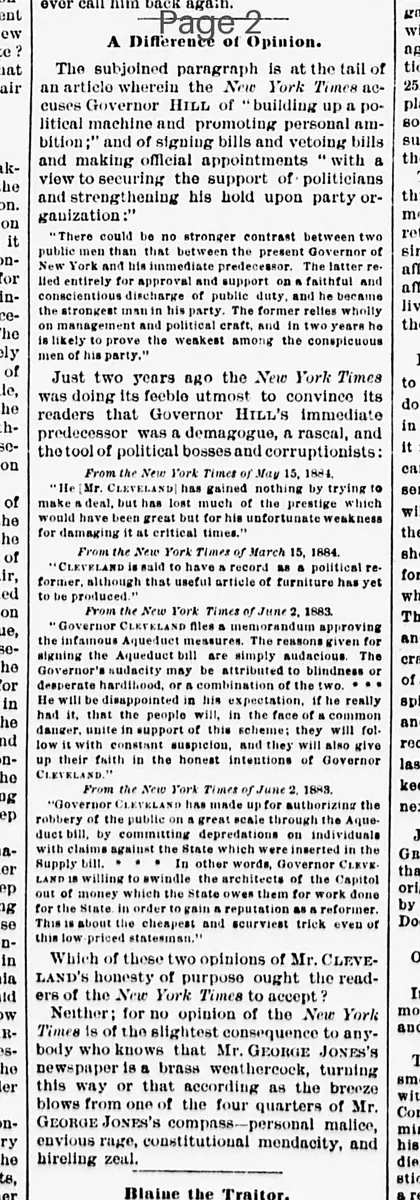
A Difference of Opinion.
The subjoined paragraph is at the tail of an article wherein the New York Times accuses Governor Hill of "building up a political machine and promoting personal ambition;" and of signing bills and vetoing bills and making official appointments "with a view to securing the support of politicians and strengthening his hold upon party organization:"
"There could be no stronger contrast between two public men than that between the present Governor of New York and his immediate predecessor. The latter relied entirely for approval and support on a faithful and conscientious discharge of public duty, and he became the strongest man in his party. The former relies wholly on management and political craft, and in two years he is likely to prove the weakest among the conspicuous men of his party."
Just two years ago the New York Times was doing its feeble utmost to convince its readers that Governor Hill's immediate predecessor was a demagogue, a rascal, and the tool of political bosses and corruptionists:
From the New York Times of May 15, 1884.
"He [Mr. Cleveland] has gained nothing by trying to make a deal, but has lost much of the prestige which would have been great but for his unfortunate weakness for damaging it at critical times."
From the New York Times of March 15, 1884.
"Cleveland is said to have a record as a political reformer, although that useful article of furniture has yet to be produced."
From the New York Times of June 2, 1883.
"Governor Cleveland files a memorandum approving the infamous Aqueduct measures. The reasons given for signing the Aqueduct bill are simply audacious. The Governor's audacity may be attributed to blindness or desperate hardihood, or a combination of the two. He will be disappointed in his expectation, if he really had it, that the people will, in the face of a common danger, unite in support of this scheme: they will follow it with constant suspicion, and they will also give up their faith in the honest intentions of Governor Cleveland."
From the New York Times of June 2, 1883
"Governor Cleveland has made up for authorizing the robbery of the public on a great scale through the Aqueduct bill, by committing depredations on individuals with claims against the State which were inserted in the Supply bill. In other words, Governor Cleveland is willing to swindle the architects of the Capitol out of money which the State owes them for work done for the State in order to gain a reputation as a reformer. This is about the cheapest and scurviest trick ever or this low-priced statesman."
Which of these two opinions of Mr. Cleveland's honesty of purpose ought the readers of the New York Times to accept? Neither; for no opinion of the New York Times is of the slightest consequence to anybody who knows that Mr. George Jones's newspaper is a brass weathercock, turning this way or that according as the breeze blows from one of the four quarters of Mr. George Jones's compass—personal malice, envious rage, constitutional mendacity, and hireling zeal.
The subjoined paragraph is at the tail of an article wherein the New York Times accuses Governor Hill of "building up a political machine and promoting personal ambition;" and of signing bills and vetoing bills and making official appointments "with a view to securing the support of politicians and strengthening his hold upon party organization:"
"There could be no stronger contrast between two public men than that between the present Governor of New York and his immediate predecessor. The latter relied entirely for approval and support on a faithful and conscientious discharge of public duty, and he became the strongest man in his party. The former relies wholly on management and political craft, and in two years he is likely to prove the weakest among the conspicuous men of his party."
Just two years ago the New York Times was doing its feeble utmost to convince its readers that Governor Hill's immediate predecessor was a demagogue, a rascal, and the tool of political bosses and corruptionists:
From the New York Times of May 15, 1884.
"He [Mr. Cleveland] has gained nothing by trying to make a deal, but has lost much of the prestige which would have been great but for his unfortunate weakness for damaging it at critical times."
From the New York Times of March 15, 1884.
"Cleveland is said to have a record as a political reformer, although that useful article of furniture has yet to be produced."
From the New York Times of June 2, 1883.
"Governor Cleveland files a memorandum approving the infamous Aqueduct measures. The reasons given for signing the Aqueduct bill are simply audacious. The Governor's audacity may be attributed to blindness or desperate hardihood, or a combination of the two. He will be disappointed in his expectation, if he really had it, that the people will, in the face of a common danger, unite in support of this scheme: they will follow it with constant suspicion, and they will also give up their faith in the honest intentions of Governor Cleveland."
From the New York Times of June 2, 1883
"Governor Cleveland has made up for authorizing the robbery of the public on a great scale through the Aqueduct bill, by committing depredations on individuals with claims against the State which were inserted in the Supply bill. In other words, Governor Cleveland is willing to swindle the architects of the Capitol out of money which the State owes them for work done for the State in order to gain a reputation as a reformer. This is about the cheapest and scurviest trick ever or this low-priced statesman."
Which of these two opinions of Mr. Cleveland's honesty of purpose ought the readers of the New York Times to accept? Neither; for no opinion of the New York Times is of the slightest consequence to anybody who knows that Mr. George Jones's newspaper is a brass weathercock, turning this way or that according as the breeze blows from one of the four quarters of Mr. George Jones's compass—personal malice, envious rage, constitutional mendacity, and hireling zeal.
What sub-type of article is it?
Partisan Politics
What keywords are associated?
New York Times
Governor Cleveland
Governor Hill
Political Inconsistency
Press Criticism
What entities or persons were involved?
Governor Hill
Governor Cleveland
New York Times
Mr. George Jones
Editorial Details
Primary Topic
Inconsistency In New York Times' Opinions On Governors Cleveland And Hill
Stance / Tone
Strongly Critical Of The New York Times
Key Figures
Governor Hill
Governor Cleveland
New York Times
Mr. George Jones
Key Arguments
New York Times Accuses Governor Hill Of Political Machine Building While Previously Attacking Cleveland As A Demagogue
Quotes From 1883 1884 Show Times' Past Criticism Of Cleveland's Honesty And Actions
Times' Opinions Are Unreliable, Like A 'Brass Weathercock' Driven By Malice And Hireling Zeal