Thank you for visiting SNEWPapers!
Sign up free
Story
October 25, 1901
Daily Kennebec Journal
Augusta, Kennebec County, Maine
What is this article about?
Testimony in a court case involving complainants' mills in Waterville, where witnesses describe operations, water power, and obstructions from refuse like shavings and sawdust from upstream mills, causing shutdowns.
Clipping
OCR Quality
75%
Good
Full Text
MUCH INVOLVED.
(Continued from page 5.)
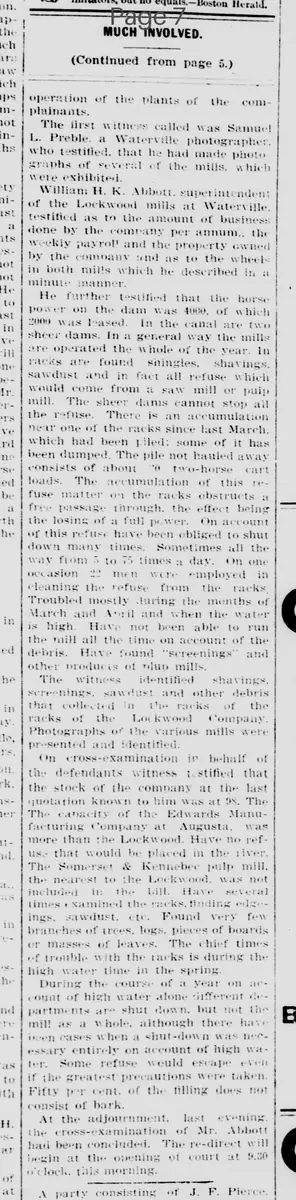
operation of the plants of the complainants. The first witness called was Samuel L. Preble, a Waterville photographer, who testified that he had made photographs of several of the mills, which were exhibited. William H. K. Abbott, superintendent of the Lockwood mills at Waterville, testified as to the amount of business done by the company per annum, the weekly payroll and the property owned by the company and as to the wheels in both mills which he described in a minute manner. He further testified that the horse power on the dam was 4000, of which 2000 was leased. In the canal are two sheer dams. In a general way the mills are operated the whole of the year. In racks are found shingles, shavings, sawdust and in fact all refuse which would come from a saw mill or pulp mill. The sheer dams cannot stop all the refuse. There is an accumulation near one of the racks since last March, which had been piled; some of it has been dumped. The pile not hauled away consists of about of two-horse cart loads. The accumulation of this refuse matter on the racks obstructs a free passage through, the effect being the losing of a full power. On account of this refuse have been obliged to shut down many times. Sometimes all the way from 5 to 75 times a day. On one occasion 2 men were employed in cleaning the refuse from the racks. Troubled mostly during the months of March and April and when the water is high. Have not been able to run the mill all the time on account of the debris. Have found "screenings" and other products of pulp mills. The witness identified shavings, screenings, sawdust and other debris that collected in the racks of the Lockwood company. Photographs of the various mills were presented and identified. On cross-examination in behalf of the defendants witness testified that the stock of the company at the last quotation known to him was at 50s. The capacity of the Edwards Manufacturing company at Augusta was more than the Lockwood. Have no refuse that would be placed in the river. The Somerset & Kennebec pulp mill, the nearest to the Lockwood, was not included in the bill. Have several times examined the racks, finding edgings, sawdust, etc. Found very few branches of trees, logs, pieces of boards or masses of leaves. The chief times of trouble with the racks is during the high water time in the spring. During the course of a year on account of high water alone different departments are shut down, but not the mill as a whole, although there have been cases when a shut-down was necessary entirely on account of high water. Some refuse would escape even if the greatest precautions were taken. Fifty per cent. of the filling does not consist of bark. At the adjournment, last evening the cross-examination of Mr. Abbott had been concluded. The re-direct will begin at the opening of court at 9:30 o'clock this morning.
(Continued from page 5.)
operation of the plants of the complainants. The first witness called was Samuel L. Preble, a Waterville photographer, who testified that he had made photographs of several of the mills, which were exhibited. William H. K. Abbott, superintendent of the Lockwood mills at Waterville, testified as to the amount of business done by the company per annum, the weekly payroll and the property owned by the company and as to the wheels in both mills which he described in a minute manner. He further testified that the horse power on the dam was 4000, of which 2000 was leased. In the canal are two sheer dams. In a general way the mills are operated the whole of the year. In racks are found shingles, shavings, sawdust and in fact all refuse which would come from a saw mill or pulp mill. The sheer dams cannot stop all the refuse. There is an accumulation near one of the racks since last March, which had been piled; some of it has been dumped. The pile not hauled away consists of about of two-horse cart loads. The accumulation of this refuse matter on the racks obstructs a free passage through, the effect being the losing of a full power. On account of this refuse have been obliged to shut down many times. Sometimes all the way from 5 to 75 times a day. On one occasion 2 men were employed in cleaning the refuse from the racks. Troubled mostly during the months of March and April and when the water is high. Have not been able to run the mill all the time on account of the debris. Have found "screenings" and other products of pulp mills. The witness identified shavings, screenings, sawdust and other debris that collected in the racks of the Lockwood company. Photographs of the various mills were presented and identified. On cross-examination in behalf of the defendants witness testified that the stock of the company at the last quotation known to him was at 50s. The capacity of the Edwards Manufacturing company at Augusta was more than the Lockwood. Have no refuse that would be placed in the river. The Somerset & Kennebec pulp mill, the nearest to the Lockwood, was not included in the bill. Have several times examined the racks, finding edgings, sawdust, etc. Found very few branches of trees, logs, pieces of boards or masses of leaves. The chief times of trouble with the racks is during the high water time in the spring. During the course of a year on account of high water alone different departments are shut down, but not the mill as a whole, although there have been cases when a shut-down was necessary entirely on account of high water. Some refuse would escape even if the greatest precautions were taken. Fifty per cent. of the filling does not consist of bark. At the adjournment, last evening the cross-examination of Mr. Abbott had been concluded. The re-direct will begin at the opening of court at 9:30 o'clock this morning.
What sub-type of article is it?
Historical Event
What themes does it cover?
Justice
Misfortune
What keywords are associated?
Court Testimony
Mill Operations
Water Power
Refuse Obstruction
Waterville Mills
Pulp Mills
Shutdowns
What entities or persons were involved?
Samuel L. Preble
William H. K. Abbott
Where did it happen?
Waterville, Augusta
Story Details
Key Persons
Samuel L. Preble
William H. K. Abbott
Location
Waterville, Augusta
Story Details
Witnesses testify in a lawsuit about mill operations, water power capacity, and obstructions from upstream refuse causing frequent shutdowns and power loss.