Thank you for visiting SNEWPapers!
Sign up free
Domestic News
August 28, 1828
The Litchfield County Post
Litchfield, Litchfield County, Connecticut
What is this article about?
Article from the N.E. Farmer detailing signs of a poor farmer, including neglect of land, stock, tools, and personal habits leading to inefficiency and poverty.
Clipping
OCR Quality
98%
Excellent
Full Text
From the N. E. Farmer.
SIGNS OF A POOR FARMER.
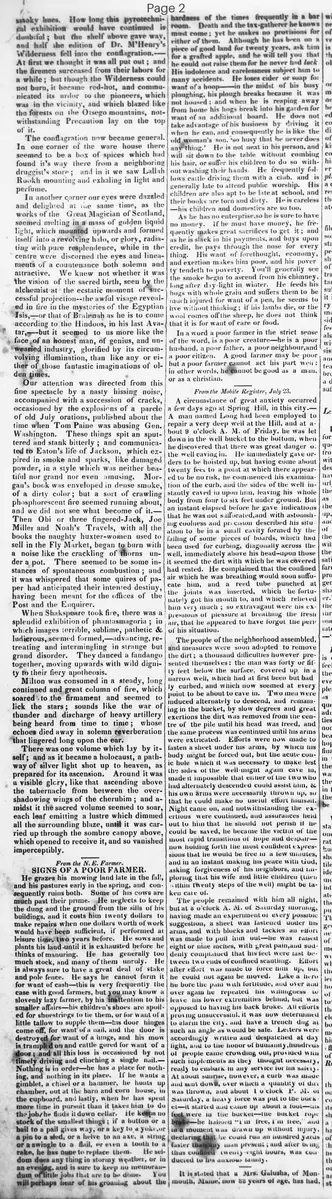
He grazes his mowing land late in the fall, and his pastures early in the spring, and consequently ruins both. Some of his cows are much past their prime. He neglects to keep the dung and the ground from the sills of his buildings, and it costs him twenty dollars to make repairs when one dollar's worth of work would have been sufficient, if performed at leisure time, two years before. He sows and plants his land until it is exhausted before he thinks of manuring. He has generally too much stock, and many of them unruly. He is always sure to have a great deal of stake and pole fence. He says he cannot farm it for want of cash—this is very frequently the case with good farmers, but you may know a slovenly lazy farmer, by his inattention to his smaller affairs—his children's shoes are spoiled for shoestrings to tie them, or for want of a little tallow to supple them—his door hinges come off, for want of a nail, and the door is destroyed for want of a hinge, and his mow is trampled on and cattle gored for want of a door; and all this loss is occasioned by not timely driving and clinching a single nail.
Nothing is in order—he has a place for nothing, and nothing in its place. If he wants a gimblet, a chisel or a hammer, he hunts up chamber, out at the barn and corn house, in the cupboard, and lastly, when he has spent more time in pursuit than it takes him to do the job, he finds it down cellar. He keeps no stock of the smallest things; if a button or a bail to a pail gives way, or a key to a yoke, or a pin to a sled, or a helve to an axe, a string or a swingle to a flail, or even a tooth to a rake, he has none to replace them. He seldom does any thing in stormy weather, or in an evening, and is sure to keep no memorandum of little jobs that are to be done. You will perhaps hear of his groaning about the hardness of the times frequently in a bar room. Death and the tax-gatherer he knows must come; yet he makes no provisions for either of them. Although he has been on a piece of good land for twenty years, ask him for a grafted apple, and he will tell you that he could not raise them for he never had luck. His indolence and carelessness subject him to many accidents. He loses cider or soap for want of a hoop—in the midst of his busy ploughing, his plough breaks because it was not housed: and when he is reaping away from home his hogs break into his garden for want of an additional board. He does not take advantage of his business by driving it when he can, and consequently he is like the old woman's son, 'so busy that he never does any thing.' He is not neat in his person, and will sit down to the table without combing his hair, or suffer his children to do so without washing their hands. He frequently follows cattle driving them with a club, and is generally late to attend public worship. His children are also apt to be late at school, and their books are torn and dirty. He is careless—his children and domestics are so too.
As he has no enterprise, so he is sure to have no money. If he must have money, he frequently makes great sacrifices to get it; and as he is slack in his payments, and buys upon credit, he pays through the nose for every thing. His want of forethought, economy, and exertion makes him poor, and his poverty tendeth to poverty. You'll generally see the smoke begin to ascend from his chimney, long after day-light in winter. He feeds his hogs with whole grain and suffers them to be much injured for want of a pen, he seems to live without thinking: if his lambs die, or the wool comes off the sheep, he does not think that it is for want of care or food.
In a word a poor farmer in the strict sense of the word, is a poor creature—he is a poor husband, a poor father, a poor neighbour, and a poor citizen. A good farmer may be poor but a poor farmer cannot act his part well: in other words, he cannot be good as a man, or as a christian.
SIGNS OF A POOR FARMER.
He grazes his mowing land late in the fall, and his pastures early in the spring, and consequently ruins both. Some of his cows are much past their prime. He neglects to keep the dung and the ground from the sills of his buildings, and it costs him twenty dollars to make repairs when one dollar's worth of work would have been sufficient, if performed at leisure time, two years before. He sows and plants his land until it is exhausted before he thinks of manuring. He has generally too much stock, and many of them unruly. He is always sure to have a great deal of stake and pole fence. He says he cannot farm it for want of cash—this is very frequently the case with good farmers, but you may know a slovenly lazy farmer, by his inattention to his smaller affairs—his children's shoes are spoiled for shoestrings to tie them, or for want of a little tallow to supple them—his door hinges come off, for want of a nail, and the door is destroyed for want of a hinge, and his mow is trampled on and cattle gored for want of a door; and all this loss is occasioned by not timely driving and clinching a single nail.
Nothing is in order—he has a place for nothing, and nothing in its place. If he wants a gimblet, a chisel or a hammer, he hunts up chamber, out at the barn and corn house, in the cupboard, and lastly, when he has spent more time in pursuit than it takes him to do the job, he finds it down cellar. He keeps no stock of the smallest things; if a button or a bail to a pail gives way, or a key to a yoke, or a pin to a sled, or a helve to an axe, a string or a swingle to a flail, or even a tooth to a rake, he has none to replace them. He seldom does any thing in stormy weather, or in an evening, and is sure to keep no memorandum of little jobs that are to be done. You will perhaps hear of his groaning about the hardness of the times frequently in a bar room. Death and the tax-gatherer he knows must come; yet he makes no provisions for either of them. Although he has been on a piece of good land for twenty years, ask him for a grafted apple, and he will tell you that he could not raise them for he never had luck. His indolence and carelessness subject him to many accidents. He loses cider or soap for want of a hoop—in the midst of his busy ploughing, his plough breaks because it was not housed: and when he is reaping away from home his hogs break into his garden for want of an additional board. He does not take advantage of his business by driving it when he can, and consequently he is like the old woman's son, 'so busy that he never does any thing.' He is not neat in his person, and will sit down to the table without combing his hair, or suffer his children to do so without washing their hands. He frequently follows cattle driving them with a club, and is generally late to attend public worship. His children are also apt to be late at school, and their books are torn and dirty. He is careless—his children and domestics are so too.
As he has no enterprise, so he is sure to have no money. If he must have money, he frequently makes great sacrifices to get it; and as he is slack in his payments, and buys upon credit, he pays through the nose for every thing. His want of forethought, economy, and exertion makes him poor, and his poverty tendeth to poverty. You'll generally see the smoke begin to ascend from his chimney, long after day-light in winter. He feeds his hogs with whole grain and suffers them to be much injured for want of a pen, he seems to live without thinking: if his lambs die, or the wool comes off the sheep, he does not think that it is for want of care or food.
In a word a poor farmer in the strict sense of the word, is a poor creature—he is a poor husband, a poor father, a poor neighbour, and a poor citizen. A good farmer may be poor but a poor farmer cannot act his part well: in other words, he cannot be good as a man, or as a christian.
What sub-type of article is it?
Agriculture
What keywords are associated?
Poor Farmer
Farming Negligence
Agricultural Habits
Rural Poverty
Farm Management
Domestic News Details
Event Details
Descriptive article outlining various signs and habits indicative of a poor farmer, such as neglecting land maintenance, poor stock management, disorganization of tools, lack of preparation for repairs, and overall indolence leading to inefficiency and poverty.