Thank you for visiting SNEWPapers!
Sign up free
Story
March 4, 1806
The Enquirer
Richmond, Henrico County, Virginia
What is this article about?
Anonymous accusation against a southern U.S. senator for leaking secret congressional debates on U.S.-British relations to a hostile merchant house, enabling their bold speculations while others hesitated; calls for punishment if true.
Clipping
OCR Quality
98%
Excellent
Full Text
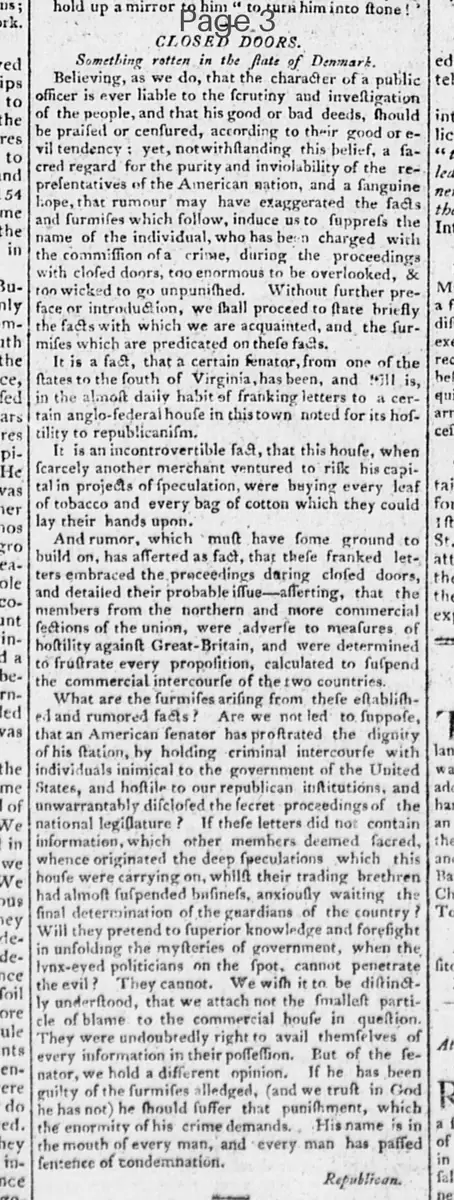
CLOSED DOORS.
Something rotten in the State of Denmark.
Believing, as we do, that the character of a public officer is ever liable to the scrutiny and investigation of the people, and that his good or bad deeds, should be praised or censured, according to their good or evil tendency : yet, notwithstanding this belief, a sacred regard for the purity and inviolability of the representatives of the American nation, and a sanguine hope, that rumour may have exaggerated the facts and surmises which follow, induce us to suppress the name of the individual, who has been charged with the commission of a crime, during the proceedings with closed doors, too enormous to be overlooked, & too wicked to go unpunished. Without further preface or introduction, we shall proceed to state briefly the facts with which we are acquainted, and the surmises which are predicated on these facts.
It is a fact, that a certain senator, from one of the states to the south of Virginia, has been, and still is, in the almost daily habit of franking letters to a certain anglo-federal house in this town noted for its hostility to republicanism.
It is an incontrovertible fact, that this house, when scarcely another merchant ventured to risk his capital in projects of peculation, were buying every leaf of tobacco and every bag of cotton which they could lay their hands upon.
And rumor, which must have some ground to build on, has asserted as fact, that these franked letters embraced the proceedings during closed doors. and detailed their probable issue—asserting, that the members from the northern and non-commercial sections of the union, were adverse to measures of hostility against Great-Britain, and were determined to frustrate every proposition, calculated to suspend the commercial intercourse of the two countries.
What are the surmises arising from these established and rumored facts? Are we not led to suppose. that an American senator has prostrated the dignity of his station, by holding criminal intercourse with individuals inimical to the government of the United States, and hostile to our republican institutions, and unwarrantably disclosed the secret proceedings of the national legislature? If these letters did not contain information, which other members deemed sacred. whence originated the deep speculations which this house were carrying on, whilst their trading brethren had almost suspended business. anxiously waiting the final determination of the guardians of the country
Will they pretend to superior knowledge and foresight in unfolding the mysteries of government, when the lynx-eyed politicians on the spot, cannot penetrate the evil? They cannot. We wish it to be distinctly understood, that we attach not the smallest particle of blame to the commercial house in question.
They were undoubtedly right to avail themselves of every information in their possession. But of the senator, we hold a different opinion. If he has been guilty of the surmises alledged, (and we trust in God he has not) he should suffer that punishment, which the enormity of his crime demands. His name is in the mouth of every man,' and every man has passed sentence of condemnation.
Something rotten in the State of Denmark.
Believing, as we do, that the character of a public officer is ever liable to the scrutiny and investigation of the people, and that his good or bad deeds, should be praised or censured, according to their good or evil tendency : yet, notwithstanding this belief, a sacred regard for the purity and inviolability of the representatives of the American nation, and a sanguine hope, that rumour may have exaggerated the facts and surmises which follow, induce us to suppress the name of the individual, who has been charged with the commission of a crime, during the proceedings with closed doors, too enormous to be overlooked, & too wicked to go unpunished. Without further preface or introduction, we shall proceed to state briefly the facts with which we are acquainted, and the surmises which are predicated on these facts.
It is a fact, that a certain senator, from one of the states to the south of Virginia, has been, and still is, in the almost daily habit of franking letters to a certain anglo-federal house in this town noted for its hostility to republicanism.
It is an incontrovertible fact, that this house, when scarcely another merchant ventured to risk his capital in projects of peculation, were buying every leaf of tobacco and every bag of cotton which they could lay their hands upon.
And rumor, which must have some ground to build on, has asserted as fact, that these franked letters embraced the proceedings during closed doors. and detailed their probable issue—asserting, that the members from the northern and non-commercial sections of the union, were adverse to measures of hostility against Great-Britain, and were determined to frustrate every proposition, calculated to suspend the commercial intercourse of the two countries.
What are the surmises arising from these established and rumored facts? Are we not led to suppose. that an American senator has prostrated the dignity of his station, by holding criminal intercourse with individuals inimical to the government of the United States, and hostile to our republican institutions, and unwarrantably disclosed the secret proceedings of the national legislature? If these letters did not contain information, which other members deemed sacred. whence originated the deep speculations which this house were carrying on, whilst their trading brethren had almost suspended business. anxiously waiting the final determination of the guardians of the country
Will they pretend to superior knowledge and foresight in unfolding the mysteries of government, when the lynx-eyed politicians on the spot, cannot penetrate the evil? They cannot. We wish it to be distinctly understood, that we attach not the smallest particle of blame to the commercial house in question.
They were undoubtedly right to avail themselves of every information in their possession. But of the senator, we hold a different opinion. If he has been guilty of the surmises alledged, (and we trust in God he has not) he should suffer that punishment, which the enormity of his crime demands. His name is in the mouth of every man,' and every man has passed sentence of condemnation.
What sub-type of article is it?
Crime Story
Mystery
Historical Event
What themes does it cover?
Betrayal
Deception
Crime Punishment
What keywords are associated?
Senator Scandal
Leaked Proceedings
Closed Doors
Political Betrayal
Anglo Federal Merchants
Where did it happen?
This Town
Story Details
Location
This Town
Story Details
A senator from a southern state is accused of franking letters containing secret congressional proceedings to an Anglo-Federal merchant house hostile to republicanism, enabling their speculative buying of tobacco and cotton amid uncertainty over U.S.-British commercial relations.