Thank you for visiting SNEWPapers!
Sign up free
Edwardsville Spectator
Edwardsville, Madison County, Illinois
What is this article about?
The London Traveller comments on a National Intelligencer article reflecting US cabinet views on Cuba, noting moderate stance against immediate acquisition but implying future necessity, amid British concerns over US expansion and need for balance of power by securing Cuba.
Clipping
OCR Quality
Full Text
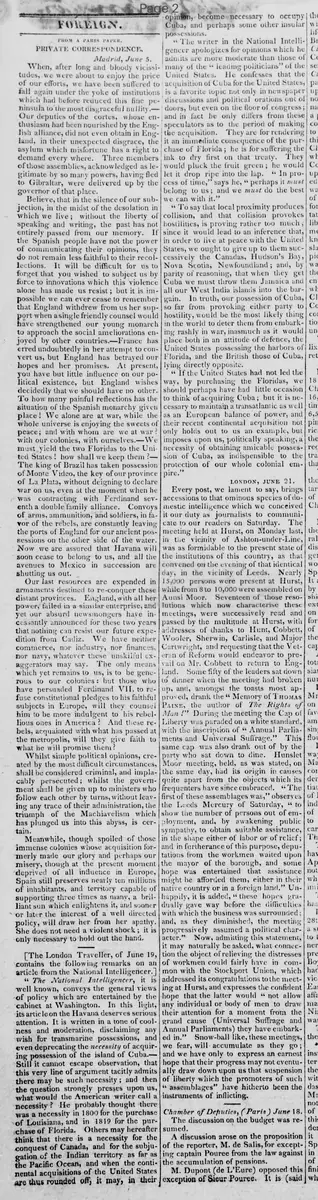
"The National Intelligencer, it is well known, conveys the general views of policy which are entertained by the cabinet at Washington. In this light, its article on the Havana deserves serious attention. It is written in a tone of coolness and moderation, disclaiming any wish for transmarine possessions, and even deprecating the necessity of acquiring possession of the island of Cuba.
Still it cannot escape observation, that this very line of argument tacitly admits there may be such necessity; and then the question strongly presses upon us, what would the American writer call a necessity? He probably thought there was a necessity in 1800 for the purchase of Louisiana, and in 1819 for the purchase of Florida. Others may hereafter think that there is a necessity for the conquest of Canada, and for the subjugation of the Indian territory as far as the Pacific Ocean, and when the continental acquisitions of the United States are thus rounded off, it may, in their opinion, become necessary to occupy Cuba, and perhaps some other insular possessions.
"The writer in the National Intelligencer apologizes for opinions which he admits are more moderate than those of many of the 'leading politicians' of the United States. He confesses that the acquisition of Cuba for the United States, is a favorite topic not only in newspaper discussions and political orations out of doors, but even on the floor of congress: and in fact he only differs from these speculators as to the period of making the acquisition. They are for rendering it an immediate consequence of the purchase of Florida: he is for suffering the ink to dry first on that treaty. They would pluck the fruit green; he would let it drop ripe into the lap. 'In process of time,' says he, 'perhaps it must belong to us; and we must do the best we can with it.'
"To say that local proximity produces collision, and that collision provokes hostilities, is proving rather too much; since it would lead to an inference that, in order to live at peace with the United States, we ought to give up to them successively the Canadas, Hudson's Bay, Nova Scotia, Newfoundland; and, by parity of reasoning, that when they get Cuba we must throw them Jamaica and all our West India islands into the bargain. In truth, our possession of Cuba, so far from provoking either party to hostility, would be the most likely thing in the world to deter them from embarking rashly in war, inasmuch as it would place both in an attitude of defence, the United States possessing the harbors of Florida, and the British those of Cuba, lying directly opposite.
"If the United States had not led the way, by purchasing the Floridas, we should perhaps have had little occasion to think of acquiring Cuba; but it is necessary to maintain a transatlantic as well as an European balance of power, and their recent continental acquisition not only holds out to us an example, but imposes upon us, politically speaking, a necessity of obtaining amicable possession of Cuba, as indispensable to the protection of our whole colonial empire."
What sub-type of article is it?
What keywords are associated?
Where did it happen?
Foreign News Details
Primary Location
Cuba
Event Date
June 19
Event Details
The London Traveller remarks on a National Intelligencer article conveying US cabinet policy views on Havana/Cuba, presented in moderate tone disclaiming desire for transmarine possessions but admitting potential future necessity, contrasting with more aggressive US politicians favoring immediate acquisition post-Florida purchase; British commentary warns of US expansionism citing Louisiana 1800 and Florida 1819 purchases, speculates on future conquests of Canada and Pacific territories leading to Cuba, argues for British acquisition of Cuba to maintain transatlantic balance of power and protect colonial empire against US proximity-induced hostilities.