Thank you for visiting SNEWPapers!
Sign up free
Editorial
May 12, 1824
The Alexandria Herald
Alexandria, Virginia
What is this article about?
Editorial praises John Quincy Adams and Massachusetts delegation's opposition to the tariff, credits Webster's speech, and urges reconciliation and unity between Massachusetts and Virginia based on shared ancestry and interests.
Clipping
OCR Quality
95%
Excellent
Full Text
Mr. Adams Oneorr.
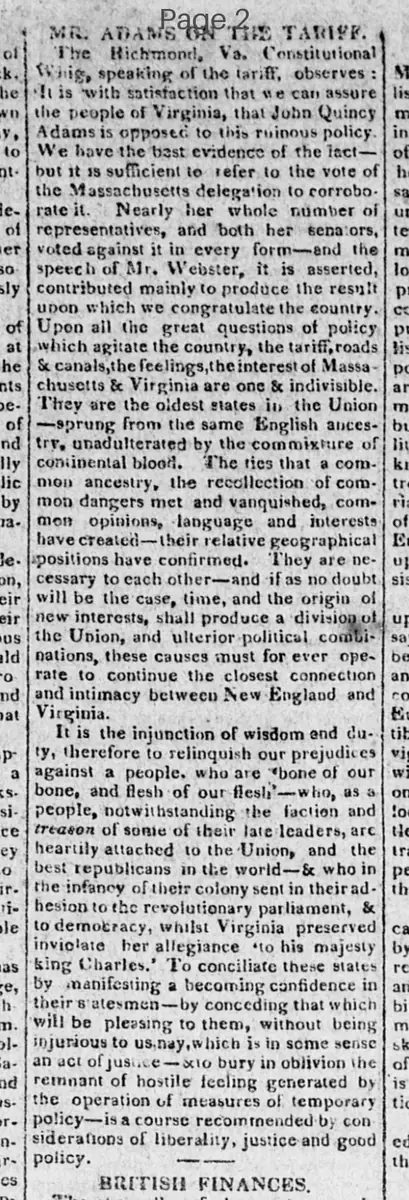
The Richmond, Va. Constitutional Whig, speaking of the tariff, observes :
It is with satisfaction that we can assure the people of Virginia, that John Quincy Adams is opposed to this ruinous policy. We have the best evidence of the fact-- but it is sufficient to refer to the vote of the Massachusetts delegation to corroborate it. Nearly her whole number of representatives, and both her senators, voted against it in every form--and the speech of Mr. Webster, it is asserted, contributed mainly to produce the result upon which we congratulate the country.
Upon all the great questions of policy which agitate the country, the tariff, roads & canals, the feelings, the interests of Massachusetts & Virginia are one & indivisible. They are the oldest states in the Union – sprung from the same English ancestry, unadulterated by the commixture of continental blood. The ties that a common ancestry, the recollection of common dangers met and vanquished, common opinions, language and interests have created--their relative geographical positions have confirmed. They are necessary to each other--and if as no doubt will be the case, time, and the origin of new interests, shall produce a division of the Union, and ulterior political combinations, these causes must for ever operate to continue the closest connection and intimacy between New England and Virginia.
It is the injunction of wisdom and duty, therefore to relinquish our prejudices against a people who are bone of our bone, and flesh of our flesh'--who, as a people, notwithstanding the faction and treason of some of their late leaders, are heartily attached to the Union, and the best republicans in the world--& who in the infancy of their colony sent in their adhesion to the revolutionary parliament, & to democracy, whilst Virginia preserved inviolate her allegiance 'to his majesty king Charles.' To conciliate these states by manifesting a becoming confidence in their statesmen--by conceding that which will be pleasing to them, without being injurious to us, nay, which is in some sense an act of justice--to bury in oblivion the remnant of hostile feeling generated by the operation of measures of temporary policy--is a course recommended by considerations of liberality, justice and good policy.
The Richmond, Va. Constitutional Whig, speaking of the tariff, observes :
It is with satisfaction that we can assure the people of Virginia, that John Quincy Adams is opposed to this ruinous policy. We have the best evidence of the fact-- but it is sufficient to refer to the vote of the Massachusetts delegation to corroborate it. Nearly her whole number of representatives, and both her senators, voted against it in every form--and the speech of Mr. Webster, it is asserted, contributed mainly to produce the result upon which we congratulate the country.
Upon all the great questions of policy which agitate the country, the tariff, roads & canals, the feelings, the interests of Massachusetts & Virginia are one & indivisible. They are the oldest states in the Union – sprung from the same English ancestry, unadulterated by the commixture of continental blood. The ties that a common ancestry, the recollection of common dangers met and vanquished, common opinions, language and interests have created--their relative geographical positions have confirmed. They are necessary to each other--and if as no doubt will be the case, time, and the origin of new interests, shall produce a division of the Union, and ulterior political combinations, these causes must for ever operate to continue the closest connection and intimacy between New England and Virginia.
It is the injunction of wisdom and duty, therefore to relinquish our prejudices against a people who are bone of our bone, and flesh of our flesh'--who, as a people, notwithstanding the faction and treason of some of their late leaders, are heartily attached to the Union, and the best republicans in the world--& who in the infancy of their colony sent in their adhesion to the revolutionary parliament, & to democracy, whilst Virginia preserved inviolate her allegiance 'to his majesty king Charles.' To conciliate these states by manifesting a becoming confidence in their statesmen--by conceding that which will be pleasing to them, without being injurious to us, nay, which is in some sense an act of justice--to bury in oblivion the remnant of hostile feeling generated by the operation of measures of temporary policy--is a course recommended by considerations of liberality, justice and good policy.
What sub-type of article is it?
Economic Policy
Partisan Politics
What keywords are associated?
Tariff Opposition
Massachusetts Virginia Unity
John Quincy Adams
Daniel Webster
Union Reconciliation
Economic Policy
What entities or persons were involved?
John Quincy Adams
Mr. Webster
Massachusetts Delegation
Virginia
Editorial Details
Primary Topic
Opposition To The Tariff And Unity Between Massachusetts And Virginia
Stance / Tone
Supportive Of Anti Tariff Stance And Reconciliation Between States
Key Figures
John Quincy Adams
Mr. Webster
Massachusetts Delegation
Virginia
Key Arguments
John Quincy Adams Opposes The Ruinous Tariff Policy
Massachusetts Representatives And Senators Voted Against The Tariff
Webster's Speech Contributed To Defeating The Tariff
Massachusetts And Virginia Share Common Ancestry, Interests, And Positions
States Are Necessary To Each Other And Should Maintain Close Connection
Relinquish Prejudices Against Massachusetts As They Are Attached To The Union
Conciliate By Confidence In Their Statesmen And Conceding Just Measures
Bury Hostile Feelings From Past Policies For Liberality And Good Policy