Thank you for visiting SNEWPapers!
Sign up free
Alexandria Daily Advertiser
Alexandria, Virginia
What is this article about?
Opinion piece from a London paper arguing that Napoleon Bonaparte will attempt to invade Britain, evidenced by his violation of Dutch neutrality and vast ambitions, urging English preparation beyond reliance on the navy.
Merged-components note: Continuation of the same foreign news article on the invasion threat, split across columns; text flows directly from one to the next.
Clipping
OCR Quality
Full Text
Extracted from a London Paper, received at the
Office of the New York Morning Chronicle.
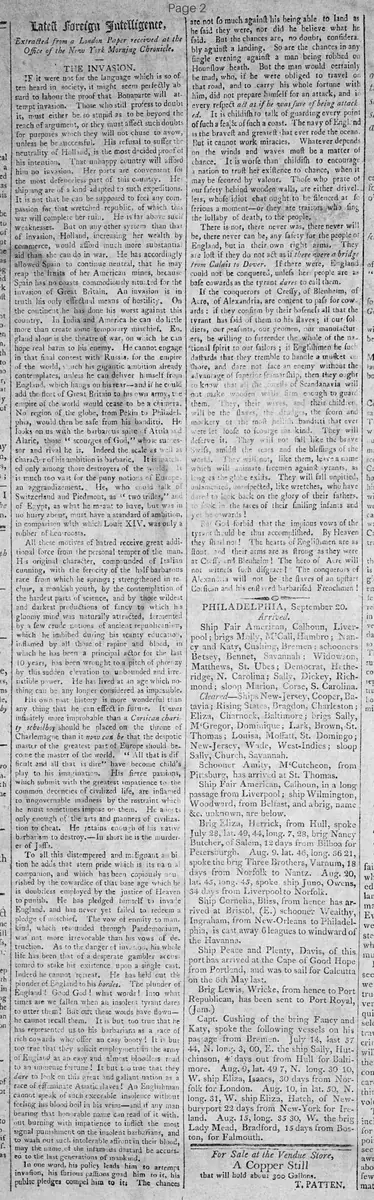
THE INVASION.
IF it were not for the language which is so often
heard in society, it might seem perfectly absurd
to labour the proof that Bonaparte will attempt
invasion. Those who still profess to doubt it,
must either be so stupid as to be beyond the reach
of argument, or they must affect such doubts for
purposes which they will not choose to avow,
unless he be successful. His refusal to suffer the
neutrality of Holland, is the most decided proof of
his intention. That unhappy country will afford
him no invasion. Her ports are convenient for
the most defenceless part of this country. Her
shipping are of a kind adapted to such expeditions.
It is not that he can be supposed to feel any compassion
for that wretched republic, of which this war will
complete her ruin. He is far above such weaknesses.
But on any other system than that of invasion,
Holland, increasing her wealth by commerce,
would afford much more substantial aid than she
can do in war. He has accordingly allowed Spain
to continue neutral, that he may reap the fruits of
her American mines, because Spain has no coasts
commodiously situated for the invasion of Great
Britain. An invasion is in truth his only effectual
means of hostility. On the continent he has done
his worst against this country. In India and
America he can do little more than create some
temporary mischief. England alone is the theatre
of war, on which he can hope real harm to his
enemy. He cannot engage in that final contest
with Russia, for the empire of the world, which
his gigantic ambition already contemplates, unless
he can deliver himself from England, which hangs
on his rear—and if he could add the fleet of Great
Britain to his own army, the empire of the world
would cease to be a chimera. No region of the
globe, from Pekin to Philadelphia, would then be
safe from his banditti. He looks on us with the
barbarous spite of Attila and Alaric, those "scourges
of God," whose successor and rival he is. Indeed
the scale as well as character of his ambition is
barbaric. It is matched only among those destroyers
of the world. It is much too vast for the puny
notions of Europe. an aggrandizement. He, who
could talk of Switzerland and Piedmont, as "two
trifles," and of Egypt, as what he meant to have,
but was in no hurry about, must have a standard
of ambition, in comparison with which Louis XIV.
was only a robber of hen-roosts.
All these motives of hatred receive great additional
force from the personal temper of the man. His
original character, compounded of Italian cunning,
with the ferocity of the half barbarous race from
which he springs; strengthened in recluse, a
monkish youth, by the contemplation of the hardest
parts of science, and by those wildest and darkest
productions of fancy to which his gloomy mind
was naturally attracted, fermented by a few crude
notions of ancient republicanism, which he imbibed
during his scanty education, inflamed by all those
of rapine and blood, in which he has been a principal
actor for the last 10 years, has been wrought to a
pitch of phrenzy by this sudden elevation to unbounded
and irresistible power. He has lived at an age which
nothing can be any longer considered as impossible.
His own past history is more wonderful than any
thing that he can effect in future. It was infinitely
more improbable than a Corsican charity schoolboy
should be placed on the throne of Charlemagne than
it now can be that the despotic master of the greatest
part of Europe should become the master of the
world. "All that is difficult and all that is dire"
have become child's play to his imagination. His
fierce passions, which submit with the greatest
impatience to the common decencies of civilized
life, are inflamed to ungovernable madness by the
restraint which he must sometimes impose on them.
He adopts only enough of the arts and manners of
civilization to cheat. He retains enough of his native
barbarism to destroy.—In short he is the murderer
of Jaffa.
To all this distempered and malignant ambition
he adds that stern pride which is its natural companion,
and which has been copiously nourished by the
cowardice of that base age which he is doubtless
employed by the justice of Heaven to punish. He
has pledged himself to invade England, and has
never yet failed to redeem a pledge of mischief.
The vow of enmity to mankind, which resounded
through Pandemonium, was not more irrevocable
than his vows of destruction. As to the danger of
invasion, his whole life has been that of a desperate
gambler accustomed to stake his existence upon a
single cast. Indeed he cannot retreat. He has held
out the plunder of England to his hordes. The
plunder of England! Good God! what words! Into
what times are we fallen when an insolent tyrant
dares to utter them! But out these words have flown—
he cannot recall them. It is but too true that he has
represented us to his barbarians as a race of rich
cowards who offer an easy booty! It is but too true
that they solicit employment in the army of England
as an easy and almost bloodless road to an immense
fortune! It but too true that they dare to look on
this great and gallant nation as a race of effeminate
Asiatic slaves! An Englishman cannot speak of such
execrable insolence without feeling his blood boil
in his veins—and if any man bearing that honorable
name can read of it without burning with impatience
to inflict the most signal punishment on the insolent
barbarians, and to wash out such intolerable affront
in their blood, may the name of the infamous dastard
be accursed to the last generations of mankind.
In one word, his policy leads him to attempt invasion,
his furious passions goad him to it, his public pledges
compel him to it: The chances are not so much against
his being able to land as he said they were, nor did
he believe what he said. But the chances are, no
doubt, considerably against a landing. So are the
chances in any single evening against a man being
robbed on Hounslow heath. But the man would
certainly be mad, who, if he were obliged to travel on
that road, and to carry his whole fortune with him,
did not prepare himself for an attack, and in every
respect act as if he was sure of being attacked. It is
childish to talk of guarding every point of such a sea
& of such a coast. The navy of England is the
bravest and greatest that ever rode the ocean. But it
cannot work miracles. Whatever depends on the
winds and waves must be a matter of chance. It is
worse than childish to encourage a nation to trust
her existence to chance, when it may be secured by
valour. Those who prate of our safety behind wooden
walls, are either drivellers, whose idiot chat ought to
be silenced at so serious a moment—or they are
traitors who sing the lullaby of death, to the people.
There is not, there never was, there never will be,
there never can be, any safety for the people of
England, but in their own right arms. They are lost
if they do not act as if there were a bridge from
Calais to Dover. If there were, England could not
be conquered, unless her people are as base cowards
as the tyrant dares to call them. If the conquerors of
Cressy, of Blenheim, of Agro, of Alexandria, are
content to pass for cowards: if they confirm by their
baseness all that the tyrant has said of them to his
slaves: if our soldiers, our peasants, our yeomen, our
manufacturers, be willing to surrender the whole of
the national spirit to our sailors: if Englishmen be
such dastards that they tremble to handle a musket
on shore, and dare not face an enemy without the
advantage of superior seamanship, then they ought to
know that all the forests of Scandinavia will not make
wooden walls firm enough to guard them. They,
their wives, and their children, will be the slaves,
the drudges, the scorn and mockery of the most
hellish banditti that ever were let loose to scourge
mankind. They will deserve it. They will not fall
like the brave Swiss, amidst the tears and the blessings
of the world. They will not, like them, leave a name
which will animate freemen against tyrants, as long
as the globe exists. They will fall unpitied, unrespected,
like wretches, who have dared to look back on the
glory of their fathers, to look in the faces of their
smiling infants and yet be cowards!
But God forbid that the impious vows of the tyrant
should be thus accomplished. By Heaven they shall
not! The hearts of Englishmen are as stout, and their
arms are as strong as they were at Cressy, and Blenheim!
The hero of Acre will not witness such disgrace! The
conquerors of Alexandria will not be the slaves of an
upstart Corsican and his enslaved barbarised Frenchmen!
What sub-type of article is it?
What keywords are associated?
What entities or persons were involved?
Where did it happen?
Foreign News Details
Primary Location
Great Britain
Key Persons
Event Details
Argument that Bonaparte intends to invade Great Britain, proven by his refusal of Dutch neutrality to use its ports and shipping, while allowing Spanish neutrality for economic gain; his ambitions aim for world empire by defeating England; personal character described as barbaric and frenzied; urges English to arm themselves beyond naval reliance.