Thank you for visiting SNEWPapers!
Sign up free
The Gazette
Portland, Cumberland County, Maine
What is this article about?
Editorial defends the US Constitution's monarchical executive for stability against French republican intrigues by diplomats like Genet, Fauchet, and Adet, which aimed to divide Americans and incite civil war, praising Pickering's response and the failure of French designs.
Merged-components note: Continuation of the editorial on monarchy, republics, and French influence across pages 2 and 3.
Clippings
1 of 2
OCR Quality
Full Text
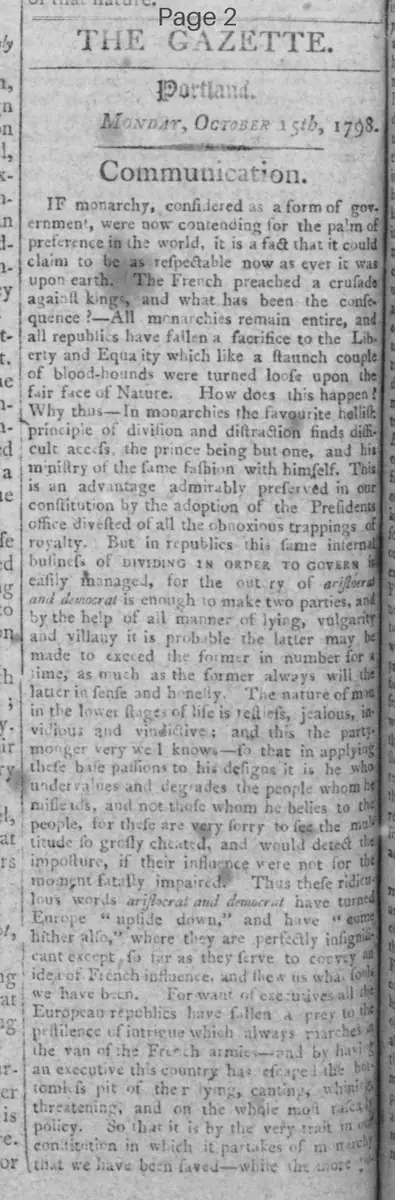
Portland.
Monday, October 15th, 1798.
Communication.
If monarchy, considered as a form of government, were now contending for the palm of preference in the world, it is a fact that it could claim to be as respectable now as ever it was upon earth. The French preached a crusade against kings, and what has been the consequence?--All monarchies remain entire, and all republics have fallen a sacrifice to the Liberty and Equality which like a staunch couple of blood-hounds were turned loose upon the fair face of Nature. How does this happen?
Why thus--In monarchies the favourite holy principle of division and distraction finds difficult access. the prince being but one, and his ministry of the same fashion with himself. This is an advantage admirably preserved in our constitution by the adoption of the President's office divested of all the obnoxious trappings of royalty. But in republics this same infernal business of DIVIDING IN ORDER TO GOVERN is easily managed, for the outcry of aristocrat and democrat is enough to make two parties, and by the help of all manner of lying, vulgarity and villainy it is probable the latter may be made to exceed the former in number for a time, as much as the former always will the latter in sense and honesty. The nature of men in the lower stages of life is restless, jealous, invidious and vindictive: and this the party-monger very well knows--so that in applying these base passions to his designs it is he who undervalues and degrades the people whom he misleads, and not those whom he belies to the people, for these are very sorry to see the multitude so grossly cheated, and would detect the imposture, if their influence were not for the moment fatally impaired. Thus these ridiculous words aristocrat and democrat have turned Europe "upside down," and have "come hither also," where they are perfectly insignificant except so far as they serve to convey an idea of French influence, and the work we have been about. For want of such executives all the European republics have fallen a prey to the pestilence of intrigue which always marches in the van of the French armies--and by having an executive this country has escaped the bolting in spite of their lying, canting, whining, threatening, and on the whole most radical policy. So that it is by the very trait in our constitution in which it partakes of monarchy that we have been saved--while the more .
The popular part has trembled, and had it not been for the former, would possibly have crumbled to pieces as all the pretended republics in Europe have done. And finally, to complete the glory of democracy, the French republic itself, after having by a thousand whoredoms produced those bastards in her own likeness, which like Sin in Milton she has received again into her own body—The French republic, mother, sister, and prostitute of all others and of her own self—to give an indisputable proof of the durability of democratic whirlwinds and of the boasted eternity of LUMINOUS PRINCIPLE, NO LONGER EXISTS. So far from needing no executive, its five-headed substitute has found it necessary to expunge all freedom from the face of France, to usurp all power, ESTABLISH DESPOTISM, AND GOVERN WITH THE SWORD. So much for democracy!
To proceed—After two very great rascals, Genet, and Fauchet, having lost their usefulness here, had been suspended from their offices, were under some mark of the displeasure of the republic to "preserve appearances," as Talleyrand says: still the work was left unfinished—the glorious business of getting the Americans into a civil war; of deposing the federal administration; of building THE TRANSATLANTIC REPUBLIC on the smoking ruins of the United States—and in the event, of gorging all American wealth and property—was in a precarious state, and required some chosen devil, to give it the coup de grace, M. Adet—the very same Adet who was sent to Geneva to replace a French minister there who had grossly affronted that little but elegant republic; the very same Adet who had matured the destruction of that poor little state while enjoying the rights of its hospitality; the same Adet for whose intrigues the Genevan fathers have borne their gray locks in sorrow to their graves, and the Genevan virgins have torn the hair from their heads, was sent to practice the same arts in the United States. He proved inferior to our Mr. Pickering in abilities; but well he might, for we had right on our side, and France nothing but mischief in her heart; which she could but awkwardly conceal, even at that time—and now, by the mouth of Talleyrand confesses. M. Adet left the country just before Mr. Adams was chosen President, and nothing was plainer than that he intended to throw what weight he could into Mr. Jefferson's scale, by sowing discontent among the people at that critical moment.—However, Mr. Pickering's elaborate, but nevertheless perspicuous and spirited investigation of his lying manifesto, defeated his designs and France was foiled once more by truth and honour, means which our government has always chosen to employ, because they will always finally prevail.
It is to be observed that wherever France has had a point to carry in any nation, and met with a party opposed to her designs; it has been the invariable practice of the republic to charge that opposition to British influence. So she did in Switzerland, and in Geneva, and every other place where a single patriot was found so hardy as to withstand her pernicious intrigues. So here in America, (for the laws of nature are not more uniform to regulate than the arts of France are to disorganize the world,) no sooner did our very best men begin to doubt the good tendency of the hairbrained measures of Genet, than there was a great outcry about British influence. Can anything be more insulting and humiliating to a people that has soul enough to keep its body from putrefaction, than to suppose it has no principle of action within itself, but must be goaded by a foreign impulse before it can show signs of life and sensibility. What unparalleled impudence is it in France to tell all nations that they are under the influence of one, and that therefore the Republic has a right to consign them to perdition!—Suppose it were true, what right has this insolent republic to dictate the measures or regulate the policy of mankind any more than England? Because she treats them better? But it is found that this British party, so called by France, is in fact only the American party, that is, those who find it necessary to oppose the gross aggressions of the impudent unprincipled Republic, and to keep in order those among ourselves whom she has been able to mislead. Not one instance of British intrigue has ever been exposed by the boasted diplomatic talents of France. On the other hand, the utmost openness and manly intercourse has ever existed between us and England since the treaty, which was death to the hopes of France in America, precisely in the same ratio wherein it was beneficial to the United States. And reason good—for if any men were left in France who could weigh consequences, it must be apparent to them that the operation of the British treaty would slowly convince the Americans of its beneficial tendency, and yield them so much knowledge of their own consequence and of the nature of foreign connections, as would entirely unfit them for French pupillage, and prepare them to give advice rather than to receive it.
M. Adet returned to France to be sent on new missions, and evangelize freedom to republics and neutral powers whither a French army could follow him on dry ground. Let us be thankful that a bridge cannot be built from France to America, and that the French navy is completely ruined. Buonaparte with his motley fleet, composed in part of the stolen navies of the Pope, Venice and Malta, may wander about the Mediterranean awhile like Blackbeard the pirate: but the suppression of this armament will put an end to French enterprise, and probably let loose a whole insulted world upon a degraded nation and its abandoned government, whose battles this General has fought much better than their cause deserved.
(To be continued.)
What sub-type of article is it?
What keywords are associated?
What entities or persons were involved?
Editorial Details
Primary Topic
Defense Of Us Constitutional Executive Against French Republican Division And Intrigues
Stance / Tone
Strongly Pro Us Government And Constitution, Anti French Republic And Its Diplomats
Key Figures
Key Arguments