Thank you for visiting SNEWPapers!
Sign up free
The National Intelligencer And Washington Advertiser
Washington, District Of Columbia
What is this article about?
In the U.S. House of Representatives on November 10, 1807, debate concludes on a bill appropriating funds for navy support following the British attack on the USS Chesapeake. Members discuss constitutionality, executive actions, and national response; the bill passes 124-2.
Merged-components note: This is a continuation of the House of Representatives debate on the navy appropriation bill across pages, with the second component providing the conclusion including the vote tally.
Clippings
1 of 2
OCR Quality
Full Text
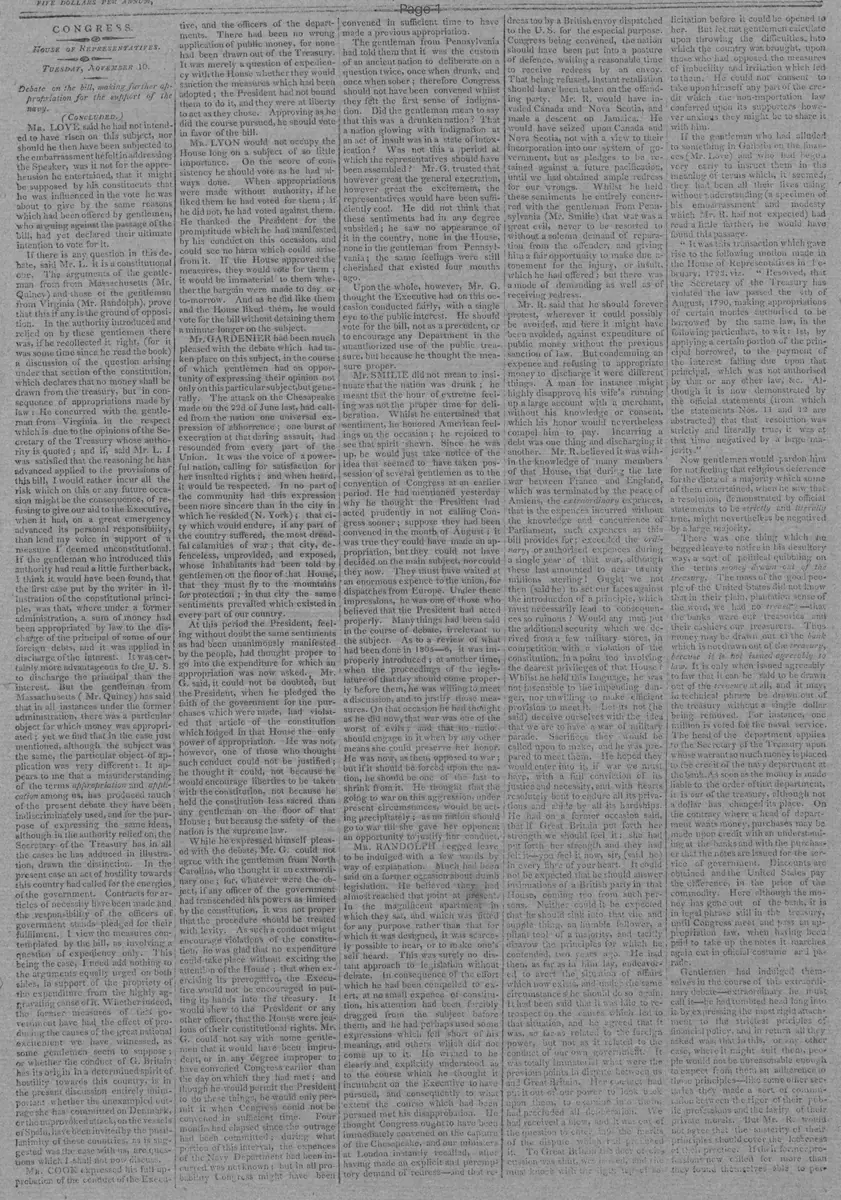
HOUSE OF REPRESENTATIVES
TUESDAY, NOVEMBER 10.
Debate on the bill, making further appropriation for the support of the navy.
(CONCLUDED.)
Mr. LOVE said he had not intended to have risen on this subject, nor should he then have been subjected to the embarrassment he felt in addressing the Speaker, was it not for the apprehension he entertained, that it might be supposed by his constituents that he was influenced in the vote he was about to give by the same reasons which had been offered by gentlemen, who arguing against the passage of the bill, had yet declared their ultimate intention to vote for it.
If there is any question in this debate, said Mr. L. it is a constitutional one. The arguments of the gentleman from Massachusetts (Mr. Quincy) and those of the gentleman from Virginia (Mr. Randolph), prove that this if any is the ground of opposition. In the authority introduced and relied on by these gentlemen there was, if he recollected it right, (for it was some time since he read the book) a discussion of the question arising under that section of the constitution, which declares that no money shall be drawn from the treasury, but in consequence of appropriations made by law: He concurred with the gentleman from Virginia in the respect which is due to the opinions of the Secretary of the Treasury whose authority is quoted; and if, said Mr. L. I was satisfied that the reasoning he has advanced applied to the provisions of this bill, I would rather incur all the risk which on this or any future occasion might be the consequence, of refusing to give our aid to the Executive, when it had, on a great emergency advanced its personal responsibility, than lend my voice in support of a measure I deemed unconstitutional.
If the gentleman who introduced this authority had read a little further back, I think it would have been found, that the first case put by the writer in illustration of the constitutional principle, was that, where under a former administration, a sum of money had been appropriated by law to the discharge of the principal of some of our foreign debts, and it was applied in discharge of the interest. It was certainly more advantageous to the U. S. to discharge the principal than the interest. But the gentleman from Massachusetts (Mr. Quincy) has said that in all instances under the former administration, there was a particular object for which money was appropriated; yet we find that in the case just mentioned, although the subject was the same, the particular object of application was very different: It appears to me that a misunderstanding of the terms appropriation and application among us, has produced much of the present debate they have been indiscriminately used, and for the purpose of expressing the same ideas, although in the authority relied on, the Secretary of the Treasury has in all the cases he has adduced in illustration, drawn the distinction. In the present case an act of hostility towards this country had called for the energies of the government. Contracts for articles of necessity have been made and the responsibility of the officers of government stands pledged for their fulfilment. I view the measures contemplated by the bill, as involving a question of expediency only. This being the case, I need add nothing to the arguments equally urged on both sides, in support of the propriety of the expenditure from the highly aggravating cause of it. Whether indeed, the former measures of this government have had the effect of producing the causes of the great national excitement we have witnessed, as some gentlemen seem to suppose; or whether the conduct of G. Britain has its origin in a determined spirit of hostility towards this country, is in the present discussion entirely unimportant whether the unprecedented outrage she has committed on Denmark, or the unprovoked attack, on the vessels of Spain, have been invited by the pusillanimity of those countries, as is suggested was the case with us, are questions which I shall not now discuss.
Mr. COOK expressed his full approbation of the conduct of the Executive, and the officers of the departments. There had been no wrong application of public money, for none had been drawn out of the Treasury. It was merely a question of expediency with the House whether they would sanction the measures which had been adopted; the President had not bound them to do it, and they were at liberty to act as they chose. Approving as he did the course pursued, he should vote in favor of the bill.
Mr. LYON would not occupy the House long on a subject of so little importance. On the score of consistency he should vote as he had always done. When appropriations were made without authority, if he liked them he had voted for them; if he did not, he had voted against them. He thanked the President for the promptitude which he had manifested by his conduct on this occasion, and could see no harm which could arise from it. If the House approved the measures, they would vote for them; it would be immaterial to them whether the bargain were made to day or to-morrow. And as he did like them and the House liked them, he would vote for the bill without detaining them a minute longer on the subject.
Mr. GARDENIER had been much pleased with the debate which had taken place on this subject, in the course of which gentlemen had an opportunity of expressing their opinion not only on this particular subject, but generally. The attack on the Chesapeake made on the 22d of June last, had called from the nation one universal expression of abhorrence; one burst of execration at that daring assault, had resounded from every part of the Union, It was the voice of a powerful nation, calling for satisfaction for her insulted rights ; and when heard, it would be respected. In no part of the community had this expression been more sincere than in the city in which he resided (N. York) : that city which would endure, if any part of the country suffered, the most dreadful calamities of war; that city, defenceless, unprovided, and exposed, whose inhabitants had been told by gentlemen on the floor of that House, that they must fly to the mountains for protection ; in that city the same sentiments prevailed which existed in every part of our country.
At this period the President, feeling without doubt the same sentiments as had been unanimously manifested by the people, had thought proper to go into the expenditure for which an appropriation was now asked. Mr. G. said, it could not be doubted, but the President, when he pledged the faith of the government for the purchases which were made, had violated that article of the constitution which lodged in that House the only power of appropriation. He was not, however, one of those who thought such conduct could not be justified; he thought it could, not because he would encourage liberties to be taken with the constitution, not because he held the constitution less sacred than any gentleman on the floor of that House; but because the safety of the nation is the supreme law.
While he expressed himself pleased with the debate, Mr. G. could not agree with the gentleman from North Carolina, who thought it an extraordinary one; for, whatever were the object, if any officer of the government had transcended his powers as limited by the constitution, it was not proper that the procedure should be treated with levity. As such a conduct might encourage violations of the constitution, he was glad that no expenditure could take place without exciting the attention of the House ; that when exercising its prerogative, the Executive would not be encouraged in putting its hands into the treasury. It would shew to the President or any other officer, that the House were jealous of their constitutional rights. Mr. G. could not say with some gentlemen that it would have been imprudent, or in any degree improper to have convened Congress earlier than the day on which they had met; and though he would permit the President to do these things, he would only permit it when Congress could not be convened in sufficient time. Four months had elapsed since the outrage had been committed; during what portion of this interval, the expences of the Navy Department had been incurred was not known; but in all probability Congress might have been convened in sufficient time to have made a previous appropriation.
The gentleman from Pennsylvania had told them that it was the custom of an ancient nation to deliberate on a question twice, once when drunk, and once when sober; therefore Congress should not have been convened whilst they felt the first sense of indignation. Did the gentleman mean to say that this was a drunken nation? That a nation glowing with indignation at an act of insult was in a state of intoxication? Was not this a period at which the representatives should have been assembled ? Mr. G. trusted that however great the general execration. however great the excitement, the representatives would have been sufficiently cool. He did not think that these sentiments had in any degree subsided; he saw no appearance of it in the country, none in the House, none in the gentleman from Pennsylvania; the same feelings were still cherished that existed four months ago.
Upon the whole, however, Mr. G. thought the Executive had on this occasion conducted fairly, with a single eye to the public interest. He should vote for the bill, not as a precedent, or to encourage any Department in the unauthorized use of the public treasure, but because he thought the measure proper.
Mr. SMILIE did not mean to insinuate that the nation was drunk ; he meant that the hour of extreme feeling was not the proper time for deliberation. Whilst he entertained that sentiment, he honored American feelings on the occasion; he rejoiced to see that spirit shewn. Since he was up, he would just take notice of the idea that seemed to have taken possession of several gentlemen as to the convention of Congress at an earlier period. He had mentioned yesterday why he thought the President had acted prudently in not calling Congress sooner; suppose they had been convened in the month of August ; it was true they could have made an appropriation, but they could not have decided on the main subject, nor could they now. They must have waited at an enormous expence to the union, for dispatches from Europe. Under these impressions, he was one of those who believed that the President had acted properly. Many things had been said in the course of debate, irrelevant to the subject. As to a review of what had been done in 1805-6, it was improperly introduced ; at another time, when the proceedings of the legislature of that day should come properly before them, he was willing to meet a discussion, and to justify those measures. On that occasion he had thought as he did now, that war was one of the worst of evils; and that no nation should engage in it when by any other means she could preserve her honor.
He was now, as then, opposed to war ; but if it should be forced upon the nation, he should be one of the last to shrink from it. He thought that the going to war on this aggression, under present circumstances, would be acting precipitately; as no nation should go to war till she gave her opponent an opportunity to justify her conduct.
MR. RANDOLPH begged leave to be indulged with a few words by way of explanation. Much had been said on a former occasion about dumb legislation. He believed they had almost reached that point at present. In the magnificent apartment in which they sat, and which was fitted for any purpose rather than that for which it was designed, it was scarcely possible to hear, or to make one's self heard. This was surely no distant approach to legislation without debate, In consequence of the effort which he had been compelled to exert, at no small expence of constitution, his attention had been forcibly dragged from the subject before them, and he had perhaps used some expressions which fell short of his meaning, and others which did not come up to it. He wished to be clearly and explicitly understood as to the course which he thought it incumbent on the Executive to have pursued, and consequently to what extent the course which had been pursued met his disapprobation. He thought Congress ought to have been immediately convened on the Capture of the Chesapeake, and our ministers at London instantly recalled, after having made an explicit and peremptory demand of redress and that redress too by a British envoy dispatched to the U. S. for the especial purpose.
Congress being convened, the nation should have been put into a posture of defence, waiting a reasonable time to receive redress by an envoy. That being refused, instant retaliation should have been taken on the offending party. Mr. R. would have invaded Canada and Nova Scotia, and made a descent on Jamaica. He would have seized upon Canada and Nova Scotia, not with a view to their incorporation into our system of government, but as pledges to be retained against a future pacification. until we had obtained ample redress for our wrongs. Whilst he held these sentiments he entirely concurred with the gentleman from Pennsylvania (Mr. Smilie) that war was a great evil, never to be resorted to without a solemn demand of reparation from the offender, and giving him a fair opportunity to make due atonement for the injury, or insult, which he had offered : but there was a mode of demanding as well as of receiving redress.
. Mr. R. said that he should forever protest, wherever it could possibly be avoided, and here it might have been avoided, against expenditure of public money without the previous sanction of law. But condemning an expence and refusing to appropriate money to discharge it were different things. A man for instance might highly disapprove his wife's running up a large account with a merchant, without his knowledge or consent which his honor would nevertheless compel him to pay. Incurring a debt was one thing and discharging it another. Mr. R. believed it was within the knowledge of many members of that House, that during the late war between France and England, which was terminated by the peace of Amiens, the extraordinary expences, that is the expences incurred without the knowledge and concurrence of Parliament, such expences as this bill provides for; exceeded the ordinary, or authorised expences during a single year of that war, although these last amounted to near twenty millions sterling! Ought we not then (said he) to set our faces against the introduction of a principle, which must necessarily lead to consequences so ruinous ? Would any man put the additional security which we derived from a few military stores, in competition with a violation of the constitution, in a point too involving the dearest privileges of that House?
Whilst he held this language, he was not insensible to the impending danger, nor unwilling to make efficient provision to meet it. Let us not (he said) deceive ourselves with the idea that we are to have a war of military parade. Sacrifices they would be called upon to make, and he was prepared to meet them. He hoped they would enter into it, if war we must have, with a full conviction of its justice and necessity, and with hearts resolutely bent to endure all its privations and abide by all its hardships.
He had on a former occasion said, that if Great Britain put forth her strength we should feel it; she had put forth her strength and they had felt it-you feel it now, sir, (said he) in every fibre of your heart. It could not be expected that he should answer insinuations of a British party in that House, coming too from such persons. Neither could it be expected that he should sink into that vile and supple thing, an humble follower, a pliant tool of a majority, and tacitly disavow the principles for which he contended, two years ago. He had then, as far as in him lay, endeavored to avert the situation of affairs which now exists, and under the same circumstances he should do so again.
It had been said that it was idle to retrospect on the causes which led to that situation, and he agreed that it was, so far as related to the foreign power, but not as it related to the conduct of our own government. It was totally immaterial what were the previous points in dispute between us and Great Britain. Her conduct had put it out of our power to look back upon them, to examine into them, had precluded all deliberation. We had received a blow, and it was out of the question to enter into the merits of the dispute which produced it. To Great Britain the door of discussion was shut, we tried, and she must know with what little success, before it could be opened to her. But let not gentlemen calculate upon throwing the difficulties into which the country was brought, upon those who had opposed the measures of imbecility and irritation which led to them. He could not consent to take upon himself any part of the credit which the non-importation law conferred upon its supporters however anxious they might be to share it with him.
If the gentleman who had alluded to something in Gallatin on the finances (Mr. Love) and who had begun very early to instruct them in the meaning of terms which, it seemed, they had been all their lives using without understanding (a specimen of his embarrassment and modesty which Mr. R. had not expected) had read a little farther, he would have found this passage.
" It was this transaction which gave rise to the following motion made in the House of Representatives in February, 1793, viz. " Resolved, that the Secretary of the Treasury has violated the law passed the 4th of August, 1790, making appropriations of certain monies authorised to be borrowed by the same law, in the following particulars, to wit: 1st, by applying a certain portion of the principal borrowed, to the payment of the interest falling due upon that principal, which was not authorised by that or any other law, &c. Although it is now demonstrated by the official statements (from which the statements Nos. 11 and 12 are abstracted) that that resolution was strictly and literally true, it was at that time negatived by a large majority."
Now gentlemen would pardon him for not feeling that religious deference for the dicta of a majority which some of them entertained, when he saw that a resolution, demonstrated by official statements to be strictly and literally true, might nevertheless be negatived by a large majority.
There was one thing which he begged leave to notice in his desultory way, a sort of political quibbling on the terms money drawn out of the treasury. The mass of the good people of the United States did not know that in their plain, plantation sense of the word, we had no treasury --that the banks were our treasuries and their cashiers our treasurers. Thus money may be drawn out of the bank which is not drawn out of the treasury because it is not issued agreeably to law. It is only when issued agreeably to law that it can be said to be drawn out of the treasury at all, and it may, in technical phrase be drawn out of the treasury without a single dollar being removed. For instance, one million is voted for the naval service. The head of the department applies to the Secretary of the Treasury upon whose warrant so much money is placed to the credit of the navy department at the bank. As soon as the money is made liable to the order of that department, it is out of the treasury, although not a dollar has changed its place. On the contrary where a head of department wants money, purchases may be made upon credit with an understanding at the banks and with the purchaser that the notes are issued for the service of government. Discounts are obtained and the United States pay the difference, in the price of the commodity. Here although the money has gone out of the bank, it is in legal phrase still in the treasury, until Congress meet and pass an appropriation law, when having been paid to take up the notes it marches again out in official costume and parade.
Gentlemen had indulged themselves in the course of this extraordinary debate-extraordinary he must call it-he had tumbled head long into it. by expressing the most rigid attachment to the strictest principles of financial policy, and in return all they asked was, that in this, or any other case, where it might suit them, people would not be unreasonable enough to expect from them an adherence to those principles-like some other sectaries they made a sort of commutation between the rigor of their public professions and the laxity of their private morals. But Mr. R. would not agree that the austerity of their principles should cover the looseness of their practice. If their former professions now called for more than they found themselves able to perform
We can could be more fit and mainly.
It ought to content us, to admire
Their solid faith and rake up our better
Spirit to their frail and imperfect con-
dition.
One of the observations of the gen-
tleman from Pennsylvania was thrown
a way on him—he could not feel it.
If the expense of convening Congress
were to be made a pretext for acting
without its authority we might as well
give the Executive power of attorney
in future to legislate for us. He scouted
such an idea. It would have been bet-
ter to have convened Congress at the
expense of half a million than that
a single cent should have been
drawn out of the treasury without
a previous appropriation by law.
When the question was taken by
yeas and nays on the passage of the bill
as follows:
YEAS.—Messrs. Alexander, L. J.
Alston, W. Alston, Bacon, Bard, Bar-
ker, Bassett, Bibb, Blackledge, Blake,
Bount, Boyle, Brown, Burwell, But-
ler, Calhoun, G. W. Campbell, J.
Campbell, Carlton, Champion, Chand-
ler, M. Clay, Clopton, Cobb, Cook,
Cuppett, Cutts, Dana, Darby, Da-
venport, Dawson, Deane, Desha, Du-
rrell, Elliot, Ely, Eppes, Findley, Fisk,
Franklin, Gardenier, Gardner, Garnett,
Goodwin, Gray, Green, Harris, Heis-
ter, Haynes, Holland, Holmes, How-
ard, Humphreys, Ilsley, Jenkins,
Johnson, Jones, Kental, Key, Kirkpa-
trick, Knight, Lambert, Lewis, Love,
Lyon, Marion, Masters, M'Creery,
Milner, D. Montgomery, J. Mont-
gomery, N. R. Moore, T. Moore,
Jer. Morrow, John Morrow, Mosely,
Linnford, Nelson, Newbold, Newton,
Pickens, Porter, Pugh, Quincy, Ran-
dolph, Rea (Pen.) Rhea (Ten.) J.
Richards, M. Richard, Riker, Rowan,
Sawyer, Seaver, Sloan, Smilie,
J. Smith, S. Smith, John Smith,
Southard, Stanford, Stedman, Storer,
Sturges, Swart, Taggart, Tallmadge,
Taylor, Thomas, Thompson, Trigg:
Troup, Upham, Van Allen, Van
Constable, Van Horne, Van Rensel-
laer, Verplanck, Wharton, Wilbour,
Withnell, Wilson, Winn, Witherell.
—124.
NAYS—Messrs. Hogg, D. R. Wil-
liams—2.
What sub-type of article is it?
What themes does it cover?
What keywords are associated?
What entities or persons were involved?
Where did it happen?
Story Details
Key Persons
Location
House Of Representatives
Event Date
Tuesday, November 10
Story Details
Debate on navy appropriation bill post-Chesapeake attack; speakers address constitutionality, executive advance expenditures, national indignation, and war readiness; bill passes overwhelmingly.