Thank you for visiting SNEWPapers!
Sign up free
Poem
November 23, 1847
Richmond Palladium
Richmond, Wayne County, Indiana
What is this article about?
A poem exhorting women to awaken their intellect, assert moral principles, and positively influence men and society amid widespread corruption by statesmen, merchants, and others, emphasizing women's noble destiny like a rill becoming a mighty river.
Clipping
OCR Quality
95%
Excellent
Full Text
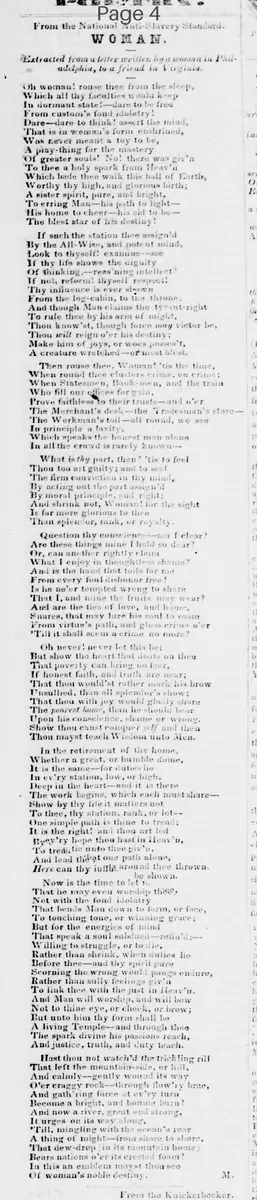
From the National Anti-Slavery Standard.
WOMAN.
Extracted from a letter written by a woman in Philadelphia, to a friend in Virginia.
Oh woman! rouse thee from the sleep,
Which all thy faculties would keep
In dormant state!—dare to be free
From custom's fond idolatry!
Dare—dare to think! assert the mind,
That is in woman's form enshrined,
Was never meant a toy to be,
A play-thing for the mastery
Of greater souls! No: there was giv'n
To thee a holy spark from Heav'n
Which bade thee walk this ball of Earth,
Worthy thy high, and glorious birth;
A sister spirit, pure, and bright,
To erring Man—his path to light—
His home to cheer—his aid to be—
The blest star of his destiny:
If such the station thee assign'd
By the All-Wise, and potent mind,
Look to thyself! examine—see
If thy life shows the dignity
Of thinking.—reasoning intellect
If not, reform: thyself respect!
Thy influence is ever shown
From the log-cabin, to the throne.
And though Man claims the tyrant's right
To rule thee by his arm of might,
Thou know'st, though force may victor be.
Thou wilt reign o'er his destiny;
Make him of joys, or woes possest,
A creature wretched—or most blest.
Then rouse thee, Woman! 'tis the time,
When round thee clusters crime, on crime;
When Statesmen, Bank-men, and the train
Who fill our offices for gain,
Prove faithless to their trusts—and o'er
The Merchant's desk—the Tradesman's store—
The Workman's toil—all round, we see
In principle a knavery,
Which speaks the honest man alone
In all the crowd is rarely known—
What is thy part, then? 'tis to feel
Thou too art guilty; and to see!
The firm conviction in thy mind,
By acting out the part assign'd
By moral principle, and right;
And shrink not, Woman: for this sight
Is far more glorious to thee
Than splendor, rank, or royalty.
Question thy conscience—and 'tis clear?
Are these things mine I hold so dear'
Or, can another rightly claim
What I enjoy in thoughtless change?
And is the hand that toils for me
From every foul dishonor free?
Is he ne'er tempted wrong to share
That I, and mine the fruits may wear?
And are the ties of love, and home,
Snares, that may lure his soul to roam
From virtue's path, and bless crime o'er
Till it shall seem a crime no more?
Oh never—never let this be;
But show the heart that doats, on thee
That poverty can bring no fear,
If honest faith, and truth are near;
That thou would'st rather mark his brow
Unsullied, than all splendor's show;
That thou with joy would gladly share
The poorest home, than he should bear
Upon his conscience, shame or wrong.
Show thou canst conquer self and then
Thou mayst teach Wisdom unto Men.
In tho retirement of thy house,
Whether 't is great, or humble dome,
It is the might—for empires lie
In ev'ry nation, town, or tribe,
Deep in the heart—and it puts there
The work begun, which each must share—
Thou by thy life it matters not
To thee, thy station, rank, or lot—
One right path is thine to tread!:
It is the right: and thou art led
By ev'ry drop thou hast in Heav'n,
To tread, the unto thee giv'n,
And lead thy husband one path above.
More can thy influence, around thee thrown.
— be shown.
Now is the time to let it.
That he may even world this thief,
Not with the fond idolatry
"That humbles Man down to form, or face,
"To touching tone, or winning grace;
But for the energies of mind
"That speak a soul subdued—refin'd:—
Willing to struggle, or to die,
Rather than shrink, when duties lie
Before thee—and thy spirit pure
Scorning the wrong would pangs endure,
Rather than sully feelings giv'n
To link thee with the just in Heav'n.
And Man will worship, and will bow
Not to thine eye, or cheek, or brow;
But unto him thy form shall be
A living Temple—and through thee
The spirit divine his passions wards,
And justice, truth, and duty teach.
Hast thou not watch'd the trickling rill
That left the mountain-side, or hill,
And calmly—gently wound its way
O'er craggy rock—through flow'ry brae,
And gath'ring force at ev'ry turn
Become a bright, and bonnie burn?
And now a river, great and strong,
It urges on its way along,
"Till, mingling with the ocean's roar
A thing of might—from shore to shore,
That dew-drop in its mountain home
Bears nations o'er its crested foam
In this an emblem most thou see
Of woman's noble destiny.
M.
WOMAN.
Extracted from a letter written by a woman in Philadelphia, to a friend in Virginia.
Oh woman! rouse thee from the sleep,
Which all thy faculties would keep
In dormant state!—dare to be free
From custom's fond idolatry!
Dare—dare to think! assert the mind,
That is in woman's form enshrined,
Was never meant a toy to be,
A play-thing for the mastery
Of greater souls! No: there was giv'n
To thee a holy spark from Heav'n
Which bade thee walk this ball of Earth,
Worthy thy high, and glorious birth;
A sister spirit, pure, and bright,
To erring Man—his path to light—
His home to cheer—his aid to be—
The blest star of his destiny:
If such the station thee assign'd
By the All-Wise, and potent mind,
Look to thyself! examine—see
If thy life shows the dignity
Of thinking.—reasoning intellect
If not, reform: thyself respect!
Thy influence is ever shown
From the log-cabin, to the throne.
And though Man claims the tyrant's right
To rule thee by his arm of might,
Thou know'st, though force may victor be.
Thou wilt reign o'er his destiny;
Make him of joys, or woes possest,
A creature wretched—or most blest.
Then rouse thee, Woman! 'tis the time,
When round thee clusters crime, on crime;
When Statesmen, Bank-men, and the train
Who fill our offices for gain,
Prove faithless to their trusts—and o'er
The Merchant's desk—the Tradesman's store—
The Workman's toil—all round, we see
In principle a knavery,
Which speaks the honest man alone
In all the crowd is rarely known—
What is thy part, then? 'tis to feel
Thou too art guilty; and to see!
The firm conviction in thy mind,
By acting out the part assign'd
By moral principle, and right;
And shrink not, Woman: for this sight
Is far more glorious to thee
Than splendor, rank, or royalty.
Question thy conscience—and 'tis clear?
Are these things mine I hold so dear'
Or, can another rightly claim
What I enjoy in thoughtless change?
And is the hand that toils for me
From every foul dishonor free?
Is he ne'er tempted wrong to share
That I, and mine the fruits may wear?
And are the ties of love, and home,
Snares, that may lure his soul to roam
From virtue's path, and bless crime o'er
Till it shall seem a crime no more?
Oh never—never let this be;
But show the heart that doats, on thee
That poverty can bring no fear,
If honest faith, and truth are near;
That thou would'st rather mark his brow
Unsullied, than all splendor's show;
That thou with joy would gladly share
The poorest home, than he should bear
Upon his conscience, shame or wrong.
Show thou canst conquer self and then
Thou mayst teach Wisdom unto Men.
In tho retirement of thy house,
Whether 't is great, or humble dome,
It is the might—for empires lie
In ev'ry nation, town, or tribe,
Deep in the heart—and it puts there
The work begun, which each must share—
Thou by thy life it matters not
To thee, thy station, rank, or lot—
One right path is thine to tread!:
It is the right: and thou art led
By ev'ry drop thou hast in Heav'n,
To tread, the unto thee giv'n,
And lead thy husband one path above.
More can thy influence, around thee thrown.
— be shown.
Now is the time to let it.
That he may even world this thief,
Not with the fond idolatry
"That humbles Man down to form, or face,
"To touching tone, or winning grace;
But for the energies of mind
"That speak a soul subdued—refin'd:—
Willing to struggle, or to die,
Rather than shrink, when duties lie
Before thee—and thy spirit pure
Scorning the wrong would pangs endure,
Rather than sully feelings giv'n
To link thee with the just in Heav'n.
And Man will worship, and will bow
Not to thine eye, or cheek, or brow;
But unto him thy form shall be
A living Temple—and through thee
The spirit divine his passions wards,
And justice, truth, and duty teach.
Hast thou not watch'd the trickling rill
That left the mountain-side, or hill,
And calmly—gently wound its way
O'er craggy rock—through flow'ry brae,
And gath'ring force at ev'ry turn
Become a bright, and bonnie burn?
And now a river, great and strong,
It urges on its way along,
"Till, mingling with the ocean's roar
A thing of might—from shore to shore,
That dew-drop in its mountain home
Bears nations o'er its crested foam
In this an emblem most thou see
Of woman's noble destiny.
M.
What sub-type of article is it?
Ode
What themes does it cover?
Moral Virtue
Liberty Independence
Satire Society
What keywords are associated?
Woman Empowerment
Moral Reform
Social Corruption
Honesty Virtue
Influence Destiny
What entities or persons were involved?
M.
Poem Details
Title
Woman.
Author
M.
Subject
Urging Women To Moral Action Amid Societal Corruption
Form / Style
Rhymed Couplets
Key Lines
Oh Woman! Rouse Thee From The Sleep,
Dare—Dare To Think! Assert The Mind,
Then Rouse Thee, Woman! 'Tis The Time,
Show Thou Canst Conquer Self And Then
In This An Emblem Most Thou See
Of Woman's Noble Destiny.