Thank you for visiting SNEWPapers!
Sign up free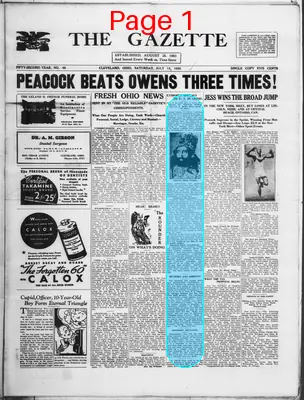
The Gazette
Cleveland, Cuyahoga County, Ohio
What is this article about?
Ethiopia delivered a five-page note to U.S. charge d'affaires William Perry George outlining the Italo-Ethiopian controversy and asserting Italy's warlike intentions aimed at conquest, citing massing of men and munitions in Italy's African colonies threatening Ethiopia's independence. The note reiterated Emperor Haile Selassie's determination to defend independence by legal means without slackening peaceful settlement efforts. Delivery came shortly after the Emperor's statement insisting Ethiopia did not want war but would do its duty if attacked. Under the Kellogg-Briand Pact signed Aug. 27, 1928, signatories including the U.S. and Italy renounced war as national policy and agreed to settle disputes by pacific means.
Merged-components note: Image bounding box is embedded within the foreign news text bounding box and sequential reading order; image relates to Ethiopia-Italy crisis.
Clipping

OCR Quality
Full Text
This is Event 1 of 2. The full text below covers all events in this component.
TO U. S. IN CRISIS.
Asks It to Find Way to Force Italy
Observe
the
American
Kellogg
Pact-U. S. Backs Down From
its Own.
Addis Ababa, N. Africa.-Ethiopia
chose America's Independence Day to
ask the U. S. to back up its American
(Kellogg) pact or treaty and warn
Italy to observe her obligations under
the Kellogg Pact, by which she re-
nounced war as an instrument of na-
tional policy. A five-page note de-
livered to William Perry George,
U. S. charge d'affaires here, outlined
the development of the Italo-Ethi-
opian
controversy and reasserted
Emperor Haile Selassie,
Ethiopia's contention that Italy has
warlike intentions aimed at the con-
quest of the African empire.
The
massing of men and munitions in
Italy's African colonies. the note con-
tended, indicates that Ethiopia's in-
dependence is threatened.
Reiterates His Decision.
Emperor Haile Selassie's oft-ex-
pressed determination to defend the
political independence of his country
by all legal means, without slacken-
ing efforts toward peaceful settle-
ment of issues involved. was reiter-
ated in the communication.
Under the Kellogg-Briand pact, or
treaty. properly called "the general
pact for the renunciation of war." the
United States, Germany. Belgium,
France, Great Britain and her do-
minions, Ireland, Italy. Japan, Po-
land and Czechoslavakia renounced
war
as
an
instrument of national
policy
and
agreed
that
among them should be settled by pa-
cific means.
It was signed at Paris,
Aug. 27. 1928.
Delivery of the note to the Ameri-
can representative came shortly after
the Emperor, in a statement, insisted
that Ethiopia did not want war with
Italy but would do her duty in case
of armed conflict.
Rumored Battle Unconfirmed.
A
rumored battle between Italian
and Ethiopian
frontier forces
in
which Italian casualties
were
re-
ported to have been heavy. remained
without
confirmation.
Authorities
here revealed that Ethiopia was hav-
ing some trouble getting munitions,
Belgium assertedly having embar-
goed
7,500,000
cartridges
after
2,000,000 of an
order for 10,000,
000 had been shipped.
However,
Abyssinia will be ready, Sept. 1, after
which Italy threatens to start the
war.
The rainy season usually ends
then.
MUTINIES AND ARRESTS!
The mutinies and rioting which
have accompanied mobilization of
950,000 Italians for military service,
have not been ended by the drastic
measures of suppression used by the
Fascist government, according to re-
ports in the N. Y. Post, N. Y. Times,
the Chicago Tribune and The New
York Daily Worker. The resistance
is particularly strong against service
in the African campaign. Italian
laborers, poor peasants, and reserv-
ists are refusing to enlist. "In farm-
ing regions outside of Florence no
volunteers enlisted." In Naples a
large number of young men who had
enlisted decamped as soon as they
received their 500 lire. Some were
caught and are now in dungeons.
(Crusader News, 6-8-35). These ar-
rests and mutinies are of such a seri-
ous nature that the "German propa-
ganda office has issued instructions
to all papers to make no mention of
mutinies during Italian mobiliza-
tion."
(N. Y. Post, 6-17-35.)
SOUTHERN BRUTALITY.
Montgomery. Ala.-On his right
cheek, between his ear and his nose,
Roy Wright, youngest of the Scotts-
boro boy-victims, but one, bears a
scar larger than a vaccination mark.
It is a reminder of the day--now
more than four years ago-when he,
with the other Scottsboro boys, was
taken off a freight train at Paint
Rock, Alabama, by an armed posse.
Just before he was locked in the
Paint Rock jail, one of the men jab-
bed a bayonet thru his cheek.
The TMTM Club held its annual
picnic. Monday at Cedar Point. The
organization gave Mrs. Evelyn Rob-
erson Brown a surprise shower.
What sub-type of article is it?
What keywords are associated?
What entities or persons were involved?
Where did it happen?
Foreign News Details
Primary Location
Addis Ababa, N. Africa
Event Date
America's Independence Day
Key Persons
Outcome
rumored battle between italian and ethiopian frontier forces with heavy italian casualties unconfirmed; ethiopia having trouble getting munitions from belgium; abyssinia will be ready sept. 1
Event Details
Ethiopia delivered a five-page note to U.S. charge d'affaires William Perry George outlining the Italo-Ethiopian controversy and asserting Italy's warlike intentions aimed at conquest, citing massing of men and munitions in Italy's African colonies threatening Ethiopia's independence. The note reiterated Emperor Haile Selassie's determination to defend independence by legal means without slackening peaceful settlement efforts. Delivery came shortly after the Emperor's statement insisting Ethiopia did not want war but would do its duty if attacked. Under the Kellogg-Briand Pact signed Aug. 27, 1928, signatories including the U.S. and Italy renounced war as national policy and agreed to settle disputes by pacific means.