Thank you for visiting SNEWPapers!
Sign up free
The New Hampshire Gazette And Historical Chronicle
Portsmouth, Greenland, Rockingham County, New Hampshire
What is this article about?
In Letter IX of 'Letters from a Farmer in Pennsylvania,' the author argues that the recent Act of Parliament, by raising revenue for defense, justice, and civil government without colonial consent, usurps the assemblies' essential authority, threatening liberty and enabling oppression through dependent judges and unchecked executive power.
Merged-components note: This is the continuation of 'Letters from a Farmer in Pennsylvania' across pages, indicated by 'see the last Page'. The content is a political opinion essay, better fitting 'editorial' than 'literary'.
Clippings
1 of 2
OCR Quality
Full Text
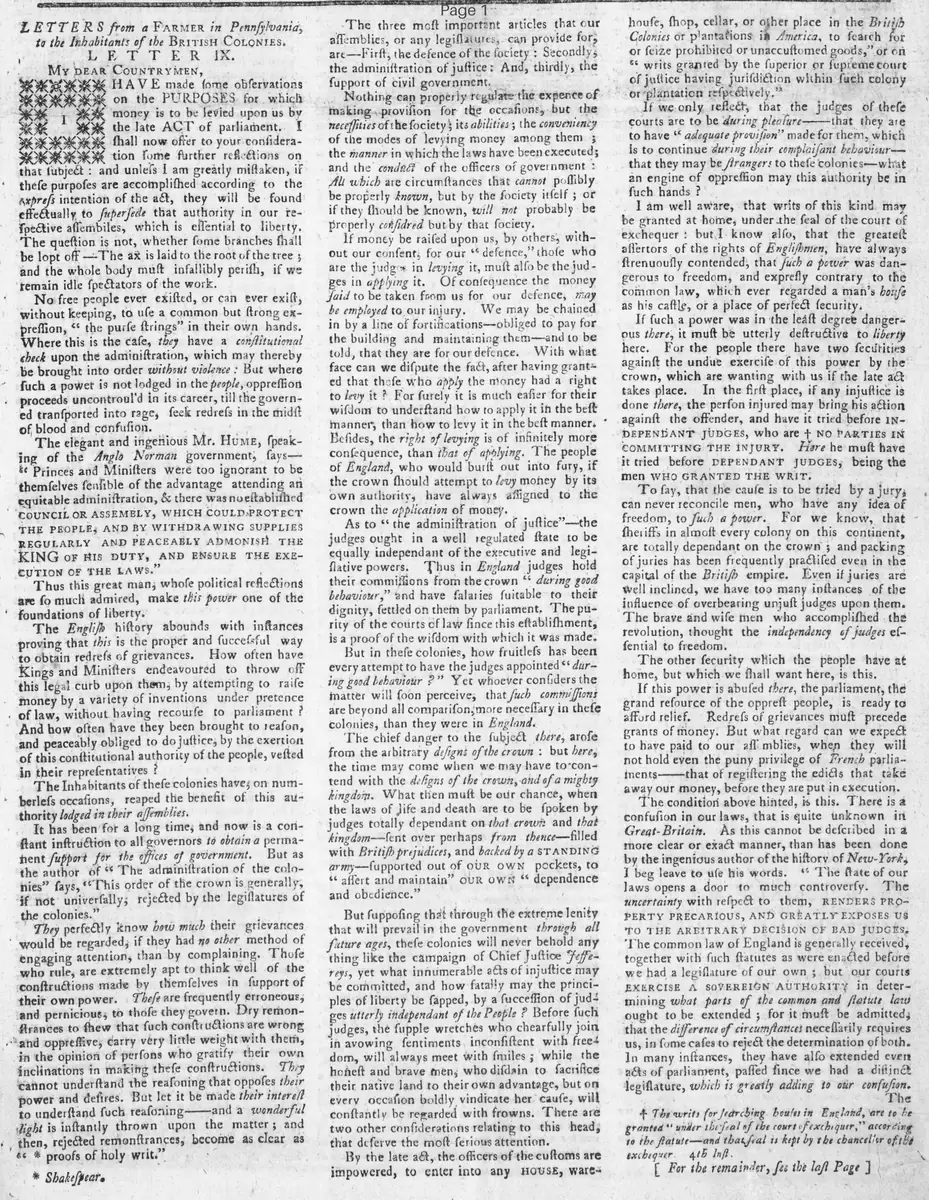
LETTER IX.
My Dear Countrymen,
I have made some observations on the purposes for which money is to be levied upon us by the late Act of parliament. I shall now offer to your consideration some further reflections on that subject: and unless I am greatly mistaken, if these purposes are accomplished according to the express intention of the Act, they will be found effectually to supersede that authority in our respective assemblies, which is essential to liberty.
The question is not, whether some branches shall be lopt off --The ax is laid to the root of the tree; and the whole body must infallibly perish, if we remain idle spectators of the work.
No free people ever existed, or can ever exist, without keeping, to use a common but strong expression, "the purse strings" in their own hands.
Where this is the case, they have a constitutional check upon the administration, which may thereby be brought into order without violence: But where such a power is not lodged in the people, oppression proceeds uncontroul'd in its career, till the governed transported into rage, seek redress in the midst of blood and confusion.
The elegant and ingenious Mr. HUME, speaking of the Anglo Norman government, says--
The Princes and Ministers were too ignorant to be themselves sensible of the advantage attending an equitable administration, & there was no established COUNCIL OR ASSEMBLY, WHICH COULD PROTECT THE PEOPLE; AND BY WITHDRAWING SUPPLIES REGULARLY AND PEACEABLY ADMONISH THE KING OF HIS DUTY, AND ENSURE THE EXECUTION OF THE LAWS.
Thus this great man; whose political reflections are so much admired, make this power one of the foundations of liberty.
The English history abounds with instances proving that this is the proper and successful way to obtain redress of grievances. How often have Kings and Ministers endeavoured to throw off this legal curb upon them; by attempting to raise money by a variety of inventions under pretence of law, without having recourse to parliament?
And how often have they been brought to reason, and peaceably obliged to do justice, by the exertion of this constitutional authority of the people, vested in their representatives
The Inhabitants of these colonies have; on numberless occasions, reaped the benefit of this authority lodged in their assemblies.
It has been for a long time, and now is a constant instruction to all governors to obtain a permanent support for the offices of government. But as the author of "The administration of the colonies" says, "This order of the crown is generally, if not universally; rejected by the legislatures of the colonies."
They perfectly know how much their grievances would be regarded; if they had no other method of engaging attention, than by complaining. Those who rule, are extremely apt to think well of the constructions made by themselves in support of their own power. These are frequently erroneous, and pernicious, to those they govern. Dry remonstrances to shew that such constructions are wrong and oppressive, carry very little weight with them, in the opinion of persons who gratify their own inclinations in making these constructions. They cannot understand the reasoning that opposes their power and desires. But let it be made their interest to understand such reasoning---and a wonderful light is instantly thrown upon the matter; and then, rejected remonstrances, become as clear as proofs of holy writ."
Shakespeare.
The three most important articles that our assemblies, or any legislatures, can provide for, are--First. the defence of the society : Secondly the administration of justice: And, thirdly, the support of civil government.
Nothing can properly regulate the expence of making provision for the occasions, but the necessities of the society: its abilities ; the conveniency of the modes of levying money among them ; the manner in which the laws have been executed; and the conduct of the officers of government : All which are circumstances that cannot possibly be properly known, but by the society itself ; or if they should be known, will not probably be properly considered but by that society.
If money be raised upon us, by others, without our consent. for our "defence,"those who are the judges in levying it, must also be the judges in applying it. Of consequence the money said to be taken from us for our defence, may be employed to our injury. We may be chained in by a line of fortifications--obliged to pay for the building and maintaining them--and to be told, that they are for our defence. With what face can we dispute the fact, after having granted that those who apply the money had a right to levy it ? For surely it is much easier for their wisdom to understand how to apply it in the best manner, than how to levy it in the best manner.
Besides, the right of levying is of infinitely more consequence, than that of applying. The people of England, who would burst out into fury, if the crown should attempt to levy money by its own authority, have always assigned to the crown the application of money.
As to " the administration of justice"the judges ought in a well regulated state to be equally independent of the executive and legislative powers. Thus in England judges hold their commissions from the crown "during good behaviour," and have salaries suitable to their dignity, settled on them by parliament. The purity of the courts of law since this establishment, is a proof of the wisdom with which it was made.
But in these colonies, how fruitless has been every attempt to have the judges appointed "during good behaviour ?" Yet whoever considers the matter will soon perceive; that such commissions are beyond all comparison more necessary in these colonies, than they were in England.
The chief danger to the subject there, arose from the arbitrary designs of the crown : but here, the time may come when we may have to contend with the designs of the crown, and of a mighty kingdom. What then must be our chance, when the laws of life and death are to be spoken by judges totally dependant on that crown and that kingdom--sent over perhaps from thence--filled with British prejudices, and backed by a STANDING army--supported out of our own pockets, to "assert and maintain" our own "dependence and obedience."
But supposing that through the extreme lenity that will prevail in the government through all future ages, these colonies will never behold any thing like the campaign of Chief Justice Jeffreys, yet what innumerable acts of injustice may be committed, and how fatally may the principles of liberty be sapped, by a succession of judges utterly independent of the People ? Before such judges, the supple wretches who cheerfully join in avowing sentiments inconsistent with freedom, will always meet with smiles : while the honest and brave men, who disdain to sacrifice their native land to their own advantage, but on every occasion boldly vindicate her cause, will constantly be regarded with frowns. There are two other considerations relating to this head. that deserve the most serious attention.
By the late Act, the officers of the customs are empowered, to enter into any House, warehouse, shop, cellar, or other place in the British Colonies or plantations in America, to search for or seize prohibited or uncustomed goods," or on writs granted by the superior or supreme court of justice having jurisdiction within such colony or plantation respectively."
If we only reflect, that the judges of these courts are to be during pleasure---that they are to have " adequate provision" made for them, which is to continue during their complaisant behaviour-- that they may be strangers to these colonies---what an engine of oppression may this authority be in such hands ?
I am well aware, that writs of this kind may be granted at home, under the seal of the court of exchequer : but I know also, that the greatest assertors of the rights of Englishmen, have always strenuously contended, that such a power was dangerous to freedom, and expressly contrary to the common law, which ever regarded a man's house as his castle, or a place of perfect security.
If such a power was in the least degree dangerous there, it must be utterly destructive to liberty here. For the people there have two securities against the undue exercise of this power by the crown, which are wanting with us if the late Act takes place. In the first place, if any injustice is done there, the person injured may bring his action against the offender, and have it tried before INDEPENDANT JUDGES, WhO are NO PARTIES IN COMMITTING THE INJURY. Here he must have it tried before DEPENDANT JUDGES, being the MEN WHO GRANTED THE WRIT.
To say, that the cause is to be tried by a jury can never reconcile men, who have any idea of freedom, to Such a power. For we know, that sheriffs in almost every colony on this continent, are totally dependant on the crown ; and packing of juries has been frequently practised even in the capital of the British empire. Even if juries are well inclined, we have too many instances of the influence of overbearing unjust judges upon them.
The brave and wise men who accomplished the revolution, thought the independency of judges essential to freedom.
The other security which the people have at home, but which we shall want here, is this. If this power is abused there, the parliament, the grand resource of the oppressed people, is ready to afford relief. Redress of grievances must precede grants of money. But what regard can we expect to have paid to our assemblies, when they will not hold even the puny privilege of French parliaments--that of registering the edicts that take away our money, before they are put in execution.
The condition above hinted, is this. There is a confusion in our laws, that is quite unknown in Great-Britain. As this cannot be described in a more clear or exact manner, than has been done by the ingenious author of the history of New-York I beg leave to use his words. " The state of our laws opens a door to much controversy. The uncertainty with respect to them, RENDERS PROPERTY PRECARIOUS, AND GREATLY EXPOSES US TO THE ARBITRARY DECISION OF BAD JUDGES.
The common law of England is generally received, together with such statutes as were enacted before we had a legislature of our own ; but our courts EXERCISE A SOVEREIGN AUTHORITY in determining what parts of the common and statute law ought to be extended ; for it must be admitted that the difference of circumstances necessarily requires us, in some cases to reject the determination of both. In many instances, they have also extended even acts of parliament, passed since we had a distinct legislature, which is greatly adding to our confusion.
The writs for searching houses in England, are to be granted " under the seal of the court of exchequer." according to the statute-and that seal is kept by the chancellor of the exchequer. 4th Inst.
[ For the remainder, see the last Page ]
The practice of courts is less uncertain than the law. Some of the English rules are adopted, others rejected. Two things therefore seem to be ABSOLUTELY NECESSARY FOR THE PUBLIC SE-CURITY. First the passing an Act for settling the extent of the English laws. Secondly, that the courts ordain a general set of rules for the re-gulation of the practice.
How easy it will be under this "state of our laws" for an artful judge to act in the most ar-bitrary manner, and yet cover his conduct under specious pretences, and how difficult it will be for the injured people to obtain relief, may be readily perceived. We may take a voyage of 3000 miles to complain; and after the trouble and hazard we have undergone, we may be told, that the col-lection of the revenue & maintenance of the prero-gative, must not be discouraged--and if the misbe-haviour is so gross as to admit of no justification, it may be said, that it was an error in judgment only, arising from the confusion of our laws, and the zeal of the king's servants to do their duty.
If the commissions of judges are during the plea-sure of the crown, yet if their salaries are during the pleasure of the people, there will be some check upon their conduct.--Few men will consent to draw on themselves the hatred and contempt of those among whom they live, for the empty honour of being judges. It is the sordid love of gain, that tempts men to turn their backs on virtue, and pay their homage where they ought not.
As to the third particular, "the support of civil government" --in-- few words will be sufficient. Every man of the least understanding must know; that the executive power may be exercised in a manner so disagreeable and harassing to the peo-ple, that it is absolutely requisite, that they should be enabled by the gentlest method which human policy has yet been ingenious enough to invent, that is, by shutting their hands to "ADMONISH" (as Mr. HUME says) CERTAIN PERSONS "OF THEIR DUTY."
What shall we now think, when upon looking into the late Act we find the assemblies of these provinces,thereby stript of their authority ON THESE SEVERAL HEADS? The declared intention of the Act is "that a revenue should be raised in his Majesty's Dominions in America, for making a more certain & adequate provision FOR DEFRAY-ING THE CHARGE OF THE ADMINISTRATION OF JUSTICE, AND THE SUPPORT OF CIVIL GOVERN-MENT IN SUCH PROVINCES WHERE IT SHALL BE FOUND NECESSARY, AND TOWARDS FURTHER DEFRAYING THE EXPENCES OF DEFENDING,PRO-TECTING AND SECURING THE SAID DOMINIONS.
Let the reader pause here one moment& reflect- whether the colony in which he lives, has not made such "certain & adequate provision" for these pur-poses as is by the colony judged suitable to its abilities and all other circumstances. Then, let him reflect- whether if this Act takes place, money is not to be raised on that colony without its consent, to make a"provision" for these purposes, which it does not judge to be suitable to its abilities, and all other circum-stances. Lastly, let him reflect-- whether the peo-ple of that country are not in a state of the most abjeCt slavery, whose property may be taken from them under the notion of right when they have refused to give it.
For my part, I think I have good reason for vindicating the honour of the assemblies on this continent by publickly asserting, that they have made as "certain and adequate provisions" for the purposes above mentioned, as they ought to have made, and that it should not be presumed, that they will not do it hereafter. Why then should these most important trusts be wrested out of their hands? Why should they not now be permitted to enjoy that authority, which they have exercised from the first settlement of these colonies? Why should they be scandalized by this innovation, when their respective provinces are now, and will be for e-veral years labouring under loads of debt imposed on them, for the very purpose now spoken of? Why should all the inhabitants of these colonies be, with tie utmost indignity, treated as a herd of de-picable stupid wretches, so utterly void of com-mon sense that they will not even make "adequate provision" for the "administration of justice, and the support of civil government" among them, or for their own "defence" - though without such "provision" every people must inevitably be over-whelmed with anarchy and destruction? Is it po-ssible to form an idea of a slavery more compleat; more miserable, more disgraceful,than that ofa people,
where justice is administered, government exercised 5 a standing army maintained, at the expence of the people, and yet without the least dependence upon them? If we can find no relief from this infamous situation, let Mr.Grenville set his fertile fancy again at work, & as by one exertion of it he has stript us of our pro-perty and liberty, let him by another deprive us of our understanding ; that, unconcious of what we have been or are, and ungoaded by tormenting re-flections, we may bow down our necks with all the stupid serenity of servitude, to any drudgery, which our lords & masters shall please to command.
When the charges of the "administration of justice," the "support of civil government," and the expences "of defending,protecting & securing" us, are provided for, I should be glad to know, upon what occasion the crown will ever call our assemblies together. ' Some few of them may meet of their own accord, by virtue of their charters. But what will they have to do, when they are met? To what shadows will they be reduced? The men, whose deliberations heretofore had an influence on every matter relating to the liberty and happiness of themselves and their constituents, and whose authority in domestic affairs, at least. might well be compared to that of Roman ena-tors, will now find their deliberations of no more consequence than those of constables.--They may perhaps beallowed to make laws for the yoking of hogs or pounding of stray cattle. Their influence will hardly be permitted to extend (o high as the keeping roads in repair, as that business may be more properly executed by those, who receive the public cash.
One most memorable example in history is so applicable to the point now insisted on, that it will form a just conclusion ofthe observations that have been made.
Spain was once free, Their cortes resembled our parliaments, no money could be raised on the sub-ject, without their consent. One of their kings having received a grant from them, to maintain a war against the Moors, desired, that if the sum which they had given, should not be sufficient, he might be allowed, for that emergency only, to raise more money without assembling the cortes.- The request was violently opposed by the best and wisest men in the assembly. It was however com-plied with by the votes of a majority ; and this single concession was a precedent for other conces-sions of the like kind, until at last, the crown obtained a general power of raising money, in cases of necessity. From that period the cortes ceased to be useful= the people ceased to be free.
" Venienti occurrite morbo."
Oppose a disease at its beginning. A F A R M E R.
What sub-type of article is it?
What keywords are associated?
What entities or persons were involved?
Editorial Details
Primary Topic
Opposition To The Late Act Of Parliament Usurping Colonial Assemblies' Authority Over Revenue For Defense, Justice, And Government
Stance / Tone
Strongly Anti Parliamentary Taxation And Pro Colonial Liberty
Key Figures
Key Arguments
- control of purse strings is essential to liberty and checks administration without violence.
- parliament's act supersedes assemblies' authority in funding defense, justice, and civil government.
- dependent judges enable oppression, especially with search writs and uncertain laws in colonies.
- colonial assemblies have adequately provided for necessary expenses and should retain this power.
- historical examples from england and spain show loss of financial control leads to loss of freedom.
- taxation without consent reduces assemblies to irrelevance, treating colonists as slaves.