Thank you for visiting SNEWPapers!
Sign up free
Editorial
March 17, 1821
Winchester Republican
Winchester, Virginia
What is this article about?
An editorial defends the use of caucuses for nominating candidates, arguing they promote rotation in office, fairness in elections, and prevent long-term incumbency by wealth and influence, contrasting with practices in northern states and criticizing individual announcements.
Merged-components note: Continuation of the editorial on caucuses and rotation in office.
Clipping
OCR Quality
98%
Excellent
Full Text
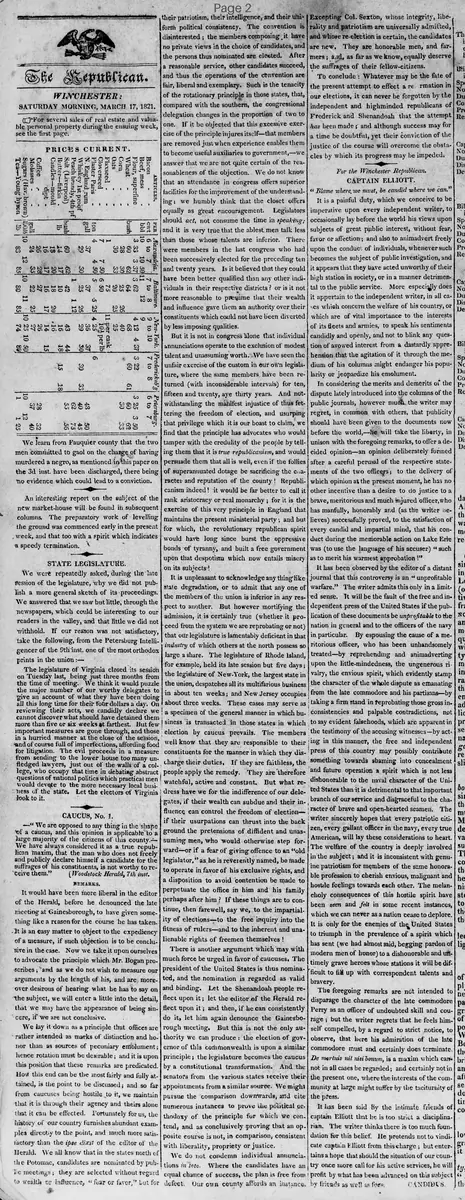
CAUCUS, No. 1.
"We are opposed to any thing in the shape of a caucus, and this opinion is applicable to a large majority of the citizens of this county. We have always considered it as a true republican maxim, that the man who does not freely and publicly declare himself a candidate for the suffrages of his constituents, is not worthy to receive them."
[Woodstock Herald, 7th inst.]
REMARKS.
It would have been more liberal in the editor of the Herald, before he denounced the late meeting at Gainesborough, to have given something like a reason for the course he has taken. It is an easy matter to object to the expediency of a measure, if such objection is to be conclusive in the case. Now we take it upon ourselves to advocate the principle which Mr. Bogan proscribes; and as we do not wish to measure our arguments by the length of his, and are moreover desirous of hearing what he has to say on the subject, we will enter a little into the detail, that we may have the appearance of being sincere, if we are not conclusive.
We lay it down as a principle that offices are rather intended as marks of distinction and honor than as sources of pecuniary emolument; hence rotation must be desirable; and it is upon this position that these remarks are predicated. How this end can be the most fairly and fully attained, is the point to be discussed; and so far from caucuses being hostile to it, we maintain that it is through their agency and theirs alone that it can be effected. Fortunately for us, the history of our country furnishes abundant examples directly to the point, and much more satisfactory than the ipse dixit of the editor of the Herald. We all know that in the states north of the Potomac, candidates are nominated by public meetings; they are selected without regard to wealth or influence, "fear or favor," but for their patriotism, their intelligence and their uniform political consistency. The convention is disinterested; the members composing it have no private views in the choice of candidates, and the persons thus nominated are elected. After a reasonable service, other candidates succeed, and thus the operations of the convention are fair, liberal and exemplary. Such is the tenacity of the rotationary principle in those states, that, compared with the southern, the congressional delegation changes in the proportion of two to one. If it be objected that this excessive exercise of the principle injures itself-that members are removed just when experience enables them to become useful auxiliaries to government,-we answer that we are not quite certain of the reasonableness of the objection. We do not know that an attendance in congress offers superior facilities for the improvement of the understanding: we humbly think that the closet offers equally as great encouragement. Legislators should act, not consume the time in speaking; and it is very true that the ablest men talk less than those whose talents are inferior. There were members in the last congress who had been successively elected for the preceding ten and twenty years. Is it believed that they could have been better qualified than any other individuals in their respective districts? or is it not more reasonable to presume that their wealth and influence gave them an authority over their constituents which could not have been diverted by less imposing qualities.
But it is not in congress alone that individual annunciations operate to the exclusion of modest talent and unassuming worth. We have seen the unfair exercise of the custom in our own legislature, where the same members have been returned (with inconsiderable intervals) for ten, fifteen and twenty, aye thirty years. And notwithstanding the manifest injustice of thus fettering the freedom of election, and usurping that privilege which it is our boast to claim, we find that the principle has advocates who would tamper with the credulity of the people by telling them that it is true republicanism, and would persuade them that all is well, even if the follies of superannuated dotage be sacrificing the character and reputation of the county! Republicanism indeed! it would be far better to call it rank aristocracy or real monarchy; for it is the exercise of this very principle in England that maintains the present ministerial party; and but for which, the revolutionary republican spirit would have long since burst the oppressive bonds of tyranny, and built a free government upon that despotism which now entails misery on its subjects!
It is unpleasant to acknowledge any thing like state degradation, or to admit that any one of the members of the union is inferior in any respect to another. But however mortifying the admission, it is certainly true (whether it proceed from the system we are reprobating or not) that our legislature is lamentably deficient in that industry of which others at the north possess so large a share. The legislature of Rhode Island, for example, held its late session but five days; the legislature of New-York, the largest state in the union, despatches all its multifarious business in about ten weeks; and New Jersey occupies about three weeks. These cases may serve as a specimen of the general manner in which business is transacted in those states in which election by caucus prevails. The members well know that they are responsible to their constituents for the manner in which they discharge their duties. If they are faithless, the people apply the remedy. They are therefore watchful, active and constant. But what redress have we for the indifference of our delegates, if their wealth can subdue and their influence can control the freedom of election- if their usurpations can thrust into the back ground the pretensions of diffident and unassuming men, who would otherwise step forward -or if a fear of giving offence to an "old legislator, " as he is reverently named, be made to operate in favor of his exclusive rights, and a disposition to avoid contention be made to perpetuate the office in him and his family perhaps after him ? If these things are to continue, then farewell, say we, to the impartiality of elections-to the free inquiry into the fitness of rulers-and to the inherent and inalienable rights of freemen themselves !
There is another argument which may with much force be urged in favor of caucuses. The president of the United States is thus nominated, and the nomination is regarded as valid and binding. Let the Shenandoah people reflect upon it; let the editor of the Herald reflect upon it; and then, if he can consistently do it, let him again denounce the Gainesborough meeting. But this is not the only authority we can produce: the election of governor of this commonwealth is upon a similar principle; the legislature becomes the caucus by a constitutional transformation. And the senators from the various states receive their appointments from a similar source. We might pursue the comparison downwards, and cite numerous instances to prove the political orthodoxy of the principle for which we contend, and as conclusively proving that an opposite course is not, in comparison, consistent with liberality, propriety or justice.
We do not condemn individual announcements in toto. Where the candidates have an equal chance of success, the plan is free from defect. Our own county affords an instance.
Excepting Col. Sexton, whose integrity, liberality and patriotism are universally admitted, and whose re-election is certain, the candidates are new. They are honorable men, and farmers; and, as far as we know, equally deserve the suffrages of their fellow-citizens.
To conclude : Whatever may be the fate of the present attempt to effect a reformation in our elections, it can never be forgotten by the independent and highminded republicans of Frederick and Shenandoah that the attempt has been made; and although success may for a time be doubtful, yet their conviction of the justice of the course will overcome the obstacles by which its progress may be impeded.
"We are opposed to any thing in the shape of a caucus, and this opinion is applicable to a large majority of the citizens of this county. We have always considered it as a true republican maxim, that the man who does not freely and publicly declare himself a candidate for the suffrages of his constituents, is not worthy to receive them."
[Woodstock Herald, 7th inst.]
REMARKS.
It would have been more liberal in the editor of the Herald, before he denounced the late meeting at Gainesborough, to have given something like a reason for the course he has taken. It is an easy matter to object to the expediency of a measure, if such objection is to be conclusive in the case. Now we take it upon ourselves to advocate the principle which Mr. Bogan proscribes; and as we do not wish to measure our arguments by the length of his, and are moreover desirous of hearing what he has to say on the subject, we will enter a little into the detail, that we may have the appearance of being sincere, if we are not conclusive.
We lay it down as a principle that offices are rather intended as marks of distinction and honor than as sources of pecuniary emolument; hence rotation must be desirable; and it is upon this position that these remarks are predicated. How this end can be the most fairly and fully attained, is the point to be discussed; and so far from caucuses being hostile to it, we maintain that it is through their agency and theirs alone that it can be effected. Fortunately for us, the history of our country furnishes abundant examples directly to the point, and much more satisfactory than the ipse dixit of the editor of the Herald. We all know that in the states north of the Potomac, candidates are nominated by public meetings; they are selected without regard to wealth or influence, "fear or favor," but for their patriotism, their intelligence and their uniform political consistency. The convention is disinterested; the members composing it have no private views in the choice of candidates, and the persons thus nominated are elected. After a reasonable service, other candidates succeed, and thus the operations of the convention are fair, liberal and exemplary. Such is the tenacity of the rotationary principle in those states, that, compared with the southern, the congressional delegation changes in the proportion of two to one. If it be objected that this excessive exercise of the principle injures itself-that members are removed just when experience enables them to become useful auxiliaries to government,-we answer that we are not quite certain of the reasonableness of the objection. We do not know that an attendance in congress offers superior facilities for the improvement of the understanding: we humbly think that the closet offers equally as great encouragement. Legislators should act, not consume the time in speaking; and it is very true that the ablest men talk less than those whose talents are inferior. There were members in the last congress who had been successively elected for the preceding ten and twenty years. Is it believed that they could have been better qualified than any other individuals in their respective districts? or is it not more reasonable to presume that their wealth and influence gave them an authority over their constituents which could not have been diverted by less imposing qualities.
But it is not in congress alone that individual annunciations operate to the exclusion of modest talent and unassuming worth. We have seen the unfair exercise of the custom in our own legislature, where the same members have been returned (with inconsiderable intervals) for ten, fifteen and twenty, aye thirty years. And notwithstanding the manifest injustice of thus fettering the freedom of election, and usurping that privilege which it is our boast to claim, we find that the principle has advocates who would tamper with the credulity of the people by telling them that it is true republicanism, and would persuade them that all is well, even if the follies of superannuated dotage be sacrificing the character and reputation of the county! Republicanism indeed! it would be far better to call it rank aristocracy or real monarchy; for it is the exercise of this very principle in England that maintains the present ministerial party; and but for which, the revolutionary republican spirit would have long since burst the oppressive bonds of tyranny, and built a free government upon that despotism which now entails misery on its subjects!
It is unpleasant to acknowledge any thing like state degradation, or to admit that any one of the members of the union is inferior in any respect to another. But however mortifying the admission, it is certainly true (whether it proceed from the system we are reprobating or not) that our legislature is lamentably deficient in that industry of which others at the north possess so large a share. The legislature of Rhode Island, for example, held its late session but five days; the legislature of New-York, the largest state in the union, despatches all its multifarious business in about ten weeks; and New Jersey occupies about three weeks. These cases may serve as a specimen of the general manner in which business is transacted in those states in which election by caucus prevails. The members well know that they are responsible to their constituents for the manner in which they discharge their duties. If they are faithless, the people apply the remedy. They are therefore watchful, active and constant. But what redress have we for the indifference of our delegates, if their wealth can subdue and their influence can control the freedom of election- if their usurpations can thrust into the back ground the pretensions of diffident and unassuming men, who would otherwise step forward -or if a fear of giving offence to an "old legislator, " as he is reverently named, be made to operate in favor of his exclusive rights, and a disposition to avoid contention be made to perpetuate the office in him and his family perhaps after him ? If these things are to continue, then farewell, say we, to the impartiality of elections-to the free inquiry into the fitness of rulers-and to the inherent and inalienable rights of freemen themselves !
There is another argument which may with much force be urged in favor of caucuses. The president of the United States is thus nominated, and the nomination is regarded as valid and binding. Let the Shenandoah people reflect upon it; let the editor of the Herald reflect upon it; and then, if he can consistently do it, let him again denounce the Gainesborough meeting. But this is not the only authority we can produce: the election of governor of this commonwealth is upon a similar principle; the legislature becomes the caucus by a constitutional transformation. And the senators from the various states receive their appointments from a similar source. We might pursue the comparison downwards, and cite numerous instances to prove the political orthodoxy of the principle for which we contend, and as conclusively proving that an opposite course is not, in comparison, consistent with liberality, propriety or justice.
We do not condemn individual announcements in toto. Where the candidates have an equal chance of success, the plan is free from defect. Our own county affords an instance.
Excepting Col. Sexton, whose integrity, liberality and patriotism are universally admitted, and whose re-election is certain, the candidates are new. They are honorable men, and farmers; and, as far as we know, equally deserve the suffrages of their fellow-citizens.
To conclude : Whatever may be the fate of the present attempt to effect a reformation in our elections, it can never be forgotten by the independent and highminded republicans of Frederick and Shenandoah that the attempt has been made; and although success may for a time be doubtful, yet their conviction of the justice of the course will overcome the obstacles by which its progress may be impeded.
What sub-type of article is it?
Partisan Politics
Suffrage
What keywords are associated?
Caucuses
Rotation In Office
Elections
Political Nominations
Incumbency
Electoral Reform
Northern States
Southern Politics
What entities or persons were involved?
Woodstock Herald
Mr. Bogan
Gainesborough Meeting
Col. Sexton
Shenandoah People
Rhode Island Legislature
New York Legislature
New Jersey Legislature
Editorial Details
Primary Topic
Defense Of Caucuses For Promoting Rotation In Office And Fair Elections
Stance / Tone
Advocacy For Caucuses Against Individual Candidate Announcements
Key Figures
Woodstock Herald
Mr. Bogan
Gainesborough Meeting
Col. Sexton
Shenandoah People
Rhode Island Legislature
New York Legislature
New Jersey Legislature
Key Arguments
Offices Are Honors, Not Emoluments, So Rotation Is Desirable.
Caucuses Ensure Fair Selection Based On Merit, Not Wealth Or Influence.
Northern States Use Caucuses, Leading To Higher Rotation Rates (2:1 Vs. South).
Long Term Incumbents In South Due To Wealth And Influence, Not Superior Qualification.
Southern Legislatures Inefficient Compared To Northern Ones Using Caucuses.
Caucuses Used For Nominating President, Governors, And Senators.
Individual Announcements Exclude Modest Talent And Perpetuate Aristocracy.
Local Example: Equal New Candidates Except Col. Sexton.