Thank you for visiting SNEWPapers!
Sign up free
Trainman News
Indianapolis, Marion County, Indiana
What is this article about?
Continuation of congressional hearing on bills to repeal the dual payment prohibition in the Railroad Retirement Act, which reduces annuities for retirees also receiving social security. Testimonies from reps like Withrow, Van Zandt, and Poulson highlight injustices to 33,000 affected workers, including Pacific Electric employees and joint staff. Opponents from Railroad Retirement Board argue against repeal due to costs.
Clipping
OCR Quality
Full Text
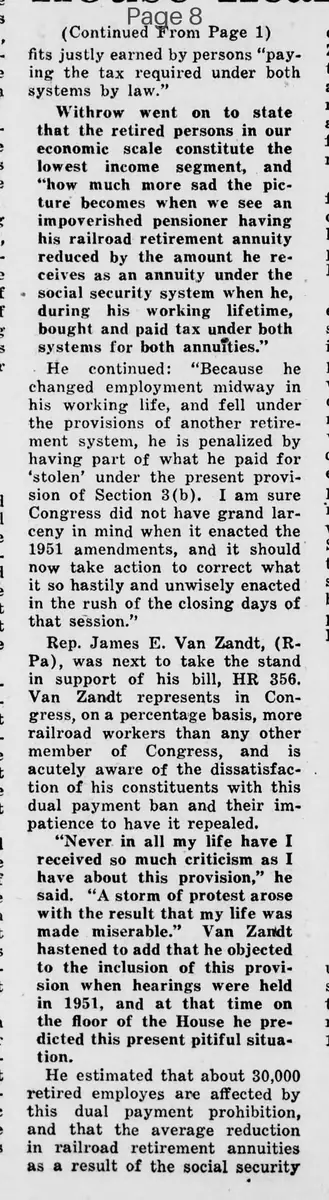
fits justly earned by persons "paying the tax required under both systems by law."
Withrow went on to state that the retired persons in our economic scale constitute the lowest income segment, and "how much more sad the picture becomes when we see an impoverished pensioner having his railroad retirement annuity reduced by the amount he receives as an annuity under the social security system when he, during his working lifetime, bought and paid tax under both systems for both annuities."
He continued: "Because he changed employment midway in his working life, and fell under the provisions of another retirement system, he is penalized by having part of what he paid for 'stolen' under the present provision of Section 3(b). I am sure Congress did not have grand larceny in mind when it enacted the 1951 amendments, and it should now take action to correct what it so hastily and unwisely enacted in the rush of the closing days of that session."
Rep. James E. Van Zandt, (R-Pa), was next to take the stand in support of his bill, HR 356.
Van Zandt represents in Congress, on a percentage basis, more railroad workers than any other member of Congress, and is acutely aware of the dissatisfaction of his constituents with this dual payment ban and their impatience to have it repealed.
"Never in all my life have I received so much criticism as I have about this provision," he said. "A storm of protest arose with the result that my life was made miserable."
Van Zandt hastened to add that he objected to the inclusion of this provision when hearings were held in 1951, and at that time on the floor of the House he predicted this present pitiful situation.
He estimated that about 30,000 retired employes are affected by this dual payment prohibition, and that the average reduction in railroad retirement annuities as a result of the social security offset is between $40-50.
Van Zandt's bill, while similar in nature to the other bills, has the additional feature of making the repayment of such reductions in annuities retroactive to the effective date of the 1951 amendments.
Rep. Norris Poulson (R-Calif), forcefully brought the attention of committee members to a problem confronting over half the employes of the Pacific Electric Railway.
Having just recently been elected Mayor of Los Angeles, he stated he has a sincere interest in the welfare of the 2,715 employes who will lose their jobs when the Pacific Electric Railway disposes of its passenger business. In the future that business will be handled by an intra-state common carrier, resulting in these employes being removed from the provisions of the Railroad Retirement Act and being forced to work under the provisions of the Social Security Act, if they continue their jobs with the intra-state carrier. These persons will be directly affected by the dual payment provision of the present Railroad Retirement Act.
Mr. Poulson stated: "When it comes time to take their pension, under the present law they will have their railroad retirement reduced by an amount equal to social security. Many of these employes are old and have been in the service of the Pacific Electric for many years, but will not be able to retain jobs with that carrier. Through no fault of their own, they will be forced into a condition of having their railroad retirement reduced when they reach retirement age."
He furnished the following figures to illustrate how many persons are affected by this iniquitous provision on just one railroad:
1,300 trainmen and motor coach operators
850 office employes
220 carmen
265 machinists
40 electricians
20 sheet metal workers
4 blacksmiths
16 laborers
Also brought out in testimony before the committee was the burden imposed on so-called "joint" employes; that is. railroad employes such as telegraphers and operators, who, especially at smaller locations, also serve as Western Union telegraph operators. Because of the dual nature of their employment, working for a railroad company and the telegraph company, they fall under both the railroad retirement and social security systems.
National Legislative Representative Harry See relates that all over the country thousands of such "joint" employes must, as a forced condition of employment, through no choice of their own, fall under the dual-payment prohibition of the present law, and face the dismal prospect of having their railroad retirement annuities reduced by the amount they will be entitled to receive as benefits under the social security system.
"Without even changing jobs in their lifetime," See states, "these employes have food taken from their mouths by this 'Frankenstein' provision of the law."
Notwithstanding the rank injustice this provision of the Act has perpetrated for 33,000 retired railroad employes, representatives of the Railroad Retirement Board and the Association of American Railroads cold-bloodedly pleaded for the retention of this freak provision in the Act. Walter Matscheck, Director of Research, testified for the Railroad Retirement Board, and Carter Fort, presented testimony for the Association of American Railroads.
Endless pages of testimony were read and a maze of figures offered in an attempt to convince committee members that nothing should be done to correct this injustice. Both witnesses admitted that approximately 33,000 retired persons were being deprived of their full earned annuities because of this dual payment prohibition. They centered their arguments for maintaining the status quo on the fact that this provision was already in the law, and to correct it now would cost some money, and by the year 2000 would cost a lot of money.
Startled by the callous attitude and complete apathy of these gentlemen for the thousands of persons who suffer because of this "legalized robbery," committee members could not refrain from expressing their instant disagreement with their position.
Rep. John Bell Williams, (D-Miss), stated the House of Representatives in 1951 had to "swallow this provision in order to get any retirement legislation at all."
Rep. Carl Hinshaw (R-Calif), after questioning Mr. Matscheck carefully, declared, "It is an inequity of the first order; it is entirely the fault of the Congress in drafting the Act."
Rep. Joseph O'Hara (R-Minn), announced that he was very troubled that "32,000 persons were victims of the most peculiar situation" and that it has resulted in further hardships to them. He added: "I do not think we can say in fairness that the dual benefit provision should not be repealed."
Rep. Homer Thornberry (D-Tex). brought out the fact that in 1951 when Congress intended a 15 per cent increase in retirement annuities for all railroad pensioners, many of them did not receive it because of this dual payment prohibition.
Shaking his head in dismay following the insistence of Witness Carter Fort that the provision should not be repealed, he stated "once you've done a wrong, you have to continue to do wrong."
The untenable position taken by the opponents of this legislation caused Harry See to recall the old remark about the coward who will not turn back when first he discovers he is on the wrong track.
The Brotherhood and the other three transportation brotherhoods will be represented at the hearing by Murray W. Latimer, former chairman of the Railroad Retirement Board.
Mr. Latimer was about to testify before the Committee as TRAINMAN NEWS went to press.
What sub-type of article is it?
What themes does it cover?
What keywords are associated?
What entities or persons were involved?
Where did it happen?
Story Details
Key Persons
Location
U.S. House Of Representatives Committee Hearing
Event Date
1951 Amendments Context, Ongoing Hearing
Story Details
Congressional committee hears testimonies supporting bills to repeal the 1951 dual payment prohibition in Railroad Retirement Act, which offsets annuities against social security benefits, affecting 33,000 retirees. Representatives highlight injustices to workers like Pacific Electric employees and joint staff; opponents argue cost concerns despite admissions of inequity.