Thank you for visiting SNEWPapers!
Sign up free
Portland Gazette, And Maine Advertiser
Portland, Cumberland County, Maine
What is this article about?
A letter to Mr. Shirley defends Federalist views and George Washington's legacy against a pamphlet by John Adams critiquing Fisher Ames. It claims Jefferson and Democrats opposed Washington and the Constitution, accuses them of misleading claims to his support, and argues against war with England, favoring compromises like Jay's Treaty to preserve peace and interests.
Clipping
OCR Quality
Full Text
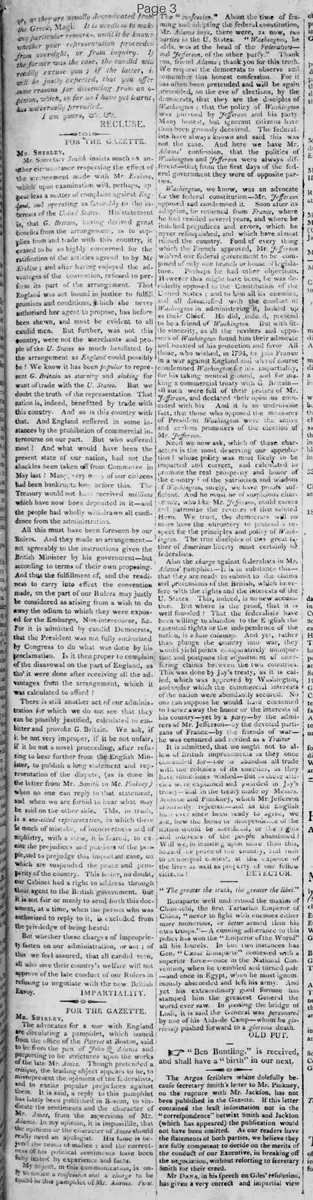
Mr. Shirley,
The advocates for a war with England are circulating a pamphlet, which issued from the office of the Patriot at Boston, said to be from the pen of John Adams and purporting to be strictures upon the works of the late Mr. Ames. Though pretended a critique, the leading object appears to be, to misrepresent the opinions of the federalists, and to excite popular prejudices against them. It is said, a reply to this pamphlet has lately been published in Boston, to vindicate the sentiments and the character of Mr. Ames, from the aspersions of Mr. Adams. In my opinion, it is impossible, that the opinions or the character of Ames should really need an apologist. His fame is beyond the reach of malice; and the correctness of his political sentiments have been fully tested by experience and facts.
My object, in this communication, is only to notice a confession and a charge to be found in this pamphlet of Mr. Adams. First.
The "confession." About the time of framing and adopting the federal constitution Mr. Adams says, there were, as now, two parties in the U. States. "Washington, he adds, was at the head of the Federalists—and Jefferson, of the other party." Thank you, friend Adams: thank you for this truth. We request the democrats to observe and remember this honest confession. For it has often been pretended and will be again pretended, on the eve of elections, by the democrats, that they are the disciples of Washington: that the policy of Washington was pursued by Jefferson and his party. Many honest, but ignorant citizens have thus been grossly deceived. The federalists have always known and said this was not the case. And here we have Mr. Adams' confession, that the politics of Washington and Jefferson were always different—that from the first days of the federal government they were of opposite parties.
Washington, we know, was an advocate for the federal constitution—Mr. Jefferson opposed and condemned it. Soon after its adoption, he returned from France, where he had resided several years, and where he imbibed prejudices and errors, which he never relinquished, and which have almost ruined the country. Fond of every thing which the French approved, Mr. Jefferson wished our federal government to be composed of only one branch or house of legislature. Perhaps he had other objections. However this might have been, he was decidedly opposed to the Constitution of the United States; and to him all its enemies, and all dissatisfied with the conduct of Washington in administering it, looked up as their Chief. He did, indeed, pretend to be a friend of Washington. But with little sincerity, as all the revilers and opposers of Washington found him their advocate and boasted of his protection and favor. All those, who wished, in 1794, to join France in a war against England and who of course condemned Washington for his impartiality, for his taking neutral ground, and for making a commercial treaty with G. Britain—all such were full of their praises of Mr. Jefferson, and declared their opinions coincided with his. And it is an undeniable fact, that those who opposed the measures of President Washington were the active and zealous promoters of the election of Mr. Jefferson.
Need we now ask, which of these characters is the most deserving our approbation? whose policy was most likely to be impartial and correct, and calculated to promote the real prosperity and honor of the country? Of the patriotism and wisdom of Washington, surely, we have proofs sufficient. And he must be of suspicious character, who like Mr. Jefferson, could caress and patronize the revilers of that sainted Hero. We trust, the democrats will no more have the effrontery to pretend a respect for the principles and policy of Washington. The true disciples of this great father of American liberty must certainly be federalists.
Also the charge against federalists in Mr. Adams' pamphlet—It is in substance this—that they are ready to submit to the claims and pretensions of the British, which interfere with the rights and the interests of the U. States. This, indeed, is no new accusation. But where is the proof, that it is well founded? That the federalists have been willing to abandon to the English the essential rights or the independence of the nation, is a base calumny. And yet, rather than plunge the country into war, they would yield points comparatively unimportant and postpone the adjustment of interfering claims between the two countries. This was done by Jay's treaty, as it is called, which was approved by Washington, and under which the commercial interests of the nation were abundantly secured. No one can suppose he would have consented to barter away the honor or the interests of his country—yet by a party—by the admirers of Mr. Jefferson—by the devoted partizans of France—by the friends of war—he was censured and reviled as a Traitor.
It is admitted, that we ought not to allow of British impressments as they once contended for—nor to abandon all trade with the colonies of its enemies, as they have sometimes wished—But as these articles were explained and guarded in Jay's treaty—and in the treaty made by Messrs. Monroe and Pinkney, which Mr. Jefferson arbitrarily rejected.—and as the English have ever since been ready to agree, we ask, how the honor or independence of the nation would be sacrificed, or the rights and interests of the people abandoned?
Will we, in insisting upon more than this, hazard the peace of the country, and rush to an unequal contest, at the expense of the lives as well as property of our fellow citizens?
ELECTOR.
What sub-type of article is it?
What themes does it cover?
What keywords are associated?
What entities or persons were involved?
Letter to Editor Details
Author
Elector.
Recipient
Mr. Shirley,
Main Argument
the letter refutes john adams' pamphlet by highlighting his admission of partisan divisions between washington (federalist) and jefferson (opposition), argues democrats falsely claim washington's legacy, defends federalist compromises like jay's treaty to avoid unjust war with england, and upholds washington's policies as superior.
Notable Details