Thank you for visiting SNEWPapers!
Sign up free
Herald Of The United States
Warren, Bristol County, Rhode Island
What is this article about?
Newspaper report details Stephen Sayre's letters revealing Francisco de Miranda's expedition plans against Spanish South American colonies. British government permits rendezvous at Trinidad; delegates from Caracas, Santa Fee, and Mexico expected to join. Speculates on potential British aid and revolutionary outcomes.
Clipping
OCR Quality
Full Text
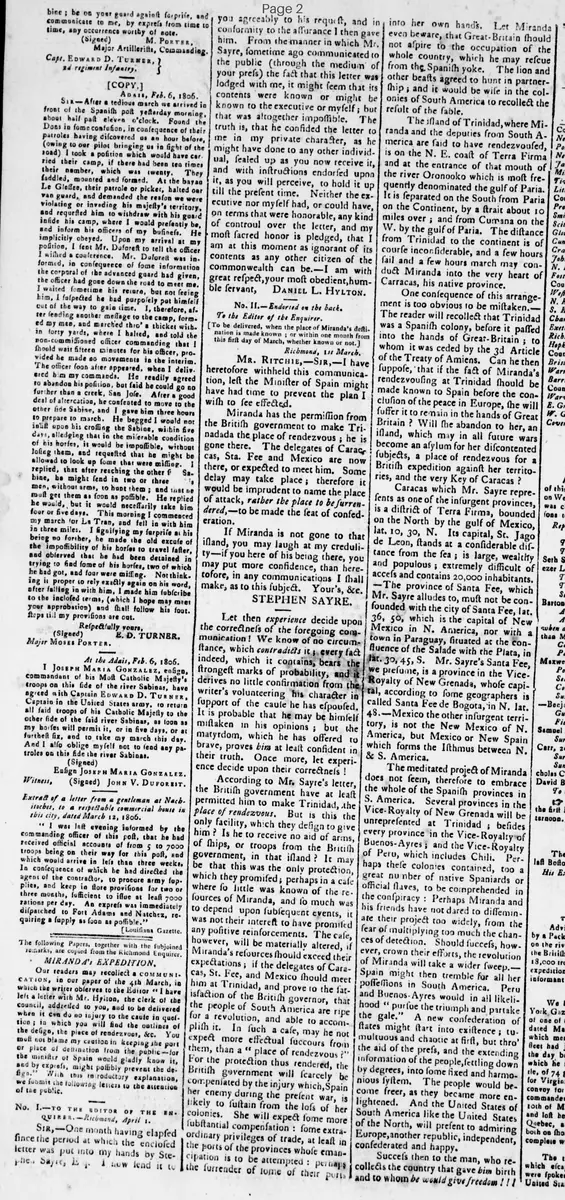
MIRANDA'S EXPEDITION.
Our readers may recollect a communication, in our paper of the 4th March, in which the writer observes to the Editor "I have left a letter with Mr. Hylton, the clerk of the council, addressed to you, and to be delivered when it can do no injury to the cause in question; in which you will find the outlines of the design, the place of rendezvous, &c. You must not blame my caution in keeping the port or place of destination from the public-for the minister of Spain would gladly know it, and by express, might possibly prevent the design."
With this introductory explanation, we submit the following letters to the attention of the public.
NO. I. TO THE EDITOR OF THE ENQUIRER.-Richmond, April 1.
SIR,-One month having elapsed since the period at which the enclosed letter was put into my hands by Stephen Sayre, Esq. I now send it to you agreeably to his request, and in conformity to the assurance I then gave him. From the manner in which Mr. Sayre, sometime ago communicated to the public (through the medium of your press) the fact that this letter was lodged with me, it might seem that its contents were known or might be known to the executive or myself; but that was altogether impossible. The truth is, that he confided the letter to me in my private character, as he might have done to any other individual, sealed up as you now receive it, and with instructions endorsed upon it, as you will perceive, to hold it up till the present time. Neither the executive nor myself had, or could have, on terms that were honorable, any kind of control over the letter, and my most sacred honor is pledged, that I am at this moment as ignorant of its contents as any other citizen of the commonwealth can be.-I am with great respect, your most obedient, humble servant,
Daniel L. Hylton.
No. II.-Endorsed on the back.
To the Editor of the Enquirer.
[To be delivered, when the place of Miranda's destination is made known; or within one month from this first day of March, whether known or not.]
Richmond. 1st March.
MR. RITCHIE,-SIR,-I have heretofore withheld this communication, lest the Minister of Spain might have had time to prevent the plan I wish to see effected.
Miranda has the permission from the British government to make Trinidad the place of rendezvous; he is gone there. The delegates of Caracas, Sta. Fee and Mexico are now there, or expected to meet him. Some delay may take place; therefore it would be imprudent to name the place of attack, rather the place to be surrendered,-to be made the seat of confederation.
If Miranda is not gone to that island, you may laugh at my credulity-if you hear of his being there, you may put more confidence, than heretofore, in any communications I shall make, as to this subject. Yours. &c.
STEPHEN SAYRE.
Let then experience decide upon the correctness of the foregoing communication! We know of no circumstance, which contradicts it; every fact indeed, which it contains, bears the strongest marks of probability, and it derives no little confirmation from the writer's volunteering his character in support of the cause he has espoused. It is probable that he may be himself mistaken in his opinions; but the martyrdom, which he has offered to brave, proves him at least confident in their truth. Once more, let experience decide upon their correctness!
According to Mr. Sayre's letter, the British government have at least permitted him to make Trinidad, the place of rendezvous. But is this the only facility, which they design to give him? Is he to receive no aid of arms, of ships, or troops from the British government, in that island? It may be that this was the only protection, which they promised; perhaps in a case where so little was known of the resources of Miranda, and so much was to depend upon subsequent events, it was not their interest to have promised any positive reinforcements. The case, however, will be materially altered, if Miranda's resources should exceed their expectations; if the delegates of Caracas, St. Fee, and Mexico should meet him at Trinidad, and prove to the satisfaction of the British governor, that the people of South America are ripe for a revolution, and able to accomplish it. In such a case, may he not expect more effectual succours from them, than a "place of rendezvous?"
For the protection thus rendered, the British government will scarcely be compensated by the injury which, Spain her enemy during the present war, is likely to sustain from the loss of her colonies. She will expect some more substantial compensation: some extraordinary privileges of trade, at least in the ports of the provinces whose emancipation is to be attempted: perhaps the surrender of some of their ports into her own hands. Let Miranda even beware, that Great-Britain should not aspire to the occupation of the whole country, which he may rescue from the Spanish yoke. The lion and other beasts agreed to hunt in partnership; and it would be wise in the colonies of South America to recollect the result of the fable.
The island of Trinidad, where Miranda and the deputies from South America are said to have rendezvoused, is on the N. E. coast of Terra Firma and at the entrance of that mouth of the river Oronooko which is most frequently denominated the gulf of Paria. It is separated on the South from Paria on the Continent, by a strait about 10 miles over; and from Cumana on the W. by the gulf of Paria. The distance from Trinidad to the continent is of course inconsiderable, and a few hours sail and a few hours march may conduct Miranda into the very heart of Carracas, his native province.
One consequence of this arrangement is too obvious to be mistaken.- The reader will recollect that Trinidad was a Spanish colony, before it passed into the hands of Great-Britain; to whom it was ceded by the 3d Article of the Treaty of Amiens. Can he then suppose, 'that if the fact of Miranda's rendezvousing at Trinidad should be made known to Spain before the conclusion of the peace in Europe, she will suffer it to remain in the hands of Great Britain? Will she abandon to her, an island, which may in all future wars become an asylum for her discontented subjects, a place of rendezvous for a British expedition against her territories, and the very Key of Caracas?
Caracas which Mr. Sayre represents as one of the insurgent provinces. is a district of Terra Firma, bounded on the North by the gulf of Mexico, lat. 10, 30, N. Its capital, St. Jago de Leon, stands at a considerable distance from the sea; is large, wealthy and populous; extremely difficult of access and contains 20,000 inhabitants. -The province of Santa Fee, which Mr. Sayre alludes to, must not be confounded with the city of Santa Fee, lat. 36, 50, which is the capital of New Mexico in N. America, nor with a town in Paraguay, situated at the confluence of the Salade with the Plata, in lat. 30, 45, S. Mr. Sayre's Santa Fee, we presume, is a province in the Vice-Royalty of New Grenada, whose capital, according to some geographers is called Santa Fee de Bogota, in N. lat. 4 48.--Mexico the other insurgent territory, is not the New Mexico of N. America, but Mexico or New Spain which forms the Isthmus between N. & S. America.
The meditated project of Miranda does not seem, therefore to embrace the whole of the Spanish provinces in S. America. Several provinces in the Vice-Royalty of New Grenada will be unrepresented at Trinidad; besides every province in the Vice-Royalty of Buenos-Ayres; and the Vice-Royalty of Peru, which includes Chili. Perhaps these colonies contained, too a great number of native Spaniards or official slaves, to be comprehended in the conspiracy: Perhaps Miranda and his friends have not dared to disseminate their project too widely, from the fear of multiplying too much the chances of detection. Should success, however, crown their efforts, the revolution of Miranda will take a wider sweep.-- Spain might then tremble for all her possessions in South America. Peru and Buenos-Ayres would in all likelihood "pursue the triumph and partake the gale." A new confederation of states might start into existence; tumultuous and chaotic at first, but through the aid of the press, and the extending information of the people, settling down by degrees, into some fixed and harmonious system. The people would become freer, as they became more enlightened. And the United States of South America like the United States of the North, will present to admiring Europe, another republic, independent, confederated and happy.
Success then to the man, who recollects the country that gave him birth and to whom he would give freedom!!!
What sub-type of article is it?
What keywords are associated?
What entities or persons were involved?
Where did it happen?
Foreign News Details
Primary Location
Trinidad
Event Date
1st March
Key Persons
Event Details
Stephen Sayre's letter reveals Miranda has British permission to rendezvous at Trinidad for a planned revolution against Spanish colonies. Delegates from Caracas, Sta. Fee, and Mexico expected to meet him. Editorial speculates on potential British aid, trade privileges, and broader revolutionary implications for South America.