Thank you for visiting SNEWPapers!
Sign up free
Editorial
October 11, 1874
Los Angeles Daily Herald
Los Angeles, Los Angeles County, California
What is this article about?
This editorial vehemently defends Andrew Jackson against accusations by Ulysses S. Grant's apologists that he aspired to a third presidential term. It criticizes Democratic turncoats like James Lyons for supporting Grant, praises Jackson's patriotism and adherence to term limits, and recounts a personal encounter from 1836.
Clipping
OCR Quality
98%
Excellent
Full Text
Jackson and the Third Term.
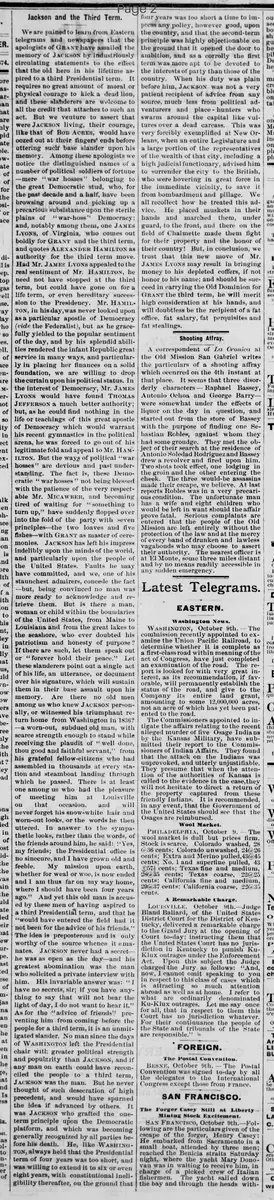
We are pained to learn from Eastern telegrams and newspapers that the apologists of Grant have assailed the memory of Jackson by industriously circulating statements to the effect that the old hero in his lifetime aspired to a third Presidential term. It requires no great amount of moral or physical courage to kick a dead lion, and these slanderers are welcome to all the credit that attaches to such an act. But we venture to assert that were Jackson living, their courage, like that of Bob Acres, would have oozed out at their fingers' ends before uttering such base slander upon his memory. Among these apologists we notice the distinguished names of a number of political soldiers of fortune—mere "war horses" belonging to the great Democratic stud, who, for the past decade and a half, have been browsing around and picking up a precarious subsistence upon the sterile plains of "war-horse" Democracy; and, notably among them, one James Lyons, of Virginia, who comes out boldly for Grant and the third term, and quotes Alexander Hamilton as authority for the third term move. Had Mr. James Lyons appealed to the real sentiment of Mr. Hamilton, he need not have stopped at the third term, but could have gone on for a life term, or even hereditary succession to the Presidency. Mr. Hamilton, in his day, was never looked upon as a particular apostle of democracy (vide the Federalist), but as he gracefully yielded to the popular sentiment of the day, and by his splendid abilities rendered the infant Republic great service in many ways, and particularly in placing her finances on a solid foundation, we are willing to drop the curtain upon his political status. In the interest of Democracy, Mr. James Lyons would have found Thomas Jefferson a much better authority; but, as he could find nothing in the life or teachings of this great apostle of Democracy which would warrant his recent gymnastics in the political arena, he was forced to go out of his legitimate fold and appeal to Mr. Hamilton. But the ways of political "war horses" are devious and past understanding. The fact is, these Democratic "war horses" not being blessed with the patience of the very respectable Mr. McCracken, and becoming tired of waiting for "something to turn up," have suddenly flopped over into the fold of the party with "even principles"—the two loaves and five fishes—with Grant as master of ceremonies. Jackson has left his impress indelibly upon the minds of the world, and particularly upon the people of the United States. Faults he may have committed, and we, one of his staunchest admirers, concede the fact—but, being convinced no man was more ready to acknowledge and retrieve them. But is there a man, woman or child within the boundaries of the United States, from Maine to Louisiana and from the great lakes to the seashore, who ever doubted his patriotism and honesty of purpose? If there are such, let them speak out or "forever hold their peace." Let these slanderers point out a single act of his life, an utterance, or document over his signature, which will sustain them in their base assault upon his memory. Are there no old men among us who knew Jackson personally, or witnessed his triumphant return home from Washington in 1836?—a worn-out, subdued old man, with scarce strength enough to stand while receiving the plaudit of "well done, thou good and faithful servant," from his grateful fellow-citizens who had assembled in thousands at every station and steamboat landing through which he passed. There is at least one among us who had the pleasure of meeting him at Louisville on that occasion, and will never forget his snow-white hair and worn-out looks, or the words he then uttered. In answer to the sympathetic looks, rather than the words, of the friends around him, he said: "Yes, my friends; the Presidential office is no sinecure, and I have grown old and feeble. My mission upon earth, whether for weal or woe, is now ended and I am thus far on my way home, where I should have been four years ago." And yet this old man is accused by these men of having aspired to a third Presidential term, and that he "would have entered the field had it not been for the advice of his friends." The idea is preposterous and is only worthy of the source whence it emanates. Jackson never had a secret—he was as open as the day—and his greatest abomination was the man who solicited a private interview with him. His invariable answer was: "I have no secrets, sir; if you have anything to say that will not bear the light of day, I do not want to hear it." As for the "advice of friends" preventing him from coming before the people for a third term, it is an unmitigated slander. No man since the days of Washington left the Presidential chair with greater political strength and popularity than Jackson, and if any man on earth could have reconciled the people to a third term, Jackson was the man. But he never thought of such desecration of high precedent, and would have spurned the idea if advanced by others. It was Jackson who grafted the one-term principle upon the Democratic platform, and which was becoming generally recognized by all parties before his death. He, like Washington, always held that the Presidential term of four years was too short, and was willing to extend it to six or even eight years, with constitutional ineligibility thereafter, on the ground that four years was too short a time to impress any policy, however good, upon the country, and that the second-term principle was highly objectionable on the ground that it opened the door to ambition, and as a corollary the first term was more apt to be devoted to the interests of party than those of the country. When his duty was plain before him, Jackson was not a very patient recipient of advice from any source, much less from political adventurers and place-hunters who swarm around the capital like vultures over a dead carcass. This was very forcibly exemplified at New Orleans, when an entire Legislature and a large portion of the representatives of the wealth of that city, including a high judicial functionary, advised him to surrender the city to the British, who were hovering in great force in the immediate vicinity, to save it from bombardment and pillage. We all recollect how he treated this advice. He placed muskets in their hands and marched them, under guard, to the front, and there on the field of Chalmette made them fight for their property and the honor of their country! But, in conclusion, we trust that this new move of Mr. James Lyons may result in bringing money to his depleted coffers, if not honor to his name; and should he succeed in carrying the Old Dominion for Grant the third term, he will merit high consideration at his hands, and will doubtless be the recipient of a fat office, fat salary, fat perquisites and fat stealings.
We are pained to learn from Eastern telegrams and newspapers that the apologists of Grant have assailed the memory of Jackson by industriously circulating statements to the effect that the old hero in his lifetime aspired to a third Presidential term. It requires no great amount of moral or physical courage to kick a dead lion, and these slanderers are welcome to all the credit that attaches to such an act. But we venture to assert that were Jackson living, their courage, like that of Bob Acres, would have oozed out at their fingers' ends before uttering such base slander upon his memory. Among these apologists we notice the distinguished names of a number of political soldiers of fortune—mere "war horses" belonging to the great Democratic stud, who, for the past decade and a half, have been browsing around and picking up a precarious subsistence upon the sterile plains of "war-horse" Democracy; and, notably among them, one James Lyons, of Virginia, who comes out boldly for Grant and the third term, and quotes Alexander Hamilton as authority for the third term move. Had Mr. James Lyons appealed to the real sentiment of Mr. Hamilton, he need not have stopped at the third term, but could have gone on for a life term, or even hereditary succession to the Presidency. Mr. Hamilton, in his day, was never looked upon as a particular apostle of democracy (vide the Federalist), but as he gracefully yielded to the popular sentiment of the day, and by his splendid abilities rendered the infant Republic great service in many ways, and particularly in placing her finances on a solid foundation, we are willing to drop the curtain upon his political status. In the interest of Democracy, Mr. James Lyons would have found Thomas Jefferson a much better authority; but, as he could find nothing in the life or teachings of this great apostle of Democracy which would warrant his recent gymnastics in the political arena, he was forced to go out of his legitimate fold and appeal to Mr. Hamilton. But the ways of political "war horses" are devious and past understanding. The fact is, these Democratic "war horses" not being blessed with the patience of the very respectable Mr. McCracken, and becoming tired of waiting for "something to turn up," have suddenly flopped over into the fold of the party with "even principles"—the two loaves and five fishes—with Grant as master of ceremonies. Jackson has left his impress indelibly upon the minds of the world, and particularly upon the people of the United States. Faults he may have committed, and we, one of his staunchest admirers, concede the fact—but, being convinced no man was more ready to acknowledge and retrieve them. But is there a man, woman or child within the boundaries of the United States, from Maine to Louisiana and from the great lakes to the seashore, who ever doubted his patriotism and honesty of purpose? If there are such, let them speak out or "forever hold their peace." Let these slanderers point out a single act of his life, an utterance, or document over his signature, which will sustain them in their base assault upon his memory. Are there no old men among us who knew Jackson personally, or witnessed his triumphant return home from Washington in 1836?—a worn-out, subdued old man, with scarce strength enough to stand while receiving the plaudit of "well done, thou good and faithful servant," from his grateful fellow-citizens who had assembled in thousands at every station and steamboat landing through which he passed. There is at least one among us who had the pleasure of meeting him at Louisville on that occasion, and will never forget his snow-white hair and worn-out looks, or the words he then uttered. In answer to the sympathetic looks, rather than the words, of the friends around him, he said: "Yes, my friends; the Presidential office is no sinecure, and I have grown old and feeble. My mission upon earth, whether for weal or woe, is now ended and I am thus far on my way home, where I should have been four years ago." And yet this old man is accused by these men of having aspired to a third Presidential term, and that he "would have entered the field had it not been for the advice of his friends." The idea is preposterous and is only worthy of the source whence it emanates. Jackson never had a secret—he was as open as the day—and his greatest abomination was the man who solicited a private interview with him. His invariable answer was: "I have no secrets, sir; if you have anything to say that will not bear the light of day, I do not want to hear it." As for the "advice of friends" preventing him from coming before the people for a third term, it is an unmitigated slander. No man since the days of Washington left the Presidential chair with greater political strength and popularity than Jackson, and if any man on earth could have reconciled the people to a third term, Jackson was the man. But he never thought of such desecration of high precedent, and would have spurned the idea if advanced by others. It was Jackson who grafted the one-term principle upon the Democratic platform, and which was becoming generally recognized by all parties before his death. He, like Washington, always held that the Presidential term of four years was too short, and was willing to extend it to six or even eight years, with constitutional ineligibility thereafter, on the ground that four years was too short a time to impress any policy, however good, upon the country, and that the second-term principle was highly objectionable on the ground that it opened the door to ambition, and as a corollary the first term was more apt to be devoted to the interests of party than those of the country. When his duty was plain before him, Jackson was not a very patient recipient of advice from any source, much less from political adventurers and place-hunters who swarm around the capital like vultures over a dead carcass. This was very forcibly exemplified at New Orleans, when an entire Legislature and a large portion of the representatives of the wealth of that city, including a high judicial functionary, advised him to surrender the city to the British, who were hovering in great force in the immediate vicinity, to save it from bombardment and pillage. We all recollect how he treated this advice. He placed muskets in their hands and marched them, under guard, to the front, and there on the field of Chalmette made them fight for their property and the honor of their country! But, in conclusion, we trust that this new move of Mr. James Lyons may result in bringing money to his depleted coffers, if not honor to his name; and should he succeed in carrying the Old Dominion for Grant the third term, he will merit high consideration at his hands, and will doubtless be the recipient of a fat office, fat salary, fat perquisites and fat stealings.
What sub-type of article is it?
Partisan Politics
Constitutional
What keywords are associated?
Jackson Third Term
Grant Apologists
Democratic Principles
Presidential Term Limits
Political Slander
James Lyons
What entities or persons were involved?
Andrew Jackson
Ulysses S. Grant
James Lyons
Alexander Hamilton
Thomas Jefferson
George Washington
Editorial Details
Primary Topic
Defense Of Andrew Jackson Against Third Term Aspirations Slander
Stance / Tone
Strongly Pro Jackson And Anti Grant Third Term
Key Figures
Andrew Jackson
Ulysses S. Grant
James Lyons
Alexander Hamilton
Thomas Jefferson
George Washington
Key Arguments
Apologists For Grant Slander Jackson By Claiming He Sought A Third Term
Jackson Was Open And Never Aspired To A Third Term
Jackson Established The One Term Principle In Democratic Platform
Personal Account Of Jackson's 1836 Return Shows His Weariness And End Of Mission
Criticism Of James Lyons For Citing Hamilton Over Jefferson
Jackson Rejected Advice When Duty Was Clear, As In New Orleans
Third Term Would Desecrate Precedent Set By Washington
Democratic 'War Horses' Have Defected To Grant's Side