Thank you for visiting SNEWPapers!
Sign up free
Alexandria Daily Advertiser
Alexandria, Virginia
What is this article about?
Aristides critiques a memorial to Congress seeking expanded powers for Alexandria's Mayor and Common Council, including jurisdiction over adjacent Virginia land, preferential tax sales on real property, and fixed electoral districts. He refutes 'Corrector''s defenses, arguing such grants exceed Congress's authority or are unwise, citing specific bill sections and prior acts.
Clipping
OCR Quality
Full Text
Fellow Citizens,
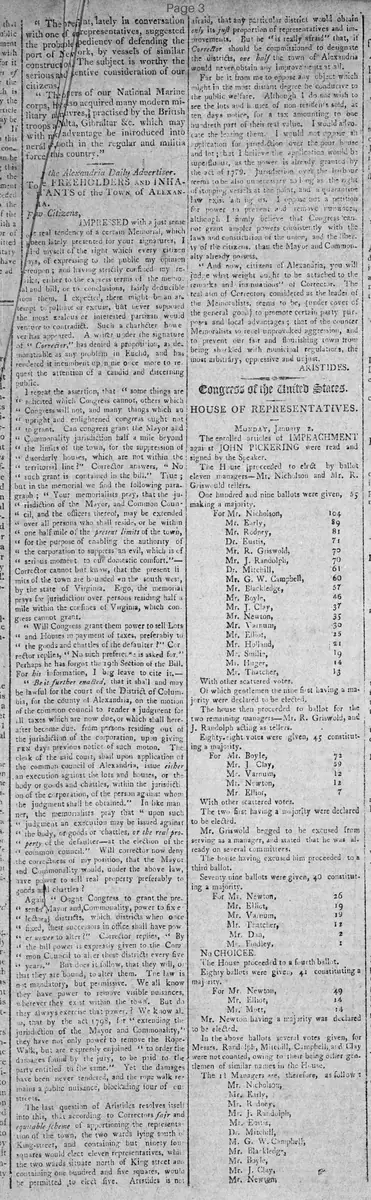
IMPRESSION with a just sense of real tendency of a certain Memorial, which has been lately presented for your signatures, I avail myself of the right which every citizen enjoys, of expressing to the public my opinion thereon; and having strictly confined myself entirely to the express terms of the memorial and bill, or to conclusions, fairly deducible from them, I expected, there might be an attempt to palliate or excuse, but never supposed the most zealous or interested partizan would venture to contradict. Such a character however has appeared, A writer under the signature of "Corrector," has denied a proposition, as demonstrable as any problem in Euclid, and has rendered it incumbent upon me once more to request the attention of a candid and discerning public.
I repeat the assertion, that "some things are solicited which Congress cannot, others which Congress will not, and many things which an upright and enlightened congress ought not to grant. Can congress grant the Mayor and Commonality jurisdiction half a mile beyond the limits of the town, for the suppression of disorderly houses, which are not within the territorial line?" Corrector answers, "No such grant is contained in the bill." True; but in the memorial we find the following paragraph; "Your memorialists pray, that the jurisdiction of the Mayor, and Common Council, and the officers thereof, may be extended over all persons who shall reside, or be within one half mile of the present limits of the town, for the purpose of enabling the authority of the corporation to suppress an evil, which is of serious moment to our domestic comfort."
Corrector cannot but know, that the present limits of the town are bounded on the south west, by the state of Virginia. Ergo, the memorial prays for jurisdiction over persons residing half a mile within the confines of Virginia, which congress cannot grant.
"Will Congress grant them power to sell Lots and Houses in payment of taxes, preferably to the goods and chattels of the defaulter?" Corrector replies, "No such preference is asked for." Perhaps he has forgot the 19th Section of the Bill. For his information, I beg leave to cite it.-- "Be it further enacted, that it shall and may be lawful for the court of the District of Columbia, for the county of Alexandria, on the motion of the common council to render a judgment for all taxes which are now due, or which shall here after become due. from persons residing out of the jurisdiction of the corporation, upon giving ten days previous notice of such motion. The clerk of the said court, shall upon application of the common council of Alexandria, issue either an execution against the lots and houses, or the body of goods and chattels, within the jurisdiction of the corporation, of the person against whom the judgment shall be obtained." In like manner, the memorialists pray that "upon such judgment an execution may be issued against the body, or goods or chattels, or the real property of the defaulter--at the election of the common council." Will corrector now deny the correctness of my position, that the Mayor and Commonality would, under the above law, have power to sell real property preferably to goods and chatties?
Again "Ought Congress to grant the present Mayor and Commonality, power to fix electoral districts, which districts when once fixed, their successors in office shall have power never to alter?" Corrector replies, "By the bill power is expressly given to the Common Council to alter these districts every five years." But does it follow, that they will, or that they are bound, to alter them. The law is not mandatory, but permissive. We all know they have power to remove visible nuisances, wherever they exist within the town. But do they always exercise that power? We know also, that by the act 1798, for "extending the jurisdiction of the Mayor and Commonality,'' they have not only power to remove the Rope-Walk, but are expressly enjoined "to order the damages found by the jury, to be paid to the party entitled to the same." Yet the damages have been never tendered, and the rope walk remains a public nuisance, blockading four of our streets.
The last question of Aristides resolves itself into this, that according to Correctors fair and equitable theme of apportioning the representation of the town, the two wards lying south of King-street, and containing but ninety four squares would elect eleven representatives, while the two wards situate north of King street and containing one hundred and five squares, would be permitted to elect five. Aristides is not afraid, that any particular district would obtain only its just proportion of representatives and improvements. But he "is really afraid" that, if Corrector should be commissioned to designate the districts, one half the town of Alexandria would never obtain any improvements at all.
Far be it from me to oppose any object which might in the most distant degree be conducive to the public welfare, Although I do not wish to see the lots and houses of non residents sold, at ten days notice, for a tax amounting to one hundreth part of their real value. I would advocate the leasing them. I would not oppose an application for jurisdiction over the poor house and lot: but I believe the application would be superfluous, as the power is already granted by the act of 1799. Jurisdiction over the harbour seems to be also unnecessary so long as the right of stopping vessels at the point, and a quarantine law exist among us. I oppose not a petition for power to prevent and remove nuisances, although I firmly believe that Congress can not grant ampler powers consistently with the laws and constitution of the union, and the liberty of the citizens. than the Mayor and Commonalty already possess.
"And now, citizens of Alexandria, you will judge what weight ought to be attached to the remarks and insinuations" of Corrector. The real aim of Corrector, considered as the leader of the Memorialists, seems to be, (under cover of the general good) to promote certain party purposes and local advantages; that of the counter Memorialists to repel unprovoked aggression, and to prevent our fair and flourishing town from being shackled with municipal regulations, the most arbitrary, oppressive and unjust.
ARISTIDES.
What sub-type of article is it?
What themes does it cover?
What keywords are associated?
What entities or persons were involved?
Letter to Editor Details
Author
Aristides
Recipient
Freeholders And Inhabitants Of The Town Of Alexandria
Main Argument
the memorial seeks powers congress cannot or should not grant, such as jurisdiction over virginia territory, preferential sale of real property for taxes, and unalterable electoral districts; aristides refutes corrector's denials by citing the memorial and bill texts.
Notable Details