Thank you for visiting SNEWPapers!
Sign up free
The Massachusetts Spy, Or, Thomas's Boston Journal
Boston, Suffolk County, Massachusetts
What is this article about?
Affidavits from coachman George Plumley and footman James Jerkins, along with statements from Ralph Izard and J. Temple, provide eyewitness accounts and clarifications regarding the duel between Mr. Temple and Mr. Whately in Hyde Park on December 11, 1773, refuting reports of falls or unfair treatment.
Merged-components note: Sequential components form a single cohesive article on the Temple-Whately duel, including affidavits, accounts, and responses; relabeling the letter portion to story for unity.
Clipping
OCR Quality
Full Text
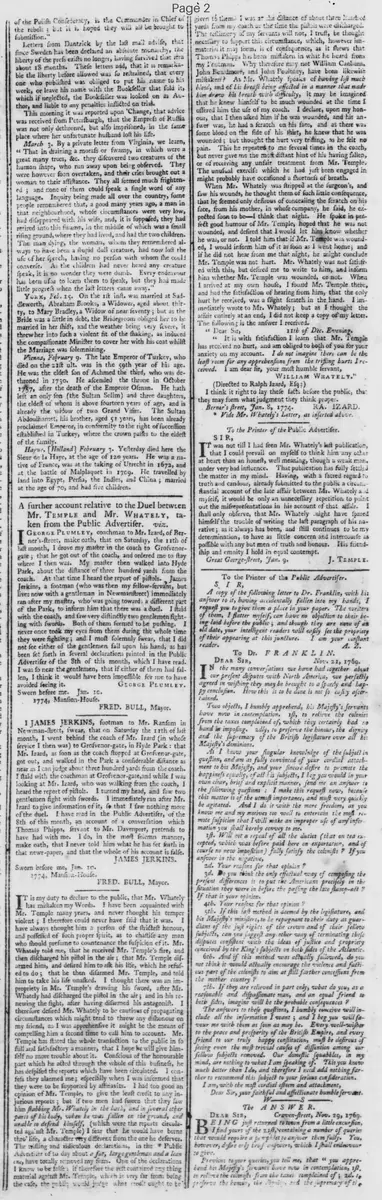
George PLUMLEY, coachman to Mr. Izard, of Berner's-street, make oath, that on Saturday, the 11th of last month, I drove my master in the coach to Grosvenor-gate; that he got out of the coach, and ordered me to stay where I then was. My master then walked into Hyde Park, about the distance of three hundred yards from the coach. At that time I heard the report of pistols. James Jerkins, a footman (who was then my fellow-servant, but lives now with a gentleman in Newman-street) immediately ran after my master, who was going towards a different part of the Park, to inform him that there was a duel. I stayed with the coaches, and saw very distinctly two gentlemen fighting with swords. Both of them seemed to be pushing. I never once took my eyes from them during the whole time they were fighting; and, I most solemnly swear, that I did not see either of the gentlemen fall upon his hand, as has been set forth in several declarations printed in the Public Advertiser of the 5th of this month, which I have read. I was so near the gentlemen, that if either of them had fallen, I think it would have been impossible for me to have avoided seeing it.
GEORGE PLUMLEY.
Sworn before me. Jan. 10. 1774, Mansion-House.
FRED. BULL, Mayor.
I JAMES JERKINS, footman to Mr. Ranom in Newman-street, swear, that on Saturday the 11th of last month, I went behind the coach of Mr. Izard (in whose service I then was) to Grosvenor-gate, in Hyde Park: that Mr. Izard, as soon as the coach stopped at Grosvenor-gate, got out, and walked in the Park a considerable distance as near as I can judge about three hundred yards from the coach. I stayed with the coachman at Grosvenor-gate, and while I was looking at Mr. Izard, who was walking from the coach, I heard the report of pistols. I turned my head, and saw two gentlemen fight with swords. I immediately ran after Mr. Izard to give information of it, so that I saw nothing more of the duel. I have read in the Public Advertiser, of the 5th of this month, an account of a conversation which Thomas Phipps, servant to Mr. Davenport, pretends to have had with me. I do, in the most solemn manner, make oath, that I never told him what he has set forth in that news-paper, and that the whole of his account is false.
JAMES JERKINS.
Sworn before me, Jan. 10. 1774, Mansion-House.
FRED. BULL, Mayor.
It is my duty to declare to the public, that Mr. Whately has mistaken my Words. I have been acquainted with Mr. Temple many years, and never thought his temper violent; I therefore could never have said that it was. I have always thought him a person of the strictest honour, and possessed of such proper spirit, as to chastise any man who should presume to countenance the suspicion of it. Mr. Whately told me, that he received Mr. Temple's fire, and then discharged his pistol in the air; that Mr. Temple disarmed him, and desired him to ask his life, which he refused to do; that he then disarmed Mr. Temple, and told him to take his life unasked. I thought there was an impropriety in Mr. Temple's drawing his sword, after Mr. Whately had discharged the pistol in the air; and in his renewing the fight, after having disarmed his antagonist. I therefore desired Mr. Whately to be cautious of propagating circumstances which might tend to throw any dishonour on my friend, as I was apprehensive it might be the means of compelling him a second time to call him to account. Mr. Temple has stated the whole transaction to the public in so full and satisfactory a manner, that I hope he will give himself no more trouble about it. Conscious of the honourable part which he acted through the whole of this business, he has despised the reports which have been circulated. I confess they alarmed me; especially when I was informed that they were to be supported by affidavits. I had too good an opinion of Mr. Temple, to give the least credit to any injurious reports; but if two men had sworn that they saw him stabbing Mr. Whately in the back, and in several other parts of his body, when he was fallen on the ground, and unable to defend himself, (which were the reports circulated against Mr. Temple) I fear that he would have borne through life, a character very different from the one he deserves. The trifling and ridiculous declarations, in the Public Advertiser of to day about a fat, large gentleman and a lean one, have totally removed my fears. One of the declarations I know to be false: if therefore the rest contained any thing material against Mr. Temple, which is very far from being the case, the public would judge what credit ought to be given to them
I was at the distance of about three hundred yards from my coach at the time the pistols were discharged. The testimony of my servants will not, I trust, be thought necessary to support this circumstance, which, however immaterial it may seem, is of consequence, as it shews that Thomas Phipps has been mistaken in what he heard from my Footman. Why therefore may not William Canburn, John Beardmore, and John Poultney, have been likewise mistaken? As Mr. Whately speaks of having lost much blood, and of his breast being affected in a manner that made him draw his breath with difficulty, it may be imagined that he knew himself to be much wounded at the time I offered him the use of my coach. I declare, upon my honour, that I then asked him if he was wounded, and his answer was, he had a scratch on his face, and as there was some blood on the side of his shirt, he knew that he was wounded; but thought the hurt very trifling, as he felt no pain. This he repeated to me several times in the coach, but never gave me the most distant hint of his having fallen, or of receiving any unfair treatment from Mr. Temple. The unusual exercise which he had just been engaged in might probably have occasioned a shortness of breath.
When Mr. Whately was stripped at the surgeon's, and saw his wounds, he thought them of such little consequence, that he seemed only desirous of concealing the scratch on his face, from his mother, in whose company, he said, he expected soon to be—I think that night. He spoke in perfect good humour of Mr. Temple, hoped that he was not wounded, and desired that I would let him know whether he was, or not. I told him that if Mr. Temple was wounded, I would inform him of it as soon as I went home; and if he did not hear from me that night, he might conclude Mr. Temple was not hurt. Mr. Whately was not satisfied with this, but desired me to write to him, and inform him whether Mr. Temple was wounded, or not. When I arrived at my own house, I found Mr. Temple there, and had the satisfaction of hearing from him, that the only hurt he received, was a slight scratch in the hand. I immediately wrote to Mr. Whately; but as I thought the affair entirely at an end, I did not keep a copy of my letter. The following is the answer I received.
"Dear Sir,
11th of Dec. Evening.
It is with satisfaction I learn that Mr. Temple has received no hurt, and am obliged to both of you for your anxiety on my account. I do not imagine there can be the least room for any apprehensions from the trifling hurts I received. I am dear sir, your most humble servant,
WILLIAM WHATELY."
(Directed to Ralph Izard, Esq;)
I think it right to lay these facts before the public, that they may form what judgment they think proper.
Berner's street, Jan. 8, 1774.
RA. IZARD.
* Vide Mr. Whately's Letter, as inserted above.
To the Printer of the Public Advertiser
SIR,
It was not till I had seen Mr. Whately's last publication, that I could prevail on myself to think him any other at heart than an honest, well meaning, though a weak man, under very bad influence. That publication has fully settled the matter in my mind. Having, with a sacred regard to truth and candour, already submitted to the public a circumstantial account of the late affair between Mr. Whately and myself, it would be only an unnecessary repetition to point out the misrepresentations in his account of that affair. I shall only observe, that Mr. Whately might have spared himself the trouble of writing the last paragraph of his narrative; as it always has been, and still continues to be my determination, to have as little concern and intercourse as possible with any but men of truth and honour. His friendship and enmity I hold in equal contempt.
Great George-street, Jan. 9.
J. TEMPLE.
What sub-type of article is it?
What themes does it cover?
What keywords are associated?
What entities or persons were involved?
Where did it happen?
Story Details
Key Persons
Location
Hyde Park, Grosvenor Gate
Event Date
Saturday, The 11th Of Last Month (December 11, 1773)
Story Details
Eyewitness affidavits from Plumley and Jerkins describe observing the pistol shots and sword fight in the duel without seeing any falls, refuting prior claims. Izard clarifies Whately's minor wounds and post-duel correspondence, defending Temple's honor against misrepresentations. Temple dismisses Whately's account as untruthful.