Thank you for visiting SNEWPapers!
Sign up free
The Liberator
Boston, Suffolk County, Massachusetts
What is this article about?
A traveler's vivid account of arriving in London by steam-packet via the Thames in June 1834, describing the river's commerce, docks, landmarks like St. Paul's and the Tower, bustling streets, and the city's chaotic urban life.
Merged-components note: Continuation of European correspondence describing London and its surroundings on page 4.
Clipping
OCR Quality
Full Text
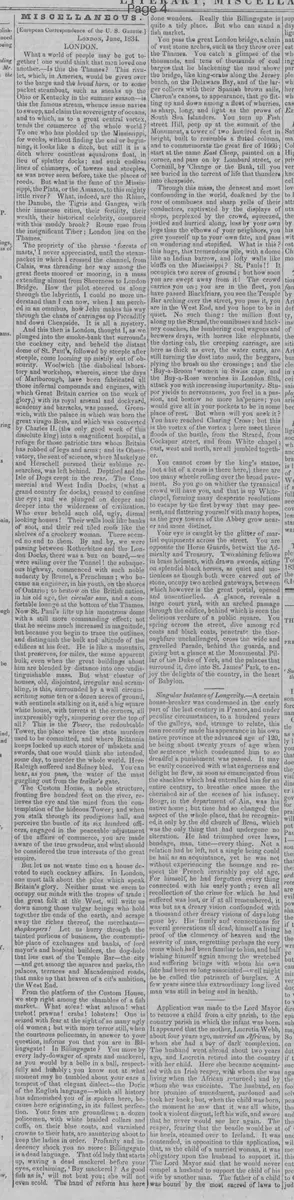
[European Correspondence of the U. S. Gazette.]
London, June, 1834.
LONDON.
What a world of people may be got together! one would think that men loved one another.-Is this the Thames? This rivulet, which, in America, would be given over to the barge and the broad horn, or to some packet steamboat, such as sneaks up the Ohio or Kentucky in the summer season—is this the famous stream, whence issue navies to sweep, and claim the sovereignty of oceans, and to which, as to a great central vortex, tends the commerce of the whole world?
To one who has plodded up the Mississippi for weeks, without finding the end or beginning, it looks like a ditch, but still it is a ditch where countless squadrons float, in lieu of splatter docks; and such endless lines of chimneys, of towers and steeples, as was never seen before, take the places of reeds. But what is the fame of the Mississippi, the Plata, or the Amazon, to this mighty little river? What, indeed, are the Rhine, the Danube, the Tigris and Ganges, with their immense cities, their fertility, their wealth, their historical celebrity, compared with this muddy brook? Rome rose from the insignificant Tiber; London lies on the Thames.
The propriety of the phrase 'forests of masts,' I never appreciated, until the steam-packet in which I crossed the channel, from Calais, was threading her way among the great fleets moored or mooring, in a mass extending almost from Sheerness to London Bridge. How the pilot steered us along through the labyrinth, I could no more understand than I can now, when I am perched in an omnibus, how Jehu makes his way through the chaos of carriages up Piccadilly and down Cheapside. It is all a mystery.
And this then is London, thought I, as we plunged into the smoke-bank that surrounds the cockney city, and beheld the distant dome of St. Paul's, followed by steeple after steeple, come looming up mistily out of obscurity. Woolwich (the diabolical laboratory and workshop, wherein, since the days of Marlborough, have been fabricated all those infernal compounds and engines, with which Great Britain carries on the work of glory,) with its royal arsenal and dockyard, academy and barracks, was passed. Greenwich, with the palace in which was born the great virago Bess, and which was converted by Charles II. (the only good work of this dissolute king) into a magnificent hospital, a refuge for those patriotic tars whom Britain has robbed of legs and arms; and its Observatory, the seat of science, where Maskelyne and Herschel pursued their sublime researches, was left behind. Deptford and the Isle of Dogs crept in the rear. The Commercial and West India Docks, (what a grand country for docks,) ceased to confuse the eye; and we plunged on deeper and deeper into the wilderness of civilization.
Who ever beheld such old, ugly, dismal looking houses! Their walls look like banks of soot, and their red tiled roofs like the shelves of a crockery woman. There seemed no end to them. By and by, we were passing between Rotherhithe and the London Docks, there was a buz on board,—we were sailing over the Tunnel! the subaqueous highway, commenced with such noble audacity by Brunel, a Frenchman ; who became an engineer, in his youth, on the shores of Ontario; to bestow on the British nation, in his old age, the circular saw, and a comfortable lounge at the bottom of the Thames.
Now St. Paul's lifts up his monstrous dome with a still more commanding effect; not that he seems much increased in magnitude, but because you begin to trace the outlines, and distinguish the bulk and altitude of the edifices at his feet. He is like a mountain, that preserves, for miles, the same apparent bulk, even when the great buildings about him are blended by distance into one indistinguishable mass. But what cluster of houses, old, disjointed, irregular and scrambling, is this, surrounded by a wall circumscribing some ten or a dozen acres of ground, with sentinels stalking on it, and a big square white house, with turrets at the corners, all inexpressibly ugly, simpering over the top of all?" This is the Tower, the redoubtable Tower, the place where the state murders used to be committed, and where Britannia keeps locked up such stores of muskets and swords, that one would think she intended some day, to murder the whole world. Here Raleigh suffered and Sidney bled. You can hear, as you pass, the water of the mast gurgling out from the traitor's gate.
The Custom House, a noble structure, fronting five hundred feet on the river, relieves the eye and the mind from the contemplation of the hideous Tower; and when you stalk through its prodigious hall, and perceive the bustle of its six hundred officers, engaged in the peaceable adjustment of the affairs of commerce, you are made aware of the true grandeur, and what should be considered the true interests of the great empire.
But let us not waste time on a house devoted to such cockney affairs. In London, one must talk about the piles which speak Britain's glory. Neither must we seem to occupy our minds with the tropes of trade: the great folk at the West, will write us down among those vulgar beings who hold together the ends of the earth, and scrape away the riches thereof, the merchants— shopkeepers! Let us hurry through the tainted purlieus of business, the contemptible place of exchanges and banks, of lord mayor's and hospital builders, the dog-hole that lies east of the Temple Bar-the city —and get among the squares and parks, the palaces, terraces and Macadamized roads, that make up that heaven of a cit's ambition, the West End
From the platform of the Custom House, we step right among the shambles of a fish market. What soles! what salmon! what turbot! prawns! crabs! lobsters! One is seized with fear at the sight of so many ugly old women; but with more terror still, when the courteous policeman, in answer to your question, informs you that you are in Billingsgate! In Billingsgate? You move by every lady-dowager of sprats and mackerel, as you would by a belle in a ball, respectfully and humbly; you know not at what moment may be tumbled about your ears a tempest of that elegant dialect-the Doric of the English language—which all history has admonished you of is spoken here, because here originating, in its fullest perfection. Your fears are groundless; a dozen policemen, with white braided collars and cuffs, on their blue coats, and varnished crowns to their hats, are sauntering about to keep the ladies in order. Profanity and indecency shock you no more: Billingsgate is a dead language. That old lady that starts up, waving a dead mackerel before your eyes, exclaiming, 'Buy mackerel? As good fish as is,' will not beat you; she will not even scold. The hand of reform has here
done wonders. Really this Billingsgate is quite a tidy place. But who can stand a fish market.
You pass the great London bridge, a chain of vast stone arches, such as they throw over the Thames. You catch a glimpse of the thousands, and tens of thousands of coal barges that lie blackening the mud above the bridge, like king-crabs along the Jersey beach, on the Delaware Bay, and of the larger colliers with their Spanish brown sails. Charon's canoes, to appearance, that go flitting up and down among a fleet of wherries, as sharp, long, and light as the prows of South Sea Islanders. You turn up Fish street Hill, peep up at the summit of the Monument, a tower of two hundred feet in height, built to resemble a fluted column, and to commemorate the great fire of 1666: start at the name East Cheap, painted on a corner, and pass on by Lombard street, or Cornhill, by 'Change or the Bank, till you are buried in the torrent of life that thunders into Cheapside.
Through this mass, the densest and most confounding in the world, deafened by the roar of omnibuses and sharp yells of their conductors, captivated by the displays of shops, perplexed by the crowd, squeezed, jostled and hurried along, less by your own legs than the elbows of your neighbors, you give yourself up to your own fate, and pass on wondering and stupified. What is this? this huge, this tremendous pile, with a dome like an Indian barrow, and lofty walls like bluffs on the Mississippi? St. Paul's!! It occupies two acres of ground; but how soon you are swept away from it! The crowd carries you on; you are in the Fleet, you have passed Blackfriars, you see the Temple Bar arching over the street, you pass it, you are in the West End, and you hope to be in quiet. No such thing: the million flow along up the Strand, the omnibuses and hackney coaches, the lumbering coal wagons and brewers drays, with horses like elephants, the darting cab, the creeping carriage, are here as thick as ever, the water carts, are still turning the dust into mud, the beggars plying the brush on the crossings; and the 'Buy-a-Broom' women in Swiss caps, and the Buy-a-Rose wenches in London filth, attack you with increasing importunity. Stupor yields to nervousness, you feel in a passion, and bestow no more ha'pennies; you would give all in your pockets to be in some place of rest. But when will you seek it?
You have reached Charing Cross; but this is the vortex of the vortex ; here meet three floods of the bustle, from the Strand, from Cockspur street, and from White chapel: east, west and north, are all jumbled together.
You cannot cross by the king's statue. (not a bit of a cross is there here,) there are too many wheels rolling over the broad pavement. So you go on whither the tyrannical crowd will have you, and that is up Whitehall, forming many desperate resolutions to escape by the first byway that may present, and flattering yourself with many hopes, as the grey towers of the Abbey grow nearer and more distinct.
Your eye is caught by the glitter of martial equipments across the street. You are opposite the Horse Guards, betwixt the Admiralty and Treasury. Two shining fellows in brass helmets, with drawn swords, sitting on splendid black horses, as quiet and motionless as though both were carved out of stone, occupy two arched gateways, between which however is the great portal, opened and unsentinelled. A glance, reveals a large court yard, with an arched passage through the edifice, behind which is seen the delicious verdure of a public square. You spring across the street, dive among red coats and black coats, penetrate the thoroughfare unchallenged, cross the wide and gravelled Parade, behind the guards, and giving but a glance at the Monumental Pillar of the Duke of York, and the palaces that surround it, dive into St. James' Park, to enjoy the delights of the country, in the heart of Babylon.
What sub-type of article is it?
What keywords are associated?
What entities or persons were involved?
Where did it happen?
Foreign News Details
Primary Location
London
Event Date
June 1834
Key Persons
Event Details
Traveler describes arrival by steam-packet from Calais, navigating Thames amid fleets and docks, passing landmarks like Woolwich Arsenal, Greenwich, Tower of London, Custom House, Billingsgate market, London Bridge, St. Paul's, and entering West End via bustling streets to St. James' Park.