Thank you for visiting SNEWPapers!
Sign up free
Literary
September 24, 1823
Massachusetts Spy And Worcester Advertiser
Worcester, Worcester County, Massachusetts
What is this article about?
John Griscom recounts his visit to Hannah More and her sister Martha at Barley Wood, describing their elegant cottage, views, conversations on America, religion, Bible societies, her works, prejudices from the Revolution, family background, and daily activities. At 75, More remains active in charity and enjoys country life.
Clipping
OCR Quality
98%
Excellent
Full Text
HANNAH MORE
Extracts from Griscom's "Year in Europe."
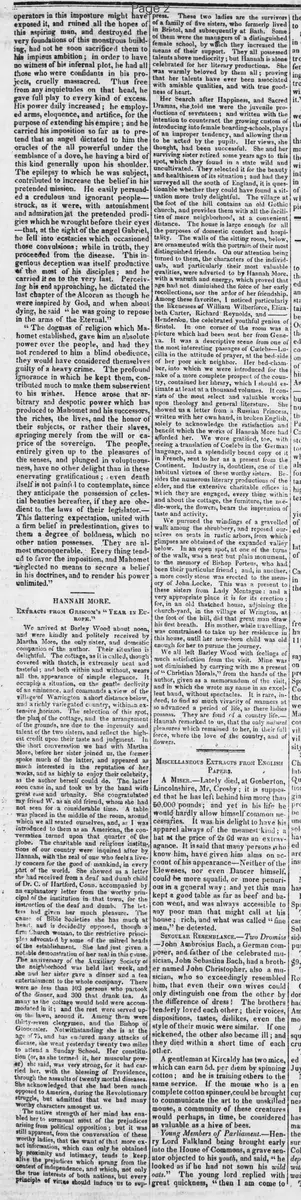
We arrived at Barley Wood about noon, and were kindly and politely received by Martha More, the only sister, and domestic companion of the author. Their situation is delightful. The cottage, as it is called, though covered with thatch, is extremely neat and tasteful; and both within and without, wears all the appearance of simple elegance. It occupies a situation, on the gentle declivity of an eminence, and commands a view of the village of Warrington a short distance below, and a richly variegated country, within an extensive horizon. The selection of this spot, the plan of the cottage, and the arrangement of the grounds, are due to the ingenuity and talent of the two sisters, and reflect the highest credit upon their taste and judgment. In the short conversation we had with Martha More, before her sister joined us, the former spoke much of the latter, and appeared as much interested in the reputation of her works, and as highly to enjoy their celebrity, as the author herself could do. The latter soon came in, and took us by the hand with great ease and urbanity. She congratulated my friend W. as an old friend, whom she had not seen for a considerable time. A table was placed in the middle of the room, around which we all seated ourselves, and, as I was introduced to them as an American, the conversation turned upon that quarter of the globe. The charitable and religious institutions of our country were inquired after by Hannah, with the zeal of one who feels a lively concern for the good of mankind, in every part of the world. She shewed us a letter she had received from a deaf and dumb child of Dr. C. of Hartford, Conn. accompanied by an explanatory letter from the worthy principal of the institution in that town, for the instruction of the deaf and dumb. The letters had given her much pleasure. The cause of Bible Societies she has much at heart, and is decidedly opposed, though a firm Church woman, to the restrictive principles advocated by some of the mitred heads of the establishment. She had just given a notable demonstration of her zeal in this Cause. The anniversary of the Auxiliary Society of the neighborhood was held last week, and she and her sister gave a dinner and a tea entertainment to the whole company. There were no less than 103 persons who partook of the dinner, and 300 that drank tea. As many as the cottage would hold were accommodated in it: and the rest were served up on the lawn, around it. Among them were thirty-seven clergymen, and the Bishop of Gloucester. Notwithstanding she is at the age of 75, and has endured many attacks of disease, she went yesterday twenty two miles to attend a Sunday School. Her constitution (or, as she termed it, her muscular powers) she said, was very strong, for it had carried her, with the blessing of Providence, through the assaults of twenty mortal diseases.
She acknowledged that she had been much opposed to America, during the Revolutionary struggle, but admitted that we had many worthy characters amongst us.
The native strength of her mind has enabled her to surmount most of the prejudices arising from political opposition; but it was still apparent, from the conversation of these worthy ladies, that the want of that more exact information, which can only be obtained by proximity and intimacy, tends to keep alive the prejudices which sprang from the contest of independence, and which, not only the true interests of both nations, but every principle of virtue should induce us to suppress.
These two ladies are the survivors of a family of five sisters, who formerly lived in Bristol, and subsequently at Bath. Some of them were the managers of a distinguished female school, by which they increased the means of their support. They all possessed talents above mediocrity; but Hannah is alone celebrated for her literary productions. She was warmly beloved by them all; proving that her talents have ever been associated with amiable qualities, and with true goodness of heart.
Her Search after Happiness, and Sacred Dramas, she told me were the juvenile productions of seventeen; and written with the intention to counteract the growing custom of introducing into female boarding-schools, plays of an improper tendency, and allowing them to be acted by the pupils. Her views, she thought, had been successful. She and her surviving sister retired some years ago to this spot, which they found in a state wild and uncultivated. They selected it for the beauty and healthiness of its situation; and had they surveyed all the south of England, it is questionable whether they could have found a situation more truly delightful. The village at the foot of the hill contains an old Gothic church, and provides them with all the facilities of mere neighborhood, at a convenient distance.
The house is large enough for all the purposes of domestic comfort and hospitality. The walls of the sitting room, below, are ornamented with the portraits of their most distinguished friends. On our attention being turned to them, the characters of the individuals, and particularly their most valuable qualities, were adverted to by Hannah More, with a warmth and energy, which proved that age had not diminished the force of her early recollections, nor the ardor of her friendship.
Among these favorites, I noticed particularly the likenesses of William Wilberforce, Elizabeth Carter, Richard Reynolds, and Henderson, the celebrated youthful genius of Bristol. In one corner of the room was a picture which had been sent her from Geneva. It was a descriptive scene from one of the most interesting passages of Coelebs—Lucilla in the attitude of prayer, at the bed-side of her poor sick neighbor. Her bed-chamber, into which we were introduced for the sake of a more complete prospect of the country, contained her library, which I should estimate at least at a thousand volumes. It consists of the most select and valuable works upon theology and general literature. She showed us a letter from a Russian Princess, written with her own hand, in broken English, solely to acknowledge the satisfaction and benefit which the works of Hannah More had afforded her. We were gratified, too, with seeing a translation of Coelebs in the German language, and a splendidly bound copy of it in French, sent to her as a present from the Continent. Industry is, doubtless, one of the habitual virtues of these worthy sisters. Besides the numerous literary productions of the elder, and the extensive charitable offices in which they are engaged, every thing within and about the cottage, the furniture, the needle-work, the flowers, bears the impression of taste and activity.
We pursued the windings of a gravelled walk among the shrubbery, and reposed ourselves on seats in rustic arbors, from which glimpses are obtained of the expanded valley below. In an open spot, at one of the turns of the walk, was a neat but plain monument, to the memory of Bishop Porteus, who had been their particular friend; and, in another, a more costly stone was erected to the memory of John Locke. This was a present to these sisters from Lady Montague: and a very appropriate place it is for its erection; for, in an old thatched house, adjoining the church-yard, in the village of Wrington, at the foot of the hill, did that great man draw his first breath. His mother, while travelling, was constrained to take up her residence in this house, until her new-born child was old enough for her to pursue the journey.
We all left Barley Wood with feelings of much satisfaction from the visit. Mine was not diminished by carrying with me a present of "Christian Morals," from the hands of the author, given as a memorandum of the visit, and in which she wrote my name in an excellent hand, without spectacles. It is rare, indeed, to find so much vivacity of manners at so advanced a period of life, as these ladies possess. They are fond of a country life. Hannah remarked to us, that the only natural pleasures which remained to her, in their full force, were the love of the country, and of flowers.
Extracts from Griscom's "Year in Europe."
We arrived at Barley Wood about noon, and were kindly and politely received by Martha More, the only sister, and domestic companion of the author. Their situation is delightful. The cottage, as it is called, though covered with thatch, is extremely neat and tasteful; and both within and without, wears all the appearance of simple elegance. It occupies a situation, on the gentle declivity of an eminence, and commands a view of the village of Warrington a short distance below, and a richly variegated country, within an extensive horizon. The selection of this spot, the plan of the cottage, and the arrangement of the grounds, are due to the ingenuity and talent of the two sisters, and reflect the highest credit upon their taste and judgment. In the short conversation we had with Martha More, before her sister joined us, the former spoke much of the latter, and appeared as much interested in the reputation of her works, and as highly to enjoy their celebrity, as the author herself could do. The latter soon came in, and took us by the hand with great ease and urbanity. She congratulated my friend W. as an old friend, whom she had not seen for a considerable time. A table was placed in the middle of the room, around which we all seated ourselves, and, as I was introduced to them as an American, the conversation turned upon that quarter of the globe. The charitable and religious institutions of our country were inquired after by Hannah, with the zeal of one who feels a lively concern for the good of mankind, in every part of the world. She shewed us a letter she had received from a deaf and dumb child of Dr. C. of Hartford, Conn. accompanied by an explanatory letter from the worthy principal of the institution in that town, for the instruction of the deaf and dumb. The letters had given her much pleasure. The cause of Bible Societies she has much at heart, and is decidedly opposed, though a firm Church woman, to the restrictive principles advocated by some of the mitred heads of the establishment. She had just given a notable demonstration of her zeal in this Cause. The anniversary of the Auxiliary Society of the neighborhood was held last week, and she and her sister gave a dinner and a tea entertainment to the whole company. There were no less than 103 persons who partook of the dinner, and 300 that drank tea. As many as the cottage would hold were accommodated in it: and the rest were served up on the lawn, around it. Among them were thirty-seven clergymen, and the Bishop of Gloucester. Notwithstanding she is at the age of 75, and has endured many attacks of disease, she went yesterday twenty two miles to attend a Sunday School. Her constitution (or, as she termed it, her muscular powers) she said, was very strong, for it had carried her, with the blessing of Providence, through the assaults of twenty mortal diseases.
She acknowledged that she had been much opposed to America, during the Revolutionary struggle, but admitted that we had many worthy characters amongst us.
The native strength of her mind has enabled her to surmount most of the prejudices arising from political opposition; but it was still apparent, from the conversation of these worthy ladies, that the want of that more exact information, which can only be obtained by proximity and intimacy, tends to keep alive the prejudices which sprang from the contest of independence, and which, not only the true interests of both nations, but every principle of virtue should induce us to suppress.
These two ladies are the survivors of a family of five sisters, who formerly lived in Bristol, and subsequently at Bath. Some of them were the managers of a distinguished female school, by which they increased the means of their support. They all possessed talents above mediocrity; but Hannah is alone celebrated for her literary productions. She was warmly beloved by them all; proving that her talents have ever been associated with amiable qualities, and with true goodness of heart.
Her Search after Happiness, and Sacred Dramas, she told me were the juvenile productions of seventeen; and written with the intention to counteract the growing custom of introducing into female boarding-schools, plays of an improper tendency, and allowing them to be acted by the pupils. Her views, she thought, had been successful. She and her surviving sister retired some years ago to this spot, which they found in a state wild and uncultivated. They selected it for the beauty and healthiness of its situation; and had they surveyed all the south of England, it is questionable whether they could have found a situation more truly delightful. The village at the foot of the hill contains an old Gothic church, and provides them with all the facilities of mere neighborhood, at a convenient distance.
The house is large enough for all the purposes of domestic comfort and hospitality. The walls of the sitting room, below, are ornamented with the portraits of their most distinguished friends. On our attention being turned to them, the characters of the individuals, and particularly their most valuable qualities, were adverted to by Hannah More, with a warmth and energy, which proved that age had not diminished the force of her early recollections, nor the ardor of her friendship.
Among these favorites, I noticed particularly the likenesses of William Wilberforce, Elizabeth Carter, Richard Reynolds, and Henderson, the celebrated youthful genius of Bristol. In one corner of the room was a picture which had been sent her from Geneva. It was a descriptive scene from one of the most interesting passages of Coelebs—Lucilla in the attitude of prayer, at the bed-side of her poor sick neighbor. Her bed-chamber, into which we were introduced for the sake of a more complete prospect of the country, contained her library, which I should estimate at least at a thousand volumes. It consists of the most select and valuable works upon theology and general literature. She showed us a letter from a Russian Princess, written with her own hand, in broken English, solely to acknowledge the satisfaction and benefit which the works of Hannah More had afforded her. We were gratified, too, with seeing a translation of Coelebs in the German language, and a splendidly bound copy of it in French, sent to her as a present from the Continent. Industry is, doubtless, one of the habitual virtues of these worthy sisters. Besides the numerous literary productions of the elder, and the extensive charitable offices in which they are engaged, every thing within and about the cottage, the furniture, the needle-work, the flowers, bears the impression of taste and activity.
We pursued the windings of a gravelled walk among the shrubbery, and reposed ourselves on seats in rustic arbors, from which glimpses are obtained of the expanded valley below. In an open spot, at one of the turns of the walk, was a neat but plain monument, to the memory of Bishop Porteus, who had been their particular friend; and, in another, a more costly stone was erected to the memory of John Locke. This was a present to these sisters from Lady Montague: and a very appropriate place it is for its erection; for, in an old thatched house, adjoining the church-yard, in the village of Wrington, at the foot of the hill, did that great man draw his first breath. His mother, while travelling, was constrained to take up her residence in this house, until her new-born child was old enough for her to pursue the journey.
We all left Barley Wood with feelings of much satisfaction from the visit. Mine was not diminished by carrying with me a present of "Christian Morals," from the hands of the author, given as a memorandum of the visit, and in which she wrote my name in an excellent hand, without spectacles. It is rare, indeed, to find so much vivacity of manners at so advanced a period of life, as these ladies possess. They are fond of a country life. Hannah remarked to us, that the only natural pleasures which remained to her, in their full force, were the love of the country, and of flowers.
What sub-type of article is it?
Essay
Journey Narrative
What themes does it cover?
Religious
Political
Moral Virtue
What keywords are associated?
Hannah More
Barley Wood
Bible Societies
American Revolution
Religious Zeal
Country Life
Literary Works
What entities or persons were involved?
Griscom
Literary Details
Title
Extracts From Griscom's "Year In Europe."
Author
Griscom
Subject
Visit To Hannah More At Barley Wood
Form / Style
Descriptive Travel Account
Key Lines
Notwithstanding She Is At The Age Of 75, And Has Endured Many Attacks Of Disease, She Went Yesterday Twenty Two Miles To Attend A Sunday School.
She Acknowledged That She Had Been Much Opposed To America, During The Revolutionary Struggle, But Admitted That We Had Many Worthy Characters Amongst Us.
Hannah Remarked To Us, That The Only Natural Pleasures Which Remained To Her, In Their Full Force, Were The Love Of The Country, And Of Flowers.