Thank you for visiting SNEWPapers!
Sign up free
Story
November 24, 1880
The Central Presbyterian
Richmond, Virginia
What is this article about?
Seasonal farming advice for housing corn and root crops to prevent loss, selecting hardy corn varieties like Gourd seed over Prolific, and experimenting with ensilage of fodder corn.
Clipping
OCR Quality
98%
Excellent
Full Text
Farm and Garden.
For the Central Presbyterian.
Work for the Season.
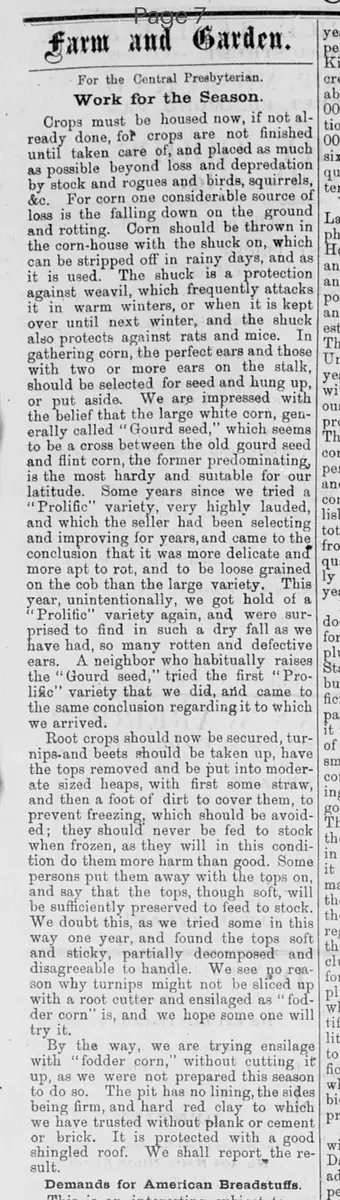
Crops must be housed now, if not already done, for crops are not finished until taken care of, and placed as much as possible beyond loss and depredation by stock and rogues and birds, squirrels, &c. For corn one considerable source of loss is the falling down on the ground and rotting. Corn should be thrown in the corn-house with the shuck on, which can be stripped off in rainy days, and as it is used. The shuck is a protection against weavil, which frequently attacks it in warm winters, or when it is kept over until next winter, and the shuck also protects against rats and mice. In gathering corn, the perfect ears and those with two or more ears on the stalk, should be selected for seed and hung up, or put aside. We are impressed with the belief that the large white corn, generally called "Gourd seed," which seems to be a cross between the old gourd seed and flint corn, the former predominating, is the most hardy and suitable for our latitude. Some years since we tried a "Prolific" variety, very highly lauded, and which the seller had been selecting and improving for years, and came to the conclusion that it was more delicate and more apt to rot, and to be loose grained on the cob than the large variety. This year, unintentionally, we got hold of a "Prolific" variety again, and were surprised to find in such a dry fall as we have had, so many rotten and defective ears. A neighbor who habitually raises the "Gourd seed," tried the first "Prolific" variety that we did, and came to the same conclusion regarding it to which we arrived.
Root crops should now be secured, turnips and beets should be taken up, have the tops removed and be put into moderate sized heaps, with first some straw, and then a foot of dirt to cover them, to prevent freezing, which should be avoided: they should never be fed to stock when frozen, as they will in this condition do them more harm than good. Some persons put them away with the tops on, and say that the tops, though soft, will be sufficiently preserved to feed to stock. We doubt this, as we tried some in this way one year, and found the tops soft and sticky, partially decomposed and disagreeable to handle. We see no reason why turnips might not be sliced up with a root cutter and ensilaged as "fodder corn" is, and we hope some one will try it.
By the way, we are trying ensilage with "fodder corn," without cutting it up, as we were not prepared this season to do so. The pit has no lining, the sides being firm, and hard red clay to which we have trusted without plank or cement or brick. It is protected with a good shingled roof. We shall report the result.
For the Central Presbyterian.
Work for the Season.
Crops must be housed now, if not already done, for crops are not finished until taken care of, and placed as much as possible beyond loss and depredation by stock and rogues and birds, squirrels, &c. For corn one considerable source of loss is the falling down on the ground and rotting. Corn should be thrown in the corn-house with the shuck on, which can be stripped off in rainy days, and as it is used. The shuck is a protection against weavil, which frequently attacks it in warm winters, or when it is kept over until next winter, and the shuck also protects against rats and mice. In gathering corn, the perfect ears and those with two or more ears on the stalk, should be selected for seed and hung up, or put aside. We are impressed with the belief that the large white corn, generally called "Gourd seed," which seems to be a cross between the old gourd seed and flint corn, the former predominating, is the most hardy and suitable for our latitude. Some years since we tried a "Prolific" variety, very highly lauded, and which the seller had been selecting and improving for years, and came to the conclusion that it was more delicate and more apt to rot, and to be loose grained on the cob than the large variety. This year, unintentionally, we got hold of a "Prolific" variety again, and were surprised to find in such a dry fall as we have had, so many rotten and defective ears. A neighbor who habitually raises the "Gourd seed," tried the first "Prolific" variety that we did, and came to the same conclusion regarding it to which we arrived.
Root crops should now be secured, turnips and beets should be taken up, have the tops removed and be put into moderate sized heaps, with first some straw, and then a foot of dirt to cover them, to prevent freezing, which should be avoided: they should never be fed to stock when frozen, as they will in this condition do them more harm than good. Some persons put them away with the tops on, and say that the tops, though soft, will be sufficiently preserved to feed to stock. We doubt this, as we tried some in this way one year, and found the tops soft and sticky, partially decomposed and disagreeable to handle. We see no reason why turnips might not be sliced up with a root cutter and ensilaged as "fodder corn" is, and we hope some one will try it.
By the way, we are trying ensilage with "fodder corn," without cutting it up, as we were not prepared this season to do so. The pit has no lining, the sides being firm, and hard red clay to which we have trusted without plank or cement or brick. It is protected with a good shingled roof. We shall report the result.
What sub-type of article is it?
Agricultural Advice
Seasonal Farming
What keywords are associated?
Corn Harvesting
Gourd Seed Corn
Root Crops Storage
Ensilage Experiment
Farming Advice
Story Details
Story Details
Instructions for housing corn with shucks to protect against pests and rot, selecting Gourd seed corn for hardiness, storing root crops like turnips and beets to prevent freezing, and experimenting with ensilage of fodder corn.