Thank you for visiting SNEWPapers!
Sign up free
The New Hampshire Gazette
Portsmouth, Rockingham County, New Hampshire
What is this article about?
February 1815 reports from New Orleans describe military reinforcements at Fort Stoddard and near Mobile amid expectations of British attack. Despite rumors of peace treaty signed at Ghent, no official news arrives; General Jackson enforces martial law, counters false publications, and urges troops to remain vigilant until ratification.
Clipping
OCR Quality
Full Text
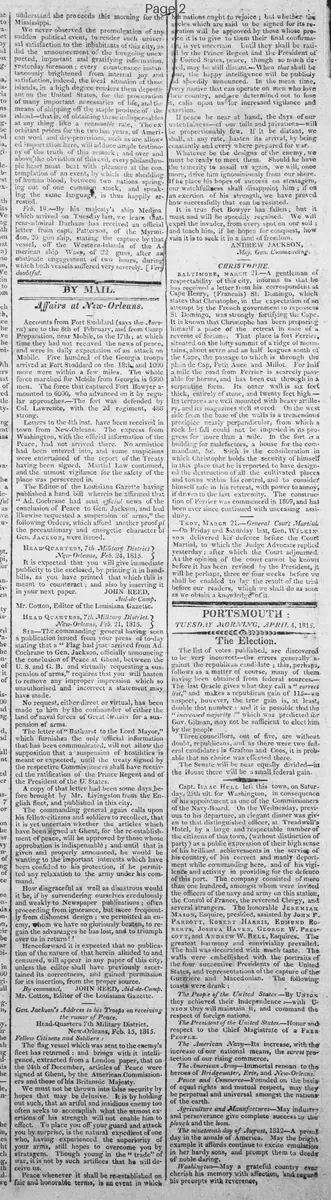
Affairs at New-Orleans.
Accounts from Fort Stoddard (says the Aurora) to the 8th of February, and from Camp Preparation, near Mobile, to the 17th: at which time they had not received the news of peace, and were in daily expectation of an attack on Mobile. Five hundred of the Georgia troops arrived at Fort Stoddard on the 18th. and 1000 more were within a few miles. The whole force marched for Mobile from Georgia is 6500 men. The force that captured Fort Bowyer amounted to 6000, who advanced on it by regular approaches.—The fort was defended by Col. Lawrence, with the 2d regiment, 488 strong.
Letters to the 4th inst. have been received in town from New-Orleans. The express from Washington, with the official information of the Peace, had not arrived there. No armistice had been entered into, and some suspicions were entertained of the report of the Treaty having been signed. Martial Law continued, and the utmost vigilance for the safety of the place was persevered in.
The Editor of the Louisiana Gazette having published a hand bill wherein he affirmed that "Ad. Cochrane had sent official news of the conclusion of Peace to Gen. Jackson, and had likewise requested a suspension of arms," the following Orders, which afford another proof of the precautionary and energetic character of Gen. Jackson, were issued.
HEAD-QUARTERS, 7th Military District,
New-Orleans, Feb. 24, 1815.
It is expected that you will give immediate publicity to the enclosed, by printing it in hand-bills, as you have printed that which this is meant to counteract; and also by inserting it in your next paper.
JOHN REED,
Aid-de-Camp.
Mr. Cotton, Editor of the Louisiana Gazette.
HEAD QUARTERS, 7th Military District.
New-Orleans, Feb. 21, 1815.
SIR—The commanding general having seen a publication issued from your press of to-day stating that a "Flag had just arrived from Ad. Cochrane to Gen. Jackson, officially announcing the conclusion of Peace at Ghent, between the U. S. and G. B. and virtually requesting a suspension of arms," requires that you will hasten to remove any improper impression which so unauthorised and incorrect a statement may have made.
No request, either direct or virtual, has been made to him by the commander of either the land or naval forces of Great-Britain for a suspension of arms.
The letter of "Bathurst to the Lord Mayor," which furnishes the only official information that has been communicated, will not allow the supposition that a suspension of hostilities is meant or expected, until the treaty signed by the respective Commissioners shall have received the ratification of the Prince Regent and of the President of the U. States.
A copy of that letter had been some days before brought by Mr. Livingston from the English fleet, and published in this city.
The commanding general again calls upon his fellow-citizens and soldiers to recollect, that it is yet uncertain whether the articles which have been signed at Ghent, for the re-establishment of peace, will be approved by those whose approbation is indispensable; and until that is given and properly announced, he would be wanting to the important interests which have been confided to his protection, if he permitted any relaxation to the army under his command.
How disgraceful as well as disastrous would it be, if by surrendering ourselves credulously and weakly to Newspaper publications; often proceeding from ignorance, but more frequently from dishonest design; we permitted an enemy, whom we have so gloriously beaten, to regain the advantages he has lost, and to triumph over us in return!!
Henceforward it is expected that no publication of the nature of that herein alluded to and censured, will appear in any paper of this city, unless the editor shall have previously ascertained its correctness, and gained permission for its insertion, from the proper source.
By command,
JOHN REED, Aid-de-Camp.
Mr. Cotton, Editor of the Louisiana Gazette.
Gen. Jackson's Address to his Troops on receiving the rumor of Peace.
Head-Quarters 7th Military District.
New-Orleans, Feb. 15, 1815.
Fellow Citizens and Soldiers:
The flag vessel which was sent to the enemy's fleet has returned: and brings with it intelligence, extracted from a London paper, that on the 24th of December, articles of Peace were signed at Ghent, by the American Commissioners and those of his Britannic Majesty.
We must not be thrown into false security by hopes that may be delusive. It is by holding out such, that an artful and insidious enemy too often seeks to accomplish what the utmost exertions of his strength will not enable him to effect. To place you off your guard and attack you by surprise, is the natural expedient of one who, having experienced the superiority of your arms, still hopes to overcome you by stratagem. Though young in the "trade" of war, it is not by such artifices that he will deceive us.
Peace whenever it shall be re-established on fair and honorable terms, is an event in which both nations ought to rejoice; but whether the articles which are said to be signed for its restoration will be approved by those whose province it is to give to them their final confirmation, is yet uncertain. Until they shall be ratified by the Prince Regent and the President of the United States, peace, though so much desired, may be still distant.—When that shall be done, the happy intelligence will be publicly and speedily announced. In the mean time, every motive that can operate on men who love their country, and are determined not to lose it, calls upon us for increased vigilance and exertion.
If peace be near at hand, the days of our watchfulness—of our toils and privations—will be proportionably few. If it be distant, we shall, at any rate, hasten its arrival, by being constantly and every where prepared for war.
Whatever be the designs of the enemy, we must be ready to meet them. Should he have the temerity to assail us again, we will, once more, drive him ignominiously from our shore. If he place his hopes of success on stratagem, our watchfulness shall disappoint him; if on an exertion of his strength, we have proved how successfully that can be resisted.
It is true Fort Bowyer has fallen; but it must and will be speedily regained. We will expel the invader, from every spot on our soil; and teach him, if he hopes for conquest, how vain it is to seek it in a land of freedom.
ANDREW JACKSON,
Maj. Gen. Commanding.
What sub-type of article is it?
What keywords are associated?
What entities or persons were involved?
Where did it happen?
Domestic News Details
Primary Location
New Orleans
Event Date
February 1815
Key Persons
Outcome
fort bowyer captured by 6000 british forces; defended by 488 men under col. lawrence. troops maintain vigilance; no relaxation until peace ratification. martial law continues.
Event Details
Military reports from Fort Stoddard and near Mobile detail Georgia troop arrivals and expectations of British attack. New Orleans letters indicate no official peace news from Washington, suspicions of treaty reports, and ongoing martial law. General Jackson issues orders to editor Mr. Cotton to retract false peace publication claiming Admiral Cochrane's request for armistice suspension, emphasizing need for ratification. Jackson addresses troops on February 15, urging vigilance despite Ghent treaty rumors, vowing to regain Fort Bowyer and repel invaders.