Thank you for visiting SNEWPapers!
Sign up free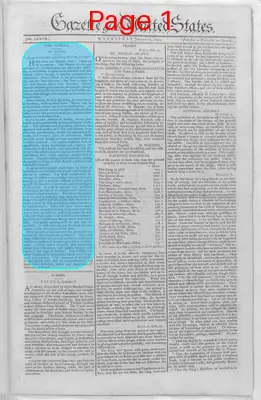
Editorial
January 6, 1790
Gazette Of The United States
New York, New York County, New York
What is this article about?
This editorial argues that true freedom requires civilization and knowledge, as ignorant peoples cannot preserve liberty and are prone to slavery, barbarism, or factionalism. It contrasts savage freedom with civil liberty under law, stressing diffusive education to guard against manipulation and ensure informed public opinion.
Clipping
OCR Quality
98%
Excellent
Full Text
THE TABLET
No. LXXVII.
"An ignorant people cannot long preserve freedom."
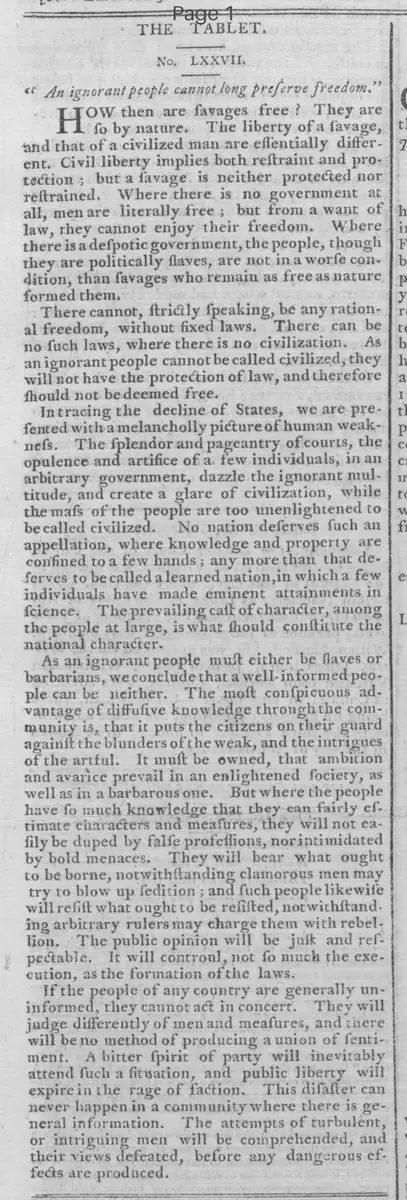
How then are savages free? They are so by nature. The liberty of a savage, and that of a civilized man are essentially different. Civil liberty implies both restraint and protection; but a savage is neither protected nor restrained. Where there is no government at all, men are literally free; but from a want of law, they cannot enjoy their freedom. Where there is a despotic government, the people, though they are politically slaves, are not in a worse condition, than savages who remain as free as nature formed them.
There cannot, strictly speaking, be any rational freedom, without fixed laws. There can be no such laws, where there is no civilization. As an ignorant people cannot be called civilized, they will not have the protection of law, and therefore should not be deemed free.
In tracing the decline of States, we are presented with a melancholy picture of human weakness. The splendor and pageantry of courts, the opulence and artifice of a few individuals, in an arbitrary government, dazzle the ignorant multitude, and create a glare of civilization, while the mass of the people are too unenlightened to be called civilized. No nation deserves such an appellation, where knowledge and property are confined to a few hands; any more than that deserves to be called a learned nation, in which a few individuals have made eminent attainments in science. The prevailing cast of character, among the people at large, is what should constitute the national character.
As an ignorant people must either be slaves or barbarians, we conclude that a well-informed people can be neither. The most conspicuous advantage of diffusive knowledge through the community is, that it puts the citizens on their guard against the blunders of the weak, and the intrigues of the artful. It must be owned, that ambition and avarice prevail in an enlightened society, as well as in a barbarous one. But where the people have so much knowledge that they can fairly estimate characters and measures, they will not easily be duped by false professions, nor intimidated by bold menaces. They will bear what ought to be borne, notwithstanding clamorous men may try to blow up sedition; and such people likewise will resist what ought to be resisted, notwithstanding arbitrary rulers may charge them with rebellion. The public opinion will be just and respectable. It will control, not so much the execution, as the formation of the laws.
If the people of any country are generally uninformed, they cannot act in concert. They will judge differently of men and measures, and there will be no method of producing a union of sentiment. A bitter spirit of party will inevitably attend such a situation, and public liberty will expire in the rage of faction. This disaster can never happen in a community where there is general information. The attempts of turbulent, or intriguing men will be comprehended, and their views defeated, before any dangerous effects are produced.
No. LXXVII.
"An ignorant people cannot long preserve freedom."
How then are savages free? They are so by nature. The liberty of a savage, and that of a civilized man are essentially different. Civil liberty implies both restraint and protection; but a savage is neither protected nor restrained. Where there is no government at all, men are literally free; but from a want of law, they cannot enjoy their freedom. Where there is a despotic government, the people, though they are politically slaves, are not in a worse condition, than savages who remain as free as nature formed them.
There cannot, strictly speaking, be any rational freedom, without fixed laws. There can be no such laws, where there is no civilization. As an ignorant people cannot be called civilized, they will not have the protection of law, and therefore should not be deemed free.
In tracing the decline of States, we are presented with a melancholy picture of human weakness. The splendor and pageantry of courts, the opulence and artifice of a few individuals, in an arbitrary government, dazzle the ignorant multitude, and create a glare of civilization, while the mass of the people are too unenlightened to be called civilized. No nation deserves such an appellation, where knowledge and property are confined to a few hands; any more than that deserves to be called a learned nation, in which a few individuals have made eminent attainments in science. The prevailing cast of character, among the people at large, is what should constitute the national character.
As an ignorant people must either be slaves or barbarians, we conclude that a well-informed people can be neither. The most conspicuous advantage of diffusive knowledge through the community is, that it puts the citizens on their guard against the blunders of the weak, and the intrigues of the artful. It must be owned, that ambition and avarice prevail in an enlightened society, as well as in a barbarous one. But where the people have so much knowledge that they can fairly estimate characters and measures, they will not easily be duped by false professions, nor intimidated by bold menaces. They will bear what ought to be borne, notwithstanding clamorous men may try to blow up sedition; and such people likewise will resist what ought to be resisted, notwithstanding arbitrary rulers may charge them with rebellion. The public opinion will be just and respectable. It will control, not so much the execution, as the formation of the laws.
If the people of any country are generally uninformed, they cannot act in concert. They will judge differently of men and measures, and there will be no method of producing a union of sentiment. A bitter spirit of party will inevitably attend such a situation, and public liberty will expire in the rage of faction. This disaster can never happen in a community where there is general information. The attempts of turbulent, or intriguing men will be comprehended, and their views defeated, before any dangerous effects are produced.
What sub-type of article is it?
Education
Constitutional
Social Reform
What keywords are associated?
Ignorant People
Freedom
Civilization
Knowledge
Public Opinion
Education
Liberty
Factionalism
Editorial Details
Primary Topic
Role Of Knowledge In Preserving Freedom
Stance / Tone
Advocacy For Widespread Education To Sustain Civil Liberty
Key Arguments
Ignorant People Cannot Preserve Freedom, Unlike Savages Who Are Free By Nature But Unprotected
Civil Liberty Requires Fixed Laws And Civilization, Absent In Ignorance
Decline Of States Stems From Unequal Knowledge Distribution Dazzling The Masses
Diffusive Knowledge Guards Citizens Against Blunders, Intrigues, And Manipulation
Informed People Act In Concert, Resist Sedition Or Tyranny, And Form Just Public Opinion
Uninformed Societies Breed Factionalism And Loss Of Liberty