Thank you for visiting SNEWPapers!
Sign up free
Alexandria Gazette, Commercial And Political
Alexandria, Virginia
What is this article about?
Nashville report on successful Indian treaty: Chickasaws cede ~10M acres north of Tennessee River for $12K/year annuity; Cherokees cede ~5M acres south/west to Coosa River for $6K/year, except Col. Brown's plantation. Negotiated by Gens. Jackson and Meriwether; valuable cotton lands acquired.
Clipping
OCR Quality
Full Text
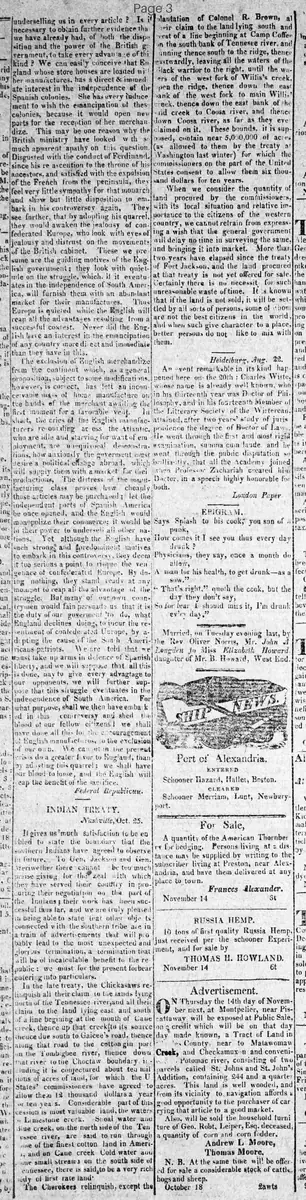
INDIAN TREATY.
Nashville, Oct. 25.
It gives us much satisfaction to be enabled to state the boundary that the southern Indians have agreed to observe in future. To Gen. Jackson and Gen. Meriwether there cannot be too much praise given for the zeal with which they have served their country in prosecuting their negotiation on the part of the Indians: their work has been successful thus far, and we are truly pleased in being able to state that other objects connected with the southern tribes are in a train of arrangements that will probably lead to the most unexpected and glorious termination, a termination that will be of incalculable benefit to the republic: we must for the present forbear entering into particulars.
In the late treaty, the Chickasaws relinquish all their claim to the lands lying north of the Tennessee river, and all their claim to the land lying east and south of a line beginning at the mouth of Cane creek, thence up that creek to its source, thence due south to Gaige's road, thence along that road to the cotton gin port on the Tombigbee river, thence down that river to the Choctaw boundary, including it is conjectured about ten millions of acres of land, for which the U. States' commissioners have agreed to allow them 12 thousand dollars a year for ten years. Considerable part of this cession is most valuable land, the waters of Limestone creek, Shoal water and Blue creek, on the north side of the Tennessee river, are said to run through some of the finest cotton land in America, and on Cane creek Cold water and two small streams on the south side of Tennessee, there is said to be a very rich body of first rate land.
The Cherokees relinquish except the plantation of Colonel R. Brown, all their claim to the land lying south and west of a line beginning at Camp Coffee in the south bank of Tennessee river, and running thence south to the ridge, thence eastwardly, leaving all the waters of the Black Warrior to the right, until the waters of the west fork of Willis's creek, open the ridge, thence down the east bank of the west fork to main Willis creek, thence down the east bank of the said creek to Coosa river, and thence down Coosa river, as far as they ever claimed on it. These bounds, it is supposed, contain near 5,000,000 of acres (as allowed to them by the treaty at Washington last winter) for which the commissioners on the part of the United States consent to allow them six thousand dollars for ten years.
When we consider the quantity of land procured by the commissioners, with its local situation and relative importance to the citizens of the western country, we cannot refrain from expressing a wish that the general government will delay no time in surveying the same, and bringing it into market. More than two years have elapsed since the treaty of Fort Jackson, and the land procured at that treaty is not yet offered for sale. Certainly there is no necessity for such unreasonable waste of time. It is known that if the land is not sold, it will be settled by all sorts of persons, some of whom are not the best citizens in the world, and when such give character to a place, better persons do not like to mix with them.
What sub-type of article is it?
What keywords are associated?
What entities or persons were involved?
Where did it happen?
Domestic News Details
Primary Location
Nashville
Event Date
Oct. 25
Key Persons
Outcome
chickasaws relinquish claims to about 10 million acres for $12,000 annually for 10 years; cherokees relinquish claims to near 5 million acres except colonel r. brown's plantation for $6,000 annually for 10 years.
Event Details
The southern Indians, including Chickasaws and Cherokees, agreed to boundary lines in a treaty negotiated by Gen. Jackson and Gen. Meriwether. Chickasaws cede lands north of Tennessee River and east/south of specified line to Tombigbee River. Cherokees cede lands south/west of line from Camp Coffee to Coosa River. Lands described as valuable cotton areas. Editorial urges prompt surveying and sale by government to prevent unauthorized settlement.