Thank you for visiting SNEWPapers!
Sign up free
Story
September 21, 1899
Harrison Press Journal
Harrison, Sioux County, Nebraska
What is this article about?
Australian newspaper reports of a double-headed sea monster in Swan Bay debunked as two beaked whale carcasses, illustrating how sea serpent myths arise from misidentification.
Clipping
OCR Quality
95%
Excellent
Full Text
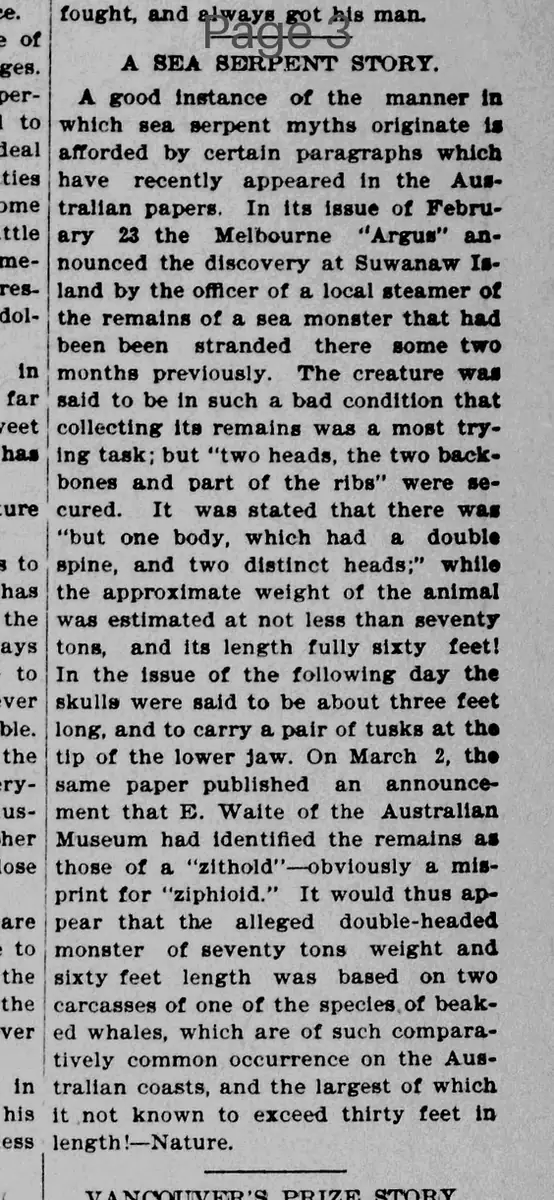
A SEA SERPENT STORY.
A good instance of the manner in which sea serpent myths originate is afforded by certain paragraphs which have recently appeared in the Australian papers. In its issue of February 23 the Melbourne "Argus" announced the discovery at Swan Bay, island by the officer of a local steamer of the remains of a sea monster that had been stranded there some two months previously.
The creature was said to be in such a bad condition that collecting its remains was a most trying task; but "two heads, the two backbones and part of the ribs" were secured. It was stated that there was "but one body, which had a double spine, and two distinct heads;" while the approximate weight of the animal was estimated at not less than seventy tons, and its length fully sixty feet!
In the issue of the following day the skulls were said to be about three feet long, and to carry a pair of tusks at the tip of the lower jaw. On March 2, the same paper published an announcement that E. Waite of the Australian Museum had identified the remains as those of a ziphioid'—obviously a misprint for "ziphiid." It would thus appear that the alleged double-headed monster of seventy tons weight and sixty feet length was based on two carcasses of one of the species of beaked whales, which are of such comparatively common occurrence on the Australian coasts, and the largest of which is not known to exceed thirty feet in length!—Nature.
A good instance of the manner in which sea serpent myths originate is afforded by certain paragraphs which have recently appeared in the Australian papers. In its issue of February 23 the Melbourne "Argus" announced the discovery at Swan Bay, island by the officer of a local steamer of the remains of a sea monster that had been stranded there some two months previously.
The creature was said to be in such a bad condition that collecting its remains was a most trying task; but "two heads, the two backbones and part of the ribs" were secured. It was stated that there was "but one body, which had a double spine, and two distinct heads;" while the approximate weight of the animal was estimated at not less than seventy tons, and its length fully sixty feet!
In the issue of the following day the skulls were said to be about three feet long, and to carry a pair of tusks at the tip of the lower jaw. On March 2, the same paper published an announcement that E. Waite of the Australian Museum had identified the remains as those of a ziphioid'—obviously a misprint for "ziphiid." It would thus appear that the alleged double-headed monster of seventy tons weight and sixty feet length was based on two carcasses of one of the species of beaked whales, which are of such comparatively common occurrence on the Australian coasts, and the largest of which is not known to exceed thirty feet in length!—Nature.
What sub-type of article is it?
Curiosity
Extraordinary Event
What themes does it cover?
Deception
Nature
What keywords are associated?
Sea Serpent
Myth Origin
Beaked Whale
Australia
Debunking
Double Headed Monster
What entities or persons were involved?
E. Waite
Where did it happen?
Swan Bay, Australia
Story Details
Key Persons
E. Waite
Location
Swan Bay, Australia
Event Date
Stranded Some Two Months Before February 23
Story Details
Reports in the Melbourne Argus described remains of a double-headed sea monster, 60 feet long and 70 tons, found in Swan Bay. Identified by E. Waite as two beaked whale carcasses.