Thank you for visiting SNEWPapers!
Sign up free
Story
March 20, 1891
The Lebanon Express
Lebanon, Linn County, Oregon
What is this article about?
The game of billiards was invented around the mid-16th century by London pawnbroker William Kew, who played with balls and a yard measure on his counter during bad weather, evolving into the modern game, as described in a 1570 manuscript.
Clipping
OCR Quality
95%
Excellent
Full Text
Origin of the Game of Billiards.
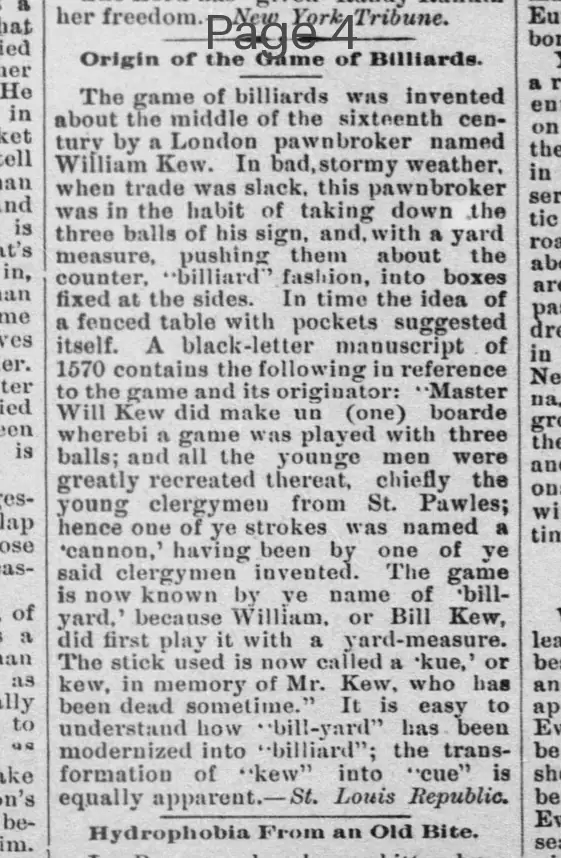
The game of billiards was invented about the middle of the sixteenth century by a London pawnbroker named William Kew. In bad, stormy weather, when trade was slack, this pawnbroker was in the habit of taking down the three balls of his sign, and, with a yard measure, pushing them about the counter, billiard fashion, into boxes fixed at the sides. In time the idea of a fenced table with pockets suggested itself. A black-letter manuscript of 1570 contains the following in reference to the game and its originator: "Master Will Kew did make un (one) boarde wherebi a game was played with three balls; and all the younge men were greatly recreated thereat, chiefly the young clergymen from St. Pawles; hence one of ye strokes was named a 'cannon,' having been by one of ye said clergymen invented. The game is now known by ye name of bill-yard,' because William, or Bill Kew, did first play it with a yard-measure. The stick used is now called a 'kue,' or kew, in memory of Mr. Kew, who has been dead sometime." It is easy to understand how 'bill-yard' has been modernized into "billiard"; the transformation of "kew" into "cue" is equally apparent.—St. Louis Republic.
The game of billiards was invented about the middle of the sixteenth century by a London pawnbroker named William Kew. In bad, stormy weather, when trade was slack, this pawnbroker was in the habit of taking down the three balls of his sign, and, with a yard measure, pushing them about the counter, billiard fashion, into boxes fixed at the sides. In time the idea of a fenced table with pockets suggested itself. A black-letter manuscript of 1570 contains the following in reference to the game and its originator: "Master Will Kew did make un (one) boarde wherebi a game was played with three balls; and all the younge men were greatly recreated thereat, chiefly the young clergymen from St. Pawles; hence one of ye strokes was named a 'cannon,' having been by one of ye said clergymen invented. The game is now known by ye name of bill-yard,' because William, or Bill Kew, did first play it with a yard-measure. The stick used is now called a 'kue,' or kew, in memory of Mr. Kew, who has been dead sometime." It is easy to understand how 'bill-yard' has been modernized into "billiard"; the transformation of "kew" into "cue" is equally apparent.—St. Louis Republic.
What sub-type of article is it?
Curiosity
Historical Event
What keywords are associated?
Billiards Origin
William Kew
London Pawnbroker
Yard Measure
Sixteenth Century
Cannon Stroke
What entities or persons were involved?
William Kew
Master Will Kew
Where did it happen?
London
Story Details
Key Persons
William Kew
Master Will Kew
Location
London
Event Date
About The Middle Of The Sixteenth Century
Story Details
William Kew, a London pawnbroker, invented billiards by pushing three balls with a yard measure on his counter during bad weather, leading to a fenced table with pockets; a 1570 manuscript describes the game as 'bill-yard' and the stick as 'kue' in his memory, with 'cannon' stroke invented by a clergyman.