Thank you for visiting SNEWPapers!
Sign up free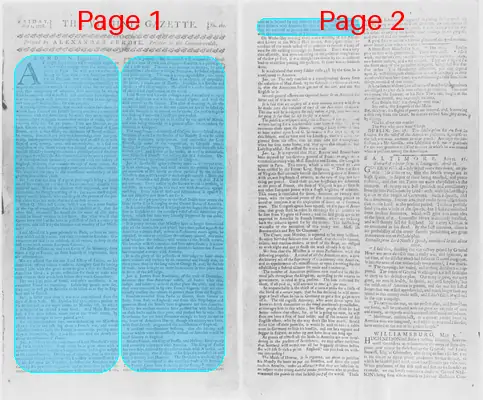
The Virginia Gazette
Williamsburg, Virginia
What is this article about?
London reports from early January detail British responses to American independence efforts, including Lord North's refusal to acknowledge mistreatment of American prisoners but promise of future redress; rumors of a French-American commercial treaty granting trade exclusives, territorial returns, and military aid; diplomatic travels by Lord Mansfield and others; economic strains from the war; and international support for America from France, Prussia, and Holland.
Merged-components note: This is a clear textual continuation of the foreign news article from page 1 into the top of page 2.
Clippings
1 of 2
OCR Quality
Full Text
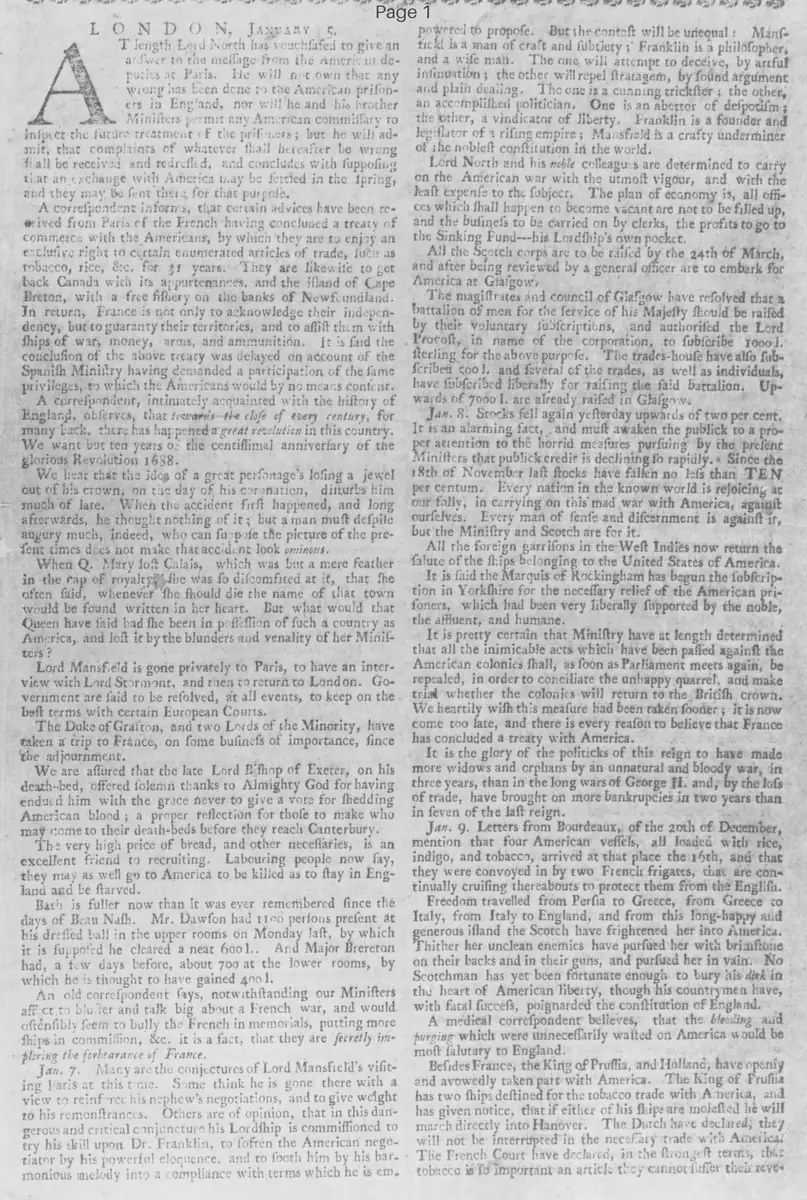
At length Lord North has vouchsafed to give an answer to the message from the American deputies at Paris. He will not own that any wrong has been done to the American prisoners in England, nor will he and his brother Ministers permit any American commissary to inspect the future treatment of the prisoners; but he will admit, that complaints of whatever shall hereafter be wrong shall all be received and redressed, and concludes with supposing that an exchange with America may be settled in the spring, and they may be sent there, for that purpose.
A correspondent informs, that certain advices have been received from Paris of the French having concluded a treaty of commerce with the Americans, by which they are to enjoy an exclusive right to certain enumerated articles of trade, such as tobacco, rice, &c. for 31 years. They are likewise to get back Canada with its appurtenances, and the island of Cape Breton, with a free fishery on the banks of Newfoundland.
In return, France is not only to acknowledge their independence, but to guaranty their territories, and to aid them with ships of war, money, arms, and ammunition. It is said the conclusion of the above treaty was delayed on account of the Spanish Ministry having demanded a participation of the same privileges, to which the Americans would by no means consent.
A correspondent, intimately acquainted with the history of England, observes, that forwards the close of every century, for many past, there has happened a great revolution in this country. We want but ten years of the centennial anniversary of the glorious Revolution 1688.
We hear that the idea of a great personage's losing a jewel out of his crown, on the day of his coronation, disturbs him much of late. When the accident first happened, and long afterwards, he thought nothing of it; but a man must despise augury much, indeed, who can suppose the picture of the present times does not make that accident look ominous.
When Q. Mary lost Calais, which was but a mere feather in the cap of royalty, she was so discomfited at it, that she often said, whenever she should die the name of that town would be found written in her heart. But what would that Queen have said had she been in possession of such a country as America, and lost it by the blunders and venality of her Ministers?
Lord Mansfield is gone privately to Paris, to have an interview with Lord Stormont, and then to return to London. Government are said to be resolved, at all events, to keep on the best terms with certain European Courts.
The Duke of Grafton, and two Lords of the Minority, have taken a trip to France, on some business of importance, since the adjournment.
We are assured that the late Lord Bishop of Exeter, on his death-bed, offered solemn thanks to Almighty God for having endued him with the grace never to give a vote for shedding American blood; a proper reflection for those to make who may come to their death-beds before they reach Canterbury.
The very high price of bread, and other necessaries, is an excellent friend to recruiting. Labouring people now say, they may as well go to America to be killed as to stay in England and be starved.
Bath is fuller now than it was ever remembered since the days of Beau Nash. Mr. Dawson had 1100 persons present at his dressed ball in the upper rooms on Monday last, by which it is supposed he cleared a neat 600l. And Major Brereton had, a few days before, about 700 at the lower rooms, by which he is thought to have gained 400l.
An old correspondent says, notwithstanding our Ministers affect to bluster and talk big about a French war, and would ostensively seem to bully the French in memorials, putting more ships in commission, &c. it is a fact, that they are secretly imploring the forbearance of France.
Jan. 7. Many are the conjectures of Lord Mansfield's visiting Paris at this time. Some think he is gone there with a view to reinforce his nephew's negotiations, and to give weight to his remonstrances. Others are of opinion, that in this dangerous and critical conjuncture his Lordship is commissioned to try his skill upon Dr. Franklin, to soften the American negotiator by his powerful eloquence, and to sooth him by his harmonious melody into a compliance with terms which he is empowered to propose. But the contest will be unequal: Mansfield is a man of craft and subtlety; Franklin is a philosopher and a wise man. The one will attempt to deceive, by artful insinuation; the other will repel stratagem, by sound argument and plain dealing. The one is a cunning trickster; the other an accomplished politician. One is an abettor of despotism; the other, a vindicator of liberty. Franklin is a founder and legislator of a rising empire; Mansfield is a crafty underminer of the noblest constitution in the world.
Lord North and his noble colleagues are determined to carry on the American war with the utmost vigour, and with the least expense to the subject. The plan of economy is, all offices which shall happen to become vacant are not to be filled up, and the business to be carried on by clerks, the profits to go to the Sinking Fund—his Lordship's own pocket.
All the Scotch corps are to be raised by the 24th of March, and after being reviewed by a general officer are to embark for America at Glasgow.
The magistrates and council of Glasgow have resolved that a battalion of men for the service of his Majesty should be raised by their voluntary subscriptions, and authorised the Lord Provost, in name of the corporation, to subscribe 1000l. sterling for the above purpose. The trades-house have also subscribed 200l. and several of the trades, as well as individuals, have subscribed liberally for raising the said battalion. Upwards of 7000l. are already raised in Glasgow.
Jan. 8. Stocks fell again yesterday upwards of two per cent. It is an alarming fact, and must awaken the publick to a proper attention to the horrid measures pursuing by the present Ministers that publick credit is declining so rapidly. Since the 18th of November last stocks have fallen no less than TEN per centum. Every nation in the known world is rejoicing at our folly, in carrying on this mad war with America, against ourselves. Every man of sense and discernment is against it, but the Ministry and Scotch are for it.
All the foreign garrisons in the West Indies now return the salute of the Ships belonging to the United States of America.
It is said the Marquis of Rockingham has begun the subscription in Yorkshire for the necessary relief of the American prisoners, which had been very liberally supported by the noble, the affluent, and humane.
It is pretty certain that Ministry have at length determined that all the inimical acts which have been passed against the American colonies shall, as soon as Parliament meets again, be repealed, in order to conciliate the unhappy quarrel, and make trial whether the colonies will return to the British crown.
We heartily wish this measure had been taken sooner; it is now come too late, and there is every reason to believe that France has concluded a treaty with America.
It is the glory of the politicks of this reign to have made more widows and orphans by an unnatural and bloody war, in three years, than in the long wars of George II. and, by the loss of trade, have brought on more bankruptcies in two years than in seven of the last reign.
Jan. 9. Letters from Bourdeaux, of the 20th of December, mention that four American vessels, all loaded with rice, indigo, and tobacco, arrived at that place the 15th, and that they were convoyed in by two French frigates, that are continually cruising thereabouts to protect them from the English.
Freedom travelled from Persia to Greece, from Greece to Italy, from Italy to England, and from this long-happy and generous island the Scotch have frightened her into America. Thither her unclean enemies have pursued her with brimstone on their backs and in their guns, and pursued her in vain. No Scotchman has yet been fortunate enough to bury his dirk in the heart of American liberty, though his countrymen have, with fatal success, poignarded the constitution of England.
A medical correspondent believes, that the bleeding and purging which were unnecessarily wasted on America would be most salutary to England.
Besides France, the King of Prussia, and Holland, have openly and avowedly taken part with America. The King of Prussia has two ships destined for the tobacco trade with America, and has given notice, that if either of his ships are molested he will march directly into Hanover. The Dutch have declared, they will not be interrupted in the necessary trade with America.
The French Court have declared, in the strongest terms, that tobacco is so important an article they cannot suffer their revenue to be injured by the English.
continues to be injured by any attempt to prohibit the commerce of their subjects with America for that article, and therefore that they are resolved to protect the commerce of their merchants with the commonwealth of Virginia.
What sub-type of article is it?
What keywords are associated?
What entities or persons were involved?
Where did it happen?
Foreign News Details
Primary Location
America
Event Date
January 5
Key Persons
Outcome
rumored french-american treaty grants trade exclusives for 31 years, return of canada and cape breton, french guarantee of independence and military aid; british stocks fall 10% since november; glasgow raises over 7000l. for battalion; potential repeal of acts against colonies; international support for america from france, prussia, holland.
Event Details
British government responds to American complaints about prisoners, promising future redress but no admission of wrong; rumors from Paris of French-American commercial treaty with territorial and military provisions, delayed by Spanish demands; diplomatic missions to Paris by Lord Mansfield and others; economic distress aids recruiting; conjectures on negotiations with Franklin; plans to continue war economically; raising of Scotch corps for America; falling stocks due to war; salutes to American ships in West Indies; subscriptions for prisoner relief; potential repeal of punitive acts; arrival of American vessels at Bordeaux under French protection; foreign powers supporting American trade.