Thank you for visiting SNEWPapers!
Sign up free
Editorial
January 12, 1945
St. Paul Recorder
Saint Paul, Ramsey County, Minnesota
What is this article about?
The Supreme Court unanimously ruled in Steele and Tunstall cases that the Brotherhood of Locomotive Firemen and Enginemen violated the Railway Labor Act by discriminating against Black workers in bargaining with Southeastern railroads, vindicating 1943 FEPC directives. Justice Murphy invoked constitutional protections.
Clipping
OCR Quality
98%
Excellent
Full Text
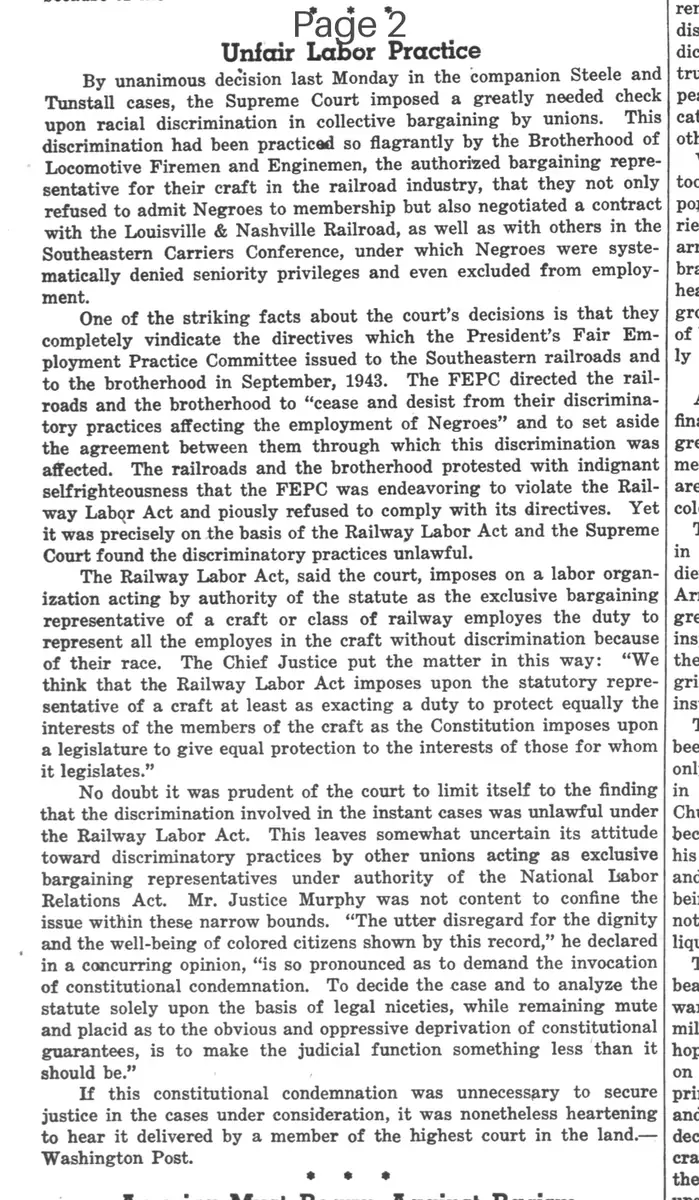
Unfair Labor Practice
By unanimous decision last Monday in the companion Steele and Tunstall cases, the Supreme Court imposed a greatly needed check upon racial discrimination in collective bargaining by unions. This discrimination had been practiced so flagrantly by the Brotherhood of Locomotive Firemen and Enginemen, the authorized bargaining representative for their craft in the railroad industry, that they not only refused to admit Negroes to membership but also negotiated a contract with the Louisville & Nashville Railroad, as well as with others in the Southeastern Carriers Conference, under which Negroes were systematically denied seniority privileges and even excluded from employment.
One of the striking facts about the court's decisions is that they completely vindicate the directives which the President's Fair Employment Practice Committee issued to the Southeastern railroads and to the brotherhood in September, 1943. The FEPC directed the railroads and the brotherhood to 'cease and desist from their discriminatory practices affecting the employment of Negroes' and to set aside the agreement between them through which this discrimination was effected. The railroads and the brotherhood protested with indignant self-righteousness that the FEPC was endeavoring to violate the Railway Labor Act and piously refused to comply with its directives. Yet it was precisely on the basis of the Railway Labor Act that the Supreme Court found the discriminatory practices unlawful.
The Railway Labor Act, said the court, imposes on a labor organization acting by authority of the statute as the exclusive bargaining representative of a craft or class of railway employees the duty to represent all the employees in the craft without discrimination because of their race. The Chief Justice put the matter in this way: 'We think that the Railway Labor Act imposes upon the statutory representative of a craft at least as exacting a duty to protect equally the interests of the members of the craft as the Constitution imposes upon a legislature to give equal protection to the interests of those for whom it legislates.'
No doubt it was prudent of the court to limit itself to the finding that the discrimination involved in the instant cases was unlawful under the Railway Labor Act. This leaves somewhat uncertain its attitude toward discriminatory practices by other unions acting as exclusive bargaining representatives under authority of the National Labor Relations Act. Mr. Justice Murphy was not content to confine the issue within these narrow bounds. 'The utter disregard for the dignity and the well-being of colored citizens shown by this record,' he declared in a concurring opinion, 'is so pronounced as to demand the invocation of constitutional condemnation. To decide the case and to analyze the statute solely upon the basis of legal niceties, while remaining mute and placid as to the obvious and oppressive deprivation of constitutional guarantees, is to make the judicial function something less than it should be.'
If this constitutional condemnation was unnecessary to secure justice in the cases under consideration, it was nonetheless heartening to hear it delivered by a member of the highest court in the land.—Washington Post.
By unanimous decision last Monday in the companion Steele and Tunstall cases, the Supreme Court imposed a greatly needed check upon racial discrimination in collective bargaining by unions. This discrimination had been practiced so flagrantly by the Brotherhood of Locomotive Firemen and Enginemen, the authorized bargaining representative for their craft in the railroad industry, that they not only refused to admit Negroes to membership but also negotiated a contract with the Louisville & Nashville Railroad, as well as with others in the Southeastern Carriers Conference, under which Negroes were systematically denied seniority privileges and even excluded from employment.
One of the striking facts about the court's decisions is that they completely vindicate the directives which the President's Fair Employment Practice Committee issued to the Southeastern railroads and to the brotherhood in September, 1943. The FEPC directed the railroads and the brotherhood to 'cease and desist from their discriminatory practices affecting the employment of Negroes' and to set aside the agreement between them through which this discrimination was effected. The railroads and the brotherhood protested with indignant self-righteousness that the FEPC was endeavoring to violate the Railway Labor Act and piously refused to comply with its directives. Yet it was precisely on the basis of the Railway Labor Act that the Supreme Court found the discriminatory practices unlawful.
The Railway Labor Act, said the court, imposes on a labor organization acting by authority of the statute as the exclusive bargaining representative of a craft or class of railway employees the duty to represent all the employees in the craft without discrimination because of their race. The Chief Justice put the matter in this way: 'We think that the Railway Labor Act imposes upon the statutory representative of a craft at least as exacting a duty to protect equally the interests of the members of the craft as the Constitution imposes upon a legislature to give equal protection to the interests of those for whom it legislates.'
No doubt it was prudent of the court to limit itself to the finding that the discrimination involved in the instant cases was unlawful under the Railway Labor Act. This leaves somewhat uncertain its attitude toward discriminatory practices by other unions acting as exclusive bargaining representatives under authority of the National Labor Relations Act. Mr. Justice Murphy was not content to confine the issue within these narrow bounds. 'The utter disregard for the dignity and the well-being of colored citizens shown by this record,' he declared in a concurring opinion, 'is so pronounced as to demand the invocation of constitutional condemnation. To decide the case and to analyze the statute solely upon the basis of legal niceties, while remaining mute and placid as to the obvious and oppressive deprivation of constitutional guarantees, is to make the judicial function something less than it should be.'
If this constitutional condemnation was unnecessary to secure justice in the cases under consideration, it was nonetheless heartening to hear it delivered by a member of the highest court in the land.—Washington Post.
What sub-type of article is it?
Labor
Constitutional
Social Reform
What keywords are associated?
Racial Discrimination
Railroad Unions
Supreme Court
Railway Labor Act
Fepc
Collective Bargaining
What entities or persons were involved?
Supreme Court
Brotherhood Of Locomotive Firemen And Enginemen
Louisville & Nashville Railroad
Southeastern Carriers Conference
President's Fair Employment Practice Committee
Chief Justice
Mr. Justice Murphy
Editorial Details
Primary Topic
Supreme Court Decision Against Racial Discrimination In Railroad Unions
Stance / Tone
Supportive Of Anti Discrimination Ruling
Key Figures
Supreme Court
Brotherhood Of Locomotive Firemen And Enginemen
Louisville & Nashville Railroad
Southeastern Carriers Conference
President's Fair Employment Practice Committee
Chief Justice
Mr. Justice Murphy
Key Arguments
Unions As Exclusive Bargaining Representatives Must Represent All Employees Without Racial Discrimination Under The Railway Labor Act
Court Vindicates Fepc Directives Against Discriminatory Practices
Discrimination Denies Seniority And Employment To Negroes
Constitutional Condemnation Of Racial Discrimination In Labor Practices