Thank you for visiting SNEWPapers!
Sign up free
Story
April 12, 1840
Rutland Herald
Rutland, Rutland County, Vermont
What is this article about?
Historical account of the American forces' surprise attack on the British fort at Stony Point on July 16, 1779, led by General Washington and General Wayne, resulting in the capture of the fort, 543 British prisoners, and 15 cannon with 98 American casualties.
Clipping
OCR Quality
98%
Excellent
Full Text
Chambers' Edinburgh Journal.
SCENE OF THE REVOLUTION.
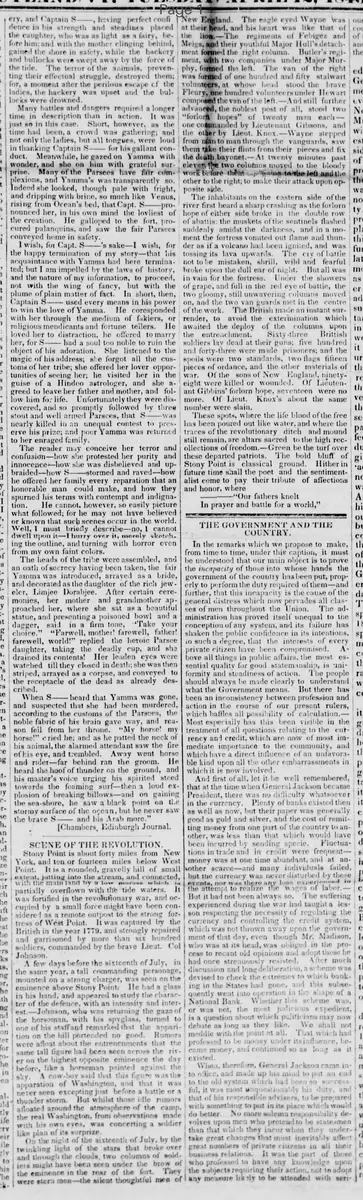
Stony Point is about forty miles from New York, and ten or fourteen miles below West Point. It is a rounded, gravelly hill of small extent, jutting into the stream, and connected with the main land by a low morass which is partially overflown with the tide waters. It was fortified in the revolutionary war, and occupied by a small force might have been considered as a remote outpost to the strong fortress of West Point. It was captured by the British in the year 1779, and strongly repaired and garrisoned by more than six hundred soldiers, commanded by the brave Lieut. Col. Johnson.
A few days before the sixteenth of July, in the same year, a tall commanding personage, mounted on a strong charger, was seen on the eminence above Stony Point: He had a glass in his hand, and appeared to study the character of the defence, with an intensity and interest.—Johnson, who was returning the gaze of the horseman, with his spyglass, turned to one of his staff and remarked that the apparition on the hill portended no good. Rumors were afloat about the entrenchments that the same tall figure had been seen across the river on the highest opposite eminence the day before, like a horseman painted against the sky.
A cow-boy said that this figure was the apparition of Washington, and that it was never seen excepting just before a battle or a thunder storm. But whilst those idle rumors afloat around the atmosphere of the camp, the real Washington, from observations made with his own eyes, was concerting a soldier-like plan of its surprise.
On the night of the sixteenth of July, by the twinkling light of the stars that broke over and through the clouds, two columns of soldiers might have been seen under the brow of the eminence in the rear of the fort. They were stern men—the silent thoughtful men of New England. The eagle-eyed Wayne was at their head, and his heart was like that of the lion—The regiments of Febiger and Meigs, and their youthful Major Hull's detachment formed the right column. Butler's regiment, with two companies under Major Murphy, formed the left. The van of the right was formed of one hundred and fifty stalwart volunteers, at whose head stood the brave Fleury, one hundred volunteers under Stewart composed the van of the left.—And still further advanced, the noblest post of all, stood two "forlorn hopes" of twenty men each— one commanded by Lieutenant Gibbons, and the other by Lieut. Knox.—Wayne stepped from man to man through the vanguards, saw them take their flints from their pieces and fix the death bayonet.—At twenty minutes past eleven, the two columns moved to the bloody work before them; one to the left and the other to the right; to make their attack upon opposite sides.
The inhabitants on the eastern side of the river first heard a sharp crashing as the forlorn hope of either side broke in the double row of abattis: the muskets of the sentinels flashed suddenly amidst the darkness, and in a moment the fortress vomited out flame and thunder as if a volcano had been ignited, and was tossing its lava upwards. The cry of battle not to be mistaken, shrill, wild and fearful broke upon the dull ear of night. But all was in vain for the fortress. Under the showers of grape, and full in the red eye of battle, the two gloomy, still unwavering columns moved on, and the two van guards met in the centre of the work. The British made an instant surrender, to avoid the extermination which awaited the deploy of the columns upon the entrenchment.
Sixty-three British soldiers lay dead at their guns: five hundred and forty-three were made prisoners; and the spoils were two standards, two flags, fifteen pieces of ordnance, and the other materials of war. Of the sons of New England, ninety-eight were killed or wounded. Of Lieutenant Gibbons' forlorn hope, seventeen were no more. Of Lieut. Knox's about the same number were slain.
These spots, where the life blood of the free has been poured out like water, and where the traces of the revolutionary ditch and mound still remain, are altars sacred to the high recollections of freedom.—Green be the turf over these departed patriots. The bold bluff of Stony Point is classical ground. Hither in future time shall the poet and the sentimentalist come to pay their tribute of affections and honor, where
"Our fathers knelt
In prayer and battle for a world,"
SCENE OF THE REVOLUTION.
Stony Point is about forty miles from New York, and ten or fourteen miles below West Point. It is a rounded, gravelly hill of small extent, jutting into the stream, and connected with the main land by a low morass which is partially overflown with the tide waters. It was fortified in the revolutionary war, and occupied by a small force might have been considered as a remote outpost to the strong fortress of West Point. It was captured by the British in the year 1779, and strongly repaired and garrisoned by more than six hundred soldiers, commanded by the brave Lieut. Col. Johnson.
A few days before the sixteenth of July, in the same year, a tall commanding personage, mounted on a strong charger, was seen on the eminence above Stony Point: He had a glass in his hand, and appeared to study the character of the defence, with an intensity and interest.—Johnson, who was returning the gaze of the horseman, with his spyglass, turned to one of his staff and remarked that the apparition on the hill portended no good. Rumors were afloat about the entrenchments that the same tall figure had been seen across the river on the highest opposite eminence the day before, like a horseman painted against the sky.
A cow-boy said that this figure was the apparition of Washington, and that it was never seen excepting just before a battle or a thunder storm. But whilst those idle rumors afloat around the atmosphere of the camp, the real Washington, from observations made with his own eyes, was concerting a soldier-like plan of its surprise.
On the night of the sixteenth of July, by the twinkling light of the stars that broke over and through the clouds, two columns of soldiers might have been seen under the brow of the eminence in the rear of the fort. They were stern men—the silent thoughtful men of New England. The eagle-eyed Wayne was at their head, and his heart was like that of the lion—The regiments of Febiger and Meigs, and their youthful Major Hull's detachment formed the right column. Butler's regiment, with two companies under Major Murphy, formed the left. The van of the right was formed of one hundred and fifty stalwart volunteers, at whose head stood the brave Fleury, one hundred volunteers under Stewart composed the van of the left.—And still further advanced, the noblest post of all, stood two "forlorn hopes" of twenty men each— one commanded by Lieutenant Gibbons, and the other by Lieut. Knox.—Wayne stepped from man to man through the vanguards, saw them take their flints from their pieces and fix the death bayonet.—At twenty minutes past eleven, the two columns moved to the bloody work before them; one to the left and the other to the right; to make their attack upon opposite sides.
The inhabitants on the eastern side of the river first heard a sharp crashing as the forlorn hope of either side broke in the double row of abattis: the muskets of the sentinels flashed suddenly amidst the darkness, and in a moment the fortress vomited out flame and thunder as if a volcano had been ignited, and was tossing its lava upwards. The cry of battle not to be mistaken, shrill, wild and fearful broke upon the dull ear of night. But all was in vain for the fortress. Under the showers of grape, and full in the red eye of battle, the two gloomy, still unwavering columns moved on, and the two van guards met in the centre of the work. The British made an instant surrender, to avoid the extermination which awaited the deploy of the columns upon the entrenchment.
Sixty-three British soldiers lay dead at their guns: five hundred and forty-three were made prisoners; and the spoils were two standards, two flags, fifteen pieces of ordnance, and the other materials of war. Of the sons of New England, ninety-eight were killed or wounded. Of Lieutenant Gibbons' forlorn hope, seventeen were no more. Of Lieut. Knox's about the same number were slain.
These spots, where the life blood of the free has been poured out like water, and where the traces of the revolutionary ditch and mound still remain, are altars sacred to the high recollections of freedom.—Green be the turf over these departed patriots. The bold bluff of Stony Point is classical ground. Hither in future time shall the poet and the sentimentalist come to pay their tribute of affections and honor, where
"Our fathers knelt
In prayer and battle for a world,"
What sub-type of article is it?
Historical Event
Military Action
Heroic Act
What themes does it cover?
Bravery Heroism
Triumph
Justice
What keywords are associated?
Stony Point Battle
Revolutionary War
Surprise Attack
Washington
Wayne
Forlorn Hope
American Victory
What entities or persons were involved?
Washington
Wayne
Johnson
Fleury
Gibbons
Knox
Febiger
Meigs
Hull
Butler
Murphy
Stewart
Where did it happen?
Stony Point, Near New York
Story Details
Key Persons
Washington
Wayne
Johnson
Fleury
Gibbons
Knox
Febiger
Meigs
Hull
Butler
Murphy
Stewart
Location
Stony Point, Near New York
Event Date
July 16, 1779
Story Details
Washington plans and oversees a nighttime surprise attack on the British fort at Stony Point led by Wayne with two columns and forlorn hopes; Americans breach defenses, overwhelm the garrison, capture 543 prisoners and artillery with 63 British dead and 98 American casualties.