Thank you for visiting SNEWPapers!
Sign up free
The Virginia Gazette
Richmond, Williamsburg, Richmond County, Virginia
What is this article about?
On November 26, 1778, King George III addressed Parliament on France's violation of treaties by aiding American rebels, leading to hostilities in North America and West Indies. He sought support for war efforts. Lords responded loyally; Commons debated military challenges and officer inquiries.
Clipping
OCR Quality
Full Text
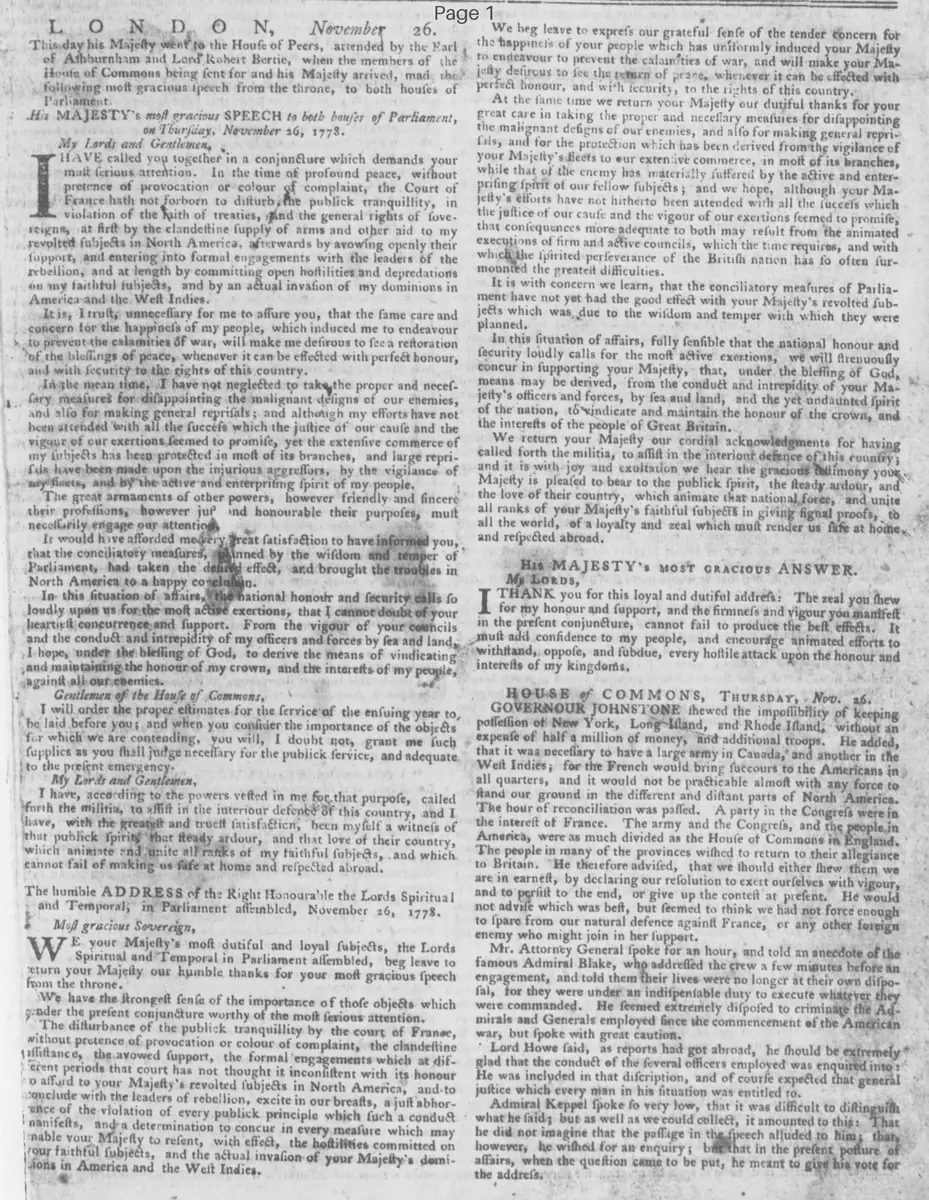
This day his Majesty went to the House of Peers, attended by the Earl of Ashburnham and Lord Robert Bertie, when the members of the House of Commons being present and his Majesty arrived, made the following most gracious speech from the throne, to both houses of Parliament.
His MAJESTY's most gracious SPEECH to both houses of Parliament, on Thursday, November 26, 1778.
My Lords and Gentlemen,
I HAVE called you together in a conjuncture which demands your most serious attention. In the time of profound peace, without pretence of provocation or colour of complaint, the Court of France hath not forborne to disturb the publick tranquillity, in violation of the faith of treaties, and the general rights of sovereigns, at first by the clandestine supply of arms and other aid to my revolted subjects in North America, afterwards by avowing openly their support, and entering into formal engagements with the leaders of the rebellion, and at length by committing open hostilities and depredations on my faithful subjects, and by an actual invasion of my dominions in America and the West Indies.
It is, I trust, unnecessary for me to assure you, that the same care and concern for the happiness of my people, which induced me to endeavour to prevent the calamities of war, will make me desirous to see a restoration of the blessings of peace, whenever it can be effected with perfect honour, and with security to the rights of this country.
In the mean time, I have not neglected to take the proper and necessary measures for disappointing the malignant designs of our enemies, and also for making general reprisals; and although my efforts have not been attended with all the success which the justice of our cause and the vigour of our exertions seemed to promise, yet the extensive commerce of my subjects has been protected in most of its branches, and large reprisals have been made upon the injurious aggressors, by the vigilance of my fleets, and by the active and enterprising spirit of my people.
The great armaments of other powers, however friendly and sincere their professions, however just and honourable their purposes, must necessarily engage our attention.
It would have afforded me very great satisfaction to have informed you, that the conciliatory measures, planned by the wisdom and temper of Parliament, had taken the desired effect, and brought the troubles in North America to a happy conclusion.
In this situation of affairs, the national honour and security calls so loudly upon us for the most active exertions, that I cannot doubt of your heartiest concurrence and support. From the vigour of your councils and the conduct and intrepidity of my officers and forces by sea and land, I hope, under the blessing of God, to derive the means of vindicating and maintaining the honour of my crown, and the interests of my people, against all our enemies.
Gentlemen of the House of Commons,
I will order the proper estimates for the service of the ensuing year to be laid before you; and when you consider the importance of the objects for which we are contending, you will, I doubt not, grant me such supplies as you shall judge necessary for the publick service, and adequate to the present emergency.
My Lords and Gentlemen,
I have, according to the powers vested in me for that purpose, called forth the militia, to assist in the interior defence of this country, and I have, with the greatest and truest satisfaction, been myself a witness of that publick spirit that steady ardour, and that love of their country, which animate and unite all ranks of my faithful subjects, and which cannot fail of making us safe at home and respected abroad.
The humble ADDRESS of the Right Honourable the Lords Spiritual and Temporal, in Parliament assembled, November 26, 1778.
Most gracious Sovereign,
WE, your Majesty's most dutiful and loyal subjects, the Lords Spiritual and Temporal in Parliament assembled, beg leave to return your Majesty our humble thanks for your most gracious speech from the throne.
We have the strongest sense of the importance of those objects which render the present conjuncture worthy of the most serious attention.
The disturbance of the publick tranquillity by the court of France, without pretence of provocation or colour of complaint, the clandestine assistance, the avowed support, the formal engagements which at different periods that court has not thought it inconsistent with its honour to afford to your Majesty's revolted subjects in North America, and to conclude with the leaders of rebellion, excite in our breasts, a just abhorrence of the violation of every publick principle which such a conduct manifests, and a determination to concur in every measure which may enable your Majesty to resent, with effect, the hostilities committed on your faithful subjects, and the actual invasion of your Majesty's dominions in America and the West Indies.
We beg leave to express our grateful sense of the tender concern for the happiness of your people which has uniformly induced your Majesty to endeavour to prevent the calamities of war, and will make your Majesty desirous to see the return of peace, whenever it can be effected with perfect honour, and with security, to the rights of this country.
At the same time we return your Majesty our dutiful thanks for your great care in taking the proper and necessary measures for disappointing the malignant designs of our enemies, and also for making general reprisals, and for the protection which has been derived from the vigilance of your Majesty's fleets to our extensive commerce, in most of its branches, while that of the enemy has materially suffered by the active and enterprising spirit of our fellow subjects; and we hope, although your Majesty's efforts have not hitherto been attended with all the success which the justice of our cause and the vigour of our exertions seemed to promise, that consequences more adequate to both may result from the animated executions of firm and active councils, which the time requires, and with which the spirited perseverance of the British nation has so often surmounted the greatest difficulties.
It is with concern we learn, that the conciliatory measures of Parliament have not yet had the good effect with your Majesty's revolted subjects which was due to the wisdom and temper with which they were planned.
In this situation of affairs, fully sensible that the national honour and security loudly calls for the most active exertions, we will strenuously concur in supporting your Majesty, that, under the blessing of God, means may be derived, from the conduct and intrepidity of your Majesty's officers and forces, by sea and land, and the yet undaunted spirit of the nation, to vindicate and maintain the honour of the crown, and the interests of the people of Great Britain.
We return your Majesty our cordial acknowledgments for having called forth the militia, to assist in the interior defence of this country; and it is with joy and exultation we hear the gracious testimony your Majesty is pleased to bear to the publick spirit, the steady ardour, and the love of their country, which animate that national force, and unite all ranks of your Majesty's faithful subjects in giving signal proofs, to all the world, of a loyalty and zeal which must render us safe at home and respected abroad.
HIS MAJESTY's MOST GRACIOUS ANSWER.
My LORDS,
THANK you for this loyal and dutiful address: The zeal you shew for my honour and support, and the firmness and vigour you manifest in the present conjuncture, cannot fail to produce the best effects. It must add confidence to my people, and encourage animated efforts to withstand, oppose, and subdue, every hostile attack upon the honour and interests of my kingdoms.
HOUSE of COMMONS, THURSDAY, Nov. 26.
GOVERNOUR JOHNSTONE shewed the impossibility of keeping possession of New York, Long Island, and Rhode Island, without an expense of half a million of money, and additional troops. He added, that it was necessary to have a large army in Canada, and another in the West Indies; for the French would bring succours to the Americans in all quarters, and it would not be practicable almost with any force to stand our ground in the different and distant parts of North America.
The hour of reconciliation was past. A party in the Congress were in the interest of France. The army and the Congress, and the people in America, were as much divided as the House of Commons in England.
The people in many of the provinces wished to return to their allegiance to Britain. He therefore advised, that we should either shew them we are in earnest, by declaring our resolution to exert ourselves with vigour, and to persist to the end, or give up the contest at present. He would not advise which was best, but seemed to think we had not force enough to spare from our natural defence against France, or any other foreign enemy who might join in her support.
Mr. Attorney General spoke for an hour, and told an anecdote of the famous Admiral Blake, who addressed the crew a few minutes before an engagement, and told them their lives were no longer at their own disposal, for they were under an indispensable duty to execute whatever they were commanded. He seemed extremely disposed to criminate the Admirals and Generals employed since the commencement of the American war, but spoke with great caution.
Lord Howe said, as reports had got abroad, he should be extremely glad that the conduct of the several officers employed was enquired into: He was included in that description, and of course expected that general justice which every man in his situation was entitled to.
Admiral Keppel spoke so very low, that it was difficult to distinguish what he said; but as well as we could collect, it amounted to this: That he did not imagine that the passage in the speech alluded to him; that however, he wished for an enquiry; but that in the present posture of affairs, when the question came to be put, he meant to give his vote for the address.
What sub-type of article is it?
What keywords are associated?
What entities or persons were involved?
Where did it happen?
Foreign News Details
Primary Location
North America
Event Date
November 26, 1778
Key Persons
Outcome
efforts to protect commerce and make reprisals; conciliatory measures unsuccessful; call for active exertions and supplies; militia called forth; debates on military challenges in north america and west indies.
Event Details
King George III delivered a speech to Parliament outlining France's escalating involvement in supporting American rebels, from clandestine aid to open hostilities and invasions in America and West Indies. He expressed desire for peace with honor, reported protective measures and reprisals, noted armaments of other powers, and lamented failed conciliatory efforts. He requested supplies and praised the militia. Lords addressed thanks and support. King replied appreciatively. In Commons, Gouvernour Johnstone discussed difficulties holding positions in New York, Long Island, Rhode Island, Canada, and West Indies against French aid; suggested vigor or abandonment. Attorney General urged duty and critiqued officers cautiously. Lord Howe and Admiral Keppel called for inquiries into officers' conduct.