Thank you for visiting SNEWPapers!
Sign up free
Norfolk Gazette And Publick Ledger
Norfolk, Virginia
What is this article about?
U.S. House of Representatives proceedings on January 2-3, 1810: bank charter petitions referred; Potomac navigation bill committed; debate and vote against indefinite postponement of 'Rupture with Mr. Jackson'; land grant bill reported; paper makers' petition; resolution on duties; President Madison's message recommending military and militia preparations; resolution for blockade information; debate on Senate resolutions.
Clipping
OCR Quality
Full Text
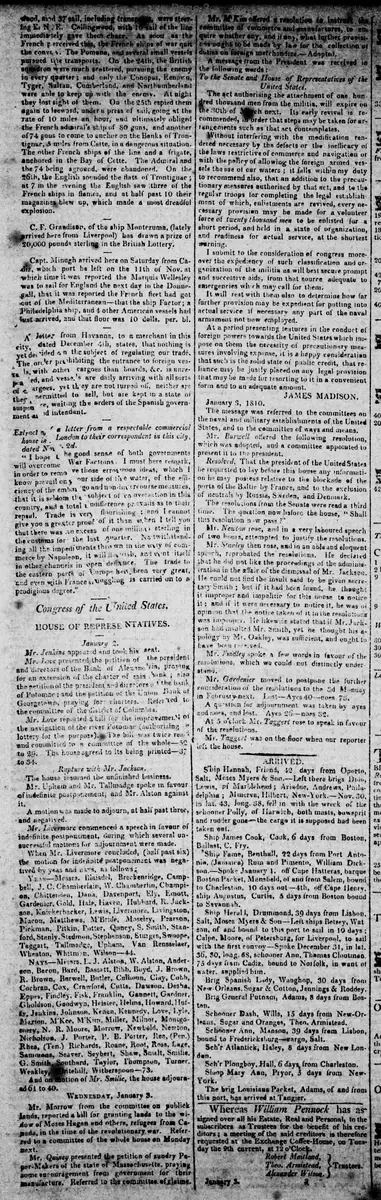
HOUSE OF REPRESENTATIVES.
January 2.
Mr. Jenkins appeared and took his seat.
Mr. Love presented the petition of the president and directors of the Bank of Alexandria, praying for an extension of the charter of said bank; also the petition of the president and directors of the bank of Potomac; and the petition of the Union Bank of Georgetown, praying for charters. Referred to the committee of the district of Columbia.
Mr. Love reported a bill for the improvement of the navigation of the river Potomac (authorising a lottery for the purposes). The bill was twice read and committed to a committee of the whole--52 to 26. The house agreed to its being printed--37 to 34.
Rupture with Mr. Jackson.
The house resumed the unfinished business.
Mr. Upham and Mr. Tallmadge spoke in favour of indefinite postponement, and Mr. Alston against it.
A motion was made to adjourn, at half past three, and negatived.
Mr. Livermore commenced a speech in favour of indefinite postponement, during which several unsuccessful motions of adjournment were made.
When Mr. Livermore concluded, (half past six the motion for indefinite postponement was negatived by yeas and nays, as follows;
Yeas--Messrs. Blaisdell, Breckenridge, Campbell, J. C. Chamberlain, W. Chamberlain, Champion, Chittenden, Dana, Davenport, Ely, Emott, Gardenier, Gold, Hale, Haven, Hubbard, R. Jackson, Knickerbocker, Lewis, Livermore, Livingston, Macon, Matthews, M'Bride, Moseley, Pearson, Pickman, Pitkin, Potter, Quincy, S. Smith, Stanford, Stanly, Stedman, Stephenson, Sturgis, Swoope, Taggart, Tallmadge, Upham, Van Rensselaer, Wheaton, Whitman, Wilson--44.
Nays--Messrs. L. J. Alston, W. Alston, Anderson, Bacon, Bard, Bassett, Bibb, Boyd, J. Brown, R. Brown, Burwell, Butler, Calhoun, Clay, Cobb, Cochran, Cox, Crawford, Cutts, Dawson, Desha, Eppes, Findley, Fisk, Franklin, Gannett, Gardner, Gholsom, Goodwyn, Heister, Helms, Howard, Huffman, Jenkins, Johnson, Kenan, Kennedy, Love, Lyle, Mercer, M'Kee, M'Kim, Miller, Milnor, Montgomery, N. R. Moore, Morrow, Newbold, Newton, Nicholson, J. Porter, P. B. Porter, Rea, (Pen.) Rhea, (Ten.) Richards, Roane, Root, Ross, Sage, Sampson, Seaver, Seybert, Shaw, Smelt, Smilie, G. Smith, Southard, Taylor, Thompson, Turner, Wenklay, Whitehill, Witherspoon--73.
And on motion of Mr. Smilie, the house adjourned 61 to 40.
Wednesday, January 3.
Mr. Morrow from the committee on public lands, reported a bill for granting lands to the widow of Moses Hagan and others, refugees from Canada, in the time of the revolutionary war. Referred to committee of the whole house on Monday next.
Mr. Quincy presented the petition of sundry Paper Makers of the state of Massachusetts, praying some encouragement from government for their manufacture, Referred to the committee of commerce.
Mr. M'Kim offered a resolution to instruct committee of commerce and manufactures to inquire whether any, and if any, what further provision ought to be made by law for the collection of duties on foreign merchandize.--Adopted.
A message from the President was received: it contained the following words:
To the Senate and House of Representatives of the United States.
The act authorising the attachment of one hundred thousand men from the militia, will expire on the 30th of April next. Its early revival is recommended, in order that steps may be taken for arrangements such as that act contemplates.
Without interfering with the modification rendered necessary by the defects of the laws restrictive of commerce and navigation, or with the policy of allowing the foreign armed vessels the use of our waters; it falls within my duty to recommend also, that an addition to the precautionary measures authorised by that act, and to the regular troops for completing the legal establishment of which, enlistments are slow, every necessary provision may be made for a volunteer force of twenty thousand men to be enlisted for a short period, and held in a state of organization, and readiness for actual service, at the shortest warning.
I submit to the consideration of congress moreover the expediency of such classification and organization of the militia as will best secure prompt and successive aids, from that source adequate to emergencies which may call for them.
It will rest with them also to determine how far further provision may be expedient for putting into actual service if necessary any part of the naval armament not now employed.
At a period presenting features in the conduct of foreign powers towards the United States which impose on them the necessity of precautionary measures involving expense, it is a happy consideration that such is the solid state of public credit, that reliance may be justly placed on any legal provision that may be made for resorting to it in a convenient form and to an adequate amount.
JAMES MADISON.
January 3, 1810.
The message was referred to the committees on the naval and military establishments of the United States, and to the committee of ways and means.
Mr. Burwell offered the following resolution, which was adopted, and a committee appointed to present it to the president.
Resolved, That the president of the United States be requested to lay before this house any information he may possess relative to the blockade of the ports of the Baltic by France, and to the exclusion of neutrals by Russia, Sweden, and Denmark.
The resolutions from the Senate were read a third time. The question now before the house, "Shall this resolution now pass?"
Mr. Newton rose, and in a very laboured speech of two hours, attempted to justify the resolutions.
Mr. Stanly then rose, and in an able and eloquent speech, reprobated the resolutions. He declared that he did not like the proceedings of the administration in the affair of the dismissal of Mr. Jackson. He could not find the insult said to be given secretary Smith; but if it had been found, he thought it improper and impolitic for this house to notice it; and if it were necessary to notice it, he was of opinion that the notice taken of it in the resolutions was improper. He likewise stated that if Mr. Jackson had insulted Mr. Smith, yet he thought his apology by Mr. Oakley, was sufficient, and ought to have been received.
Mr. Findlay spoke a few words in favour of the resolutions, which we could not distinctly understand.
Mr. Gardenier moved to postpone the further consideration of the resolutions to the 3d Monday in February next. Lost--Ayes 40--Noes 78.
A question for adjournment was taken by ayes and noes, and lost. Ayes 26--Noes 82.
At 5 o'clock Mr. Taggart rose to speak in favour of the resolutions.
Mr. Taggart was on the floor when our reporter left the house.
What sub-type of article is it?
What keywords are associated?
What entities or persons were involved?
Where did it happen?
Domestic News Details
Primary Location
Washington, D.C.
Event Date
January 2 3, 1810
Key Persons
Event Details
On January 2, Mr. Jenkins took his seat; petitions from Bank of Alexandria, Bank of Potomac, and Union Bank of Georgetown for charters referred to committee; bill for Potomac navigation improvement via lottery committed and ordered printed; debate on 'Rupture with Mr. Jackson' with speeches by Upham, Tallmadge, Alston, Livermore; motion for indefinite postponement negatived 44-73; adjourned. On January 3, bill for land grants to Canadian refugees reported; Massachusetts paper makers' petition referred; resolution on duties collection adopted; President Madison's message recommending militia revival, volunteer force, militia organization, naval provisions, and public credit referred to committees; resolution for blockade information adopted; debate on Senate resolutions with speeches by Newton, Stanly, Findlay; postponement motion lost 40-78; adjournment motion lost 26-82; Taggart speaking when reported.