Thank you for visiting SNEWPapers!
Sign up free
Editorial
October 4, 1836
State Journal
Montpelier, Washington County, Vermont
What is this article about?
In 'Remarks on the State of American Education No. 6,' the author criticizes inadequate school houses and teaching methods, urging spacious facilities with specialized rooms, sensory-based instruction, professionalization of teaching, and government legislative support to elevate education for societal benefit.
Clipping
OCR Quality
98%
Excellent
Full Text
For the State Journal.
REMARKS ON THE STATE OF AMERICAN EDUCATION. No. 6.
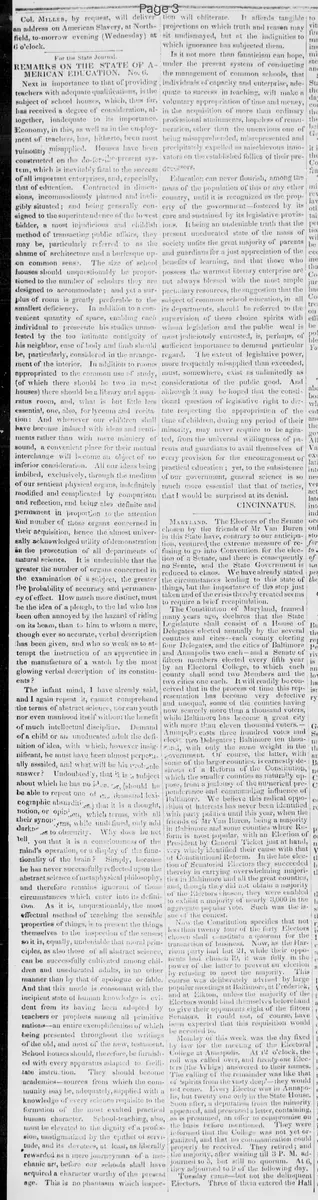
Next in importance to that of providing teachers with adequate qualifications, is the subject of school houses, which, thus far, has received a degree of consideration, altogether, inadequate to its importance.
Economy, in this, as well as in the employment of teachers, has, hitherto, been most ruinously misapplied. Houses have been constructed on the do-for-the-present system, which is inevitably fatal to the success of all important enterprises, and, especially, that of education. Contracted in dimensions, incommodiously planned and ineligible situated; and being generally consigned to the superintendence of the lowest bidder, a most injudicious and childish method of transacting public affairs, they may be, particularly referred to as the shame of architecture and a burlesque upon common sense. The size of school houses should unquestionably be proportioned to the number of scholars they are designed to accommodate; and yet a surplus of room is greatly preferable to the smallest deficiency. In addition to a convenient quantity of space, enabling each individual to prosecute his studies unmolested by the too intimate contiguity of his neighbor, ease of body and limb should be, particularly, considered in the arrangement of the interior. In addition to rooms appropriated to the common use of study, (of which there should be two in most houses) there should be a library and apparatus room, and, what is but little less essential, one, also, for declamation and recitation: And whenever our children shall have become imbued with ideas and sentiments rather than with mere mimicry of sound, a convenient place for their mutual interchange will become an object of no inferior consideration. All our ideas being imbibed, exclusively, through the medium of our sentient physical organs, indefinitely modified and complicated by comparison and reflection, and being also definite and permanent in proportion to the attention and number of those organs concerned in their acquisition, hence the almost universally acknowledged utility of demonstration in the prosecution of all departments of natural science. It is undeniable that the greater the number of organs concerned in the examination of a subject, the greater the probability of accuracy and permanency of effect. How much more distinct, must be the idea of a plough, to the lad who has been often annoyed by the hazard of riding on its beam, than to him to whom a mere, though ever so accurate, verbal description has been given, and who so weak as to attempt the instruction of an apprentice in the manufacture of a watch by the most glowing verbal description of its constituents?
The infant mind, I have already said, and I again repeat it, cannot comprehend the terms of abstract science, nor can youth nor even manhood itself without the benefit of much intellectual discipline. Demand of a child or an uneducated adult the definition of idea, with which, however insignificant, he must have been almost perpetually assailed, and what will be his probable answer? Undoubtedly, that it is a subject about which he has no idea. (should he be able to repeat one of the thousand lexicographic absurdities.) that it is a thought, notion, or opinion, which terms, with all their synonyms, while undefined, only add darkness to obscurity. Why does he not tell you that it is a consciousness of the mind's operation, or a display of the functionality of the brain? Simply, because he has never successfully reflected upon the abstract science of metaphysical philosophy, and therefore remains ignorant of those circumstances which enter into its definition. As it is, unquestionably, the most effectual method of teaching the sensible properties of things, is to present the things themselves to the inspection of the senses; so it is, equally, undeniable that moral principles, as also those of all abstract science, can be successfully cultivated among children and uneducated adults, in no other manner than by that of apologue or fable. And that this mode is consonant with the incipient state of human knowledge is evident from its having been adopted by teachers or prophets among all primitive nations—an entire exemplification of which being presented throughout the writings of the old, and most of the new, testament.
School houses should, therefore, be furnished with every apparatus adapted to facilitate instruction. They should become academies—sources from which the community may be, adequately, supplied with a knowledge of every science requisite to the formation of the most exalted practical human character. School-teaching, also, must be elevated to the dignity of a profession, unstigmatized by the epithet of servitude, and its devotees, at least, as liberally rewarded as a mere journeyman of a mechanic art, before our schools shall have acquired a character worthy of the present age. This is no phantasm which inspection will obliterate.
It affords tangible projections on which truth and reason may sit undismayed, but at the indignities to which ignorance has subjected them.
Is it not more than fanaticism can hope, under the present system of conducting the management of common schools, that individuals of capacity and enterprise, adequate to success in teaching, will make a voluntary appropriation of time and money, in the acquisition of more than ordinary professional attainments, hopeless of remuneration, other than the unenvious one of being misapprehended, misrepresented and precipitately expelled as mischievous innovators on the established follies of their predecessors.
Education can never flourish, among the mass of the population of this or any other country, until it is recognized as the property of the government—fostered by its care and sustained by its legislative provisions. It being an undeniable truth that the present uneducated state of the mass of society unfits the great majority of parents and guardians for a just appreciation of the benefits of learning, and that those who possess the warmest literary enterprise are not always blessed with the most ample pecuniary resources, the suggestion that the subject of common school education, in all its departments, should be referred to the supervision of those choice spirits with whom legislation and the public weal is most judiciously entrusted, is, perhaps, of sufficient importance to demand particular regard. The extent of legislative power, more frequently misapplied than exceeded, must, somewhere, exist as unlimitedly as considerations of the public good. And although it may be hoped that the constitutional question of legislative right to dictate respecting the appropriation of the time of children, during any period of their minority, may never require to be agitated, from the universal willingness of parents and guardians to avail themselves of every provision for the encouragement of practical education; yet, to the subsistence of our government, general science is so much more essential than that of tactics, that I would be surprised at its denial.
REMARKS ON THE STATE OF AMERICAN EDUCATION. No. 6.
Next in importance to that of providing teachers with adequate qualifications, is the subject of school houses, which, thus far, has received a degree of consideration, altogether, inadequate to its importance.
Economy, in this, as well as in the employment of teachers, has, hitherto, been most ruinously misapplied. Houses have been constructed on the do-for-the-present system, which is inevitably fatal to the success of all important enterprises, and, especially, that of education. Contracted in dimensions, incommodiously planned and ineligible situated; and being generally consigned to the superintendence of the lowest bidder, a most injudicious and childish method of transacting public affairs, they may be, particularly referred to as the shame of architecture and a burlesque upon common sense. The size of school houses should unquestionably be proportioned to the number of scholars they are designed to accommodate; and yet a surplus of room is greatly preferable to the smallest deficiency. In addition to a convenient quantity of space, enabling each individual to prosecute his studies unmolested by the too intimate contiguity of his neighbor, ease of body and limb should be, particularly, considered in the arrangement of the interior. In addition to rooms appropriated to the common use of study, (of which there should be two in most houses) there should be a library and apparatus room, and, what is but little less essential, one, also, for declamation and recitation: And whenever our children shall have become imbued with ideas and sentiments rather than with mere mimicry of sound, a convenient place for their mutual interchange will become an object of no inferior consideration. All our ideas being imbibed, exclusively, through the medium of our sentient physical organs, indefinitely modified and complicated by comparison and reflection, and being also definite and permanent in proportion to the attention and number of those organs concerned in their acquisition, hence the almost universally acknowledged utility of demonstration in the prosecution of all departments of natural science. It is undeniable that the greater the number of organs concerned in the examination of a subject, the greater the probability of accuracy and permanency of effect. How much more distinct, must be the idea of a plough, to the lad who has been often annoyed by the hazard of riding on its beam, than to him to whom a mere, though ever so accurate, verbal description has been given, and who so weak as to attempt the instruction of an apprentice in the manufacture of a watch by the most glowing verbal description of its constituents?
The infant mind, I have already said, and I again repeat it, cannot comprehend the terms of abstract science, nor can youth nor even manhood itself without the benefit of much intellectual discipline. Demand of a child or an uneducated adult the definition of idea, with which, however insignificant, he must have been almost perpetually assailed, and what will be his probable answer? Undoubtedly, that it is a subject about which he has no idea. (should he be able to repeat one of the thousand lexicographic absurdities.) that it is a thought, notion, or opinion, which terms, with all their synonyms, while undefined, only add darkness to obscurity. Why does he not tell you that it is a consciousness of the mind's operation, or a display of the functionality of the brain? Simply, because he has never successfully reflected upon the abstract science of metaphysical philosophy, and therefore remains ignorant of those circumstances which enter into its definition. As it is, unquestionably, the most effectual method of teaching the sensible properties of things, is to present the things themselves to the inspection of the senses; so it is, equally, undeniable that moral principles, as also those of all abstract science, can be successfully cultivated among children and uneducated adults, in no other manner than by that of apologue or fable. And that this mode is consonant with the incipient state of human knowledge is evident from its having been adopted by teachers or prophets among all primitive nations—an entire exemplification of which being presented throughout the writings of the old, and most of the new, testament.
School houses should, therefore, be furnished with every apparatus adapted to facilitate instruction. They should become academies—sources from which the community may be, adequately, supplied with a knowledge of every science requisite to the formation of the most exalted practical human character. School-teaching, also, must be elevated to the dignity of a profession, unstigmatized by the epithet of servitude, and its devotees, at least, as liberally rewarded as a mere journeyman of a mechanic art, before our schools shall have acquired a character worthy of the present age. This is no phantasm which inspection will obliterate.
It affords tangible projections on which truth and reason may sit undismayed, but at the indignities to which ignorance has subjected them.
Is it not more than fanaticism can hope, under the present system of conducting the management of common schools, that individuals of capacity and enterprise, adequate to success in teaching, will make a voluntary appropriation of time and money, in the acquisition of more than ordinary professional attainments, hopeless of remuneration, other than the unenvious one of being misapprehended, misrepresented and precipitately expelled as mischievous innovators on the established follies of their predecessors.
Education can never flourish, among the mass of the population of this or any other country, until it is recognized as the property of the government—fostered by its care and sustained by its legislative provisions. It being an undeniable truth that the present uneducated state of the mass of society unfits the great majority of parents and guardians for a just appreciation of the benefits of learning, and that those who possess the warmest literary enterprise are not always blessed with the most ample pecuniary resources, the suggestion that the subject of common school education, in all its departments, should be referred to the supervision of those choice spirits with whom legislation and the public weal is most judiciously entrusted, is, perhaps, of sufficient importance to demand particular regard. The extent of legislative power, more frequently misapplied than exceeded, must, somewhere, exist as unlimitedly as considerations of the public good. And although it may be hoped that the constitutional question of legislative right to dictate respecting the appropriation of the time of children, during any period of their minority, may never require to be agitated, from the universal willingness of parents and guardians to avail themselves of every provision for the encouragement of practical education; yet, to the subsistence of our government, general science is so much more essential than that of tactics, that I would be surprised at its denial.
What sub-type of article is it?
Education
Social Reform
What keywords are associated?
American Education
School Houses
Teaching Methods
Education Reform
Government Role
Sensory Learning
Legislative Provisions
What entities or persons were involved?
Government
Legislature
Parents And Guardians
Editorial Details
Primary Topic
Reform Of School Infrastructure And Teaching In American Education
Stance / Tone
Advocatory Critique Urging Government Involvement
Key Figures
Government
Legislature
Parents And Guardians
Key Arguments
School Houses Must Be Spacious And Well Equipped Rather Than Economically Minimal
Include Rooms For Library, Apparatus, Declamation To Facilitate Learning
Sensory Demonstration Essential For Permanent Knowledge Acquisition
Teach Abstract Concepts Via Fables For Children And Uneducated Adults
Elevate Teaching To A Respected Profession With Fair Compensation
Education Requires Government Recognition And Legislative Support