Thank you for visiting SNEWPapers!
Sign up free
Letter to Editor
August 6, 1821
Alexandria Gazette & Daily Advertiser
Alexandria, Virginia
What is this article about?
A letter from E. W. Grade in Danzig refutes MP Curwen's claim that wheat can be grown in Poland for 8s. per quarter, citing historical and current grain prices across Europe, production costs exceeding that figure, and the impacts of British trade policies on Prussian agriculture.
Clipping
OCR Quality
95%
Excellent
Full Text
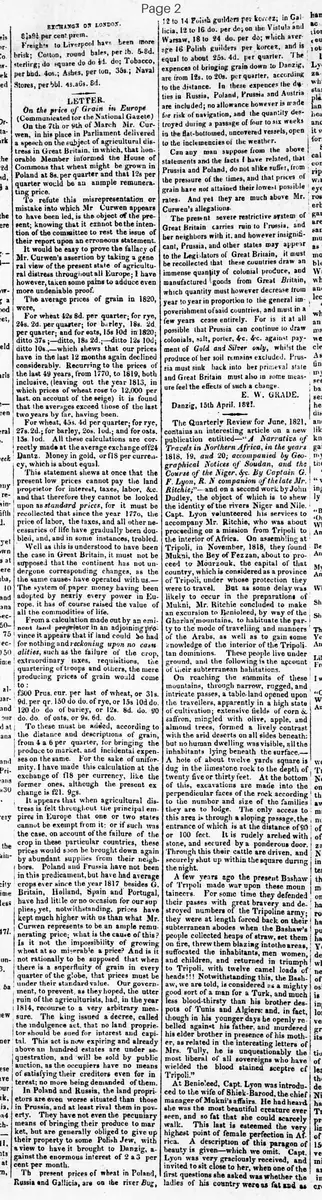
LETTER.
On the price of Grain in Europe
(Communicated for the National Gazette)
On the 7th or 9th of March Mr. Curwen, in his place in Parliament delivered a speech on the subject of agricultural distress in Great Britain, in which, that honorable Member informed the House of Commons that wheat might be grown in Poland at 8s. per quarter and that 12s per quarter would be an ample remunerating price.
To refute this misrepresentation, or mistake into which Mr Curwen appears to have been led, is the object of the present; knowing that it cannot be the intention of the committee to rest the issue of their report upon an erroneous statement.
It would be easy to prove the fallacy of Mr. Curwen's assertion by taking a general view of the present state of agricultural distress throughout all Europe: I have however, taken some pains to adduce even more undeniable proof.
The average prices of grain in 1820, were,
For wheat 42s 8d. per quarter: for rye, 24s. 2d. per quarter; for barley, 18s. 2d. per quarter: and for oats, 15s 10d in 1820: ditto 37s ;ditto, 18s 2d.:--ditto 12s 10d: ditto 10s.,—which shews that our prices have in the last 12 months again declined considerably. Recurring to the prices of the last 49 years, from 1770, to 1819, both inclusive, (leaving out the year 1813, in which prices of wheat rose to 120s per last. on account of the siege) it is found that the averages exceed those of the last two years by far, having been.
For wheat, 45s. 4d per quarter: for rye, 27s.2d.: for barley, 20s. 10d.; and for oats. 13s. 10d. All these calculations are correctly made at the average exchange of 24 Dantz. Money in gold, or fis per currency, which is about equal.
This statement shews at once that the present low prices cannot pay the land proprietor for interest, taxes, labor, &c. and that therefore they cannot be looked upon as standard prices, for it must be recollected that since the year 1770, the price of labor, the taxes, and all other necessaries of life have gradually been doubled, and, and in some instances, trebled.
Well as this is understood to have been the case in Great Britain, it must not be supposed that the continent has not undergone corresponding changes, as the same causes have operated with us.- The system of paper money having been adopted by nearly every power in Europe, it has of course raised the value of all the commodities of life
From a calculation made out by an eminent land proprietor in an adjoining province it appears that if land could be had for nothing and reckoning upon no casualties, such as the failure of the crop, extraordinary taxes, requisitions, the quartering of troops and others, the mere producing prices of grain would come to :
300 Prus. cur. per last of wheat, or 31s. 9d. per qr. 150 do do. of rye, or 15s 10d do. 120 do. do of barley, or 12s. 8d. do. 90 do. do. of oats. or 9s. 6d. do.
To these must be added, according to the distance and descriptions of grain, from 4 a 6 per quarter, for bringing the produce to market. and incidental expenses on the same. For the sake of uniformity. I have made this calculation at the exchange of 18 per currency, like the former ones, although the present exchange is 21. 9gs.
It appears that when agricultural distress is felt throughout the principal empires in Europe that one or two states cannot be exempt from it; or if such was the case. on account of the failure of the crop in these particular countries, these prices would soon be brought down again by abundant supplies from their neighbors. Poland and Prussia have not been in this predicament, but have had average crops ever since the year 1817 besides G. Britain, Holland, Spain and Portugal have had little or no occasion for our supplies; yet, notwithstanding, prices have kept much higher with us than what Mr. Curwen represents to be an ample remunerating price: what is the cause of this? Is it not the impossibility of growing wheat at so miserable a price? And is it not rationally to be supposed that when there is a superfluity of grain in every quarter of the globe, that prices must be under their standard value. Our government, to prevent, as they hoped, the utter ruin of the agriculturists, had, in the year 1814, recourse to a very arbitrary measure. The king issued a decree, called the indulgence act. that no land proprietor should be sued for interest and capital. This act is now expiring and already above an hundred estates are under sequestration, and will be sold by public auction, as the occupiers have no means of satisfying their creditors even for interest; no more being demanded of them.
In Poland and Russia, the land proprietors are even worse situated than those in Prussia, and at least rival them in poverty. They have not even the pecuniary means of bringing their produce to market, but are generally obliged to give up their property to some Polish Jew, with a view to have it brought to Danzig, against the enormous interest of 2 a 3 per cent per month.
The present prices of wheat in Poland, Russia and Gallicia, are on the river Bug, 12 to 14 Polish guilders per korzec: in Gallicia, 12 to 16 do. per do; on the Vistula and Warsaw, 18 to 24 do. per do; which average 16 Polish guilders per korzec, and is equal to about 25s. 4d. per quarter. The expences of bringing grain down to Danzig. are from 12s. to 20s. per quarter, according to the distance. In these expences the duties in Russia, Poland, Prussia and Austria are included; no allowance however is made for risk of navigation, and the quantity destroyed during a passage of four to six weeks in the flat-bottomed, uncovered vessels, open to the inclemencies of the weather.
Can any man suppose from the above statements and the facts I have related, that Prussia and Poland, do not alike suffer, from the pressure of the times, and that prices of grain have not attained their lowest possible rates. And yet they are much above Mr. Curwen's allegations.
The present severe restrictive system of Great Britain carries ruin to Prussia, and her neighbors with it. and however insignificant, Prussia, and other states may appear to the Legislators of Great Britain, it must be recollected that these countries draw an immense quantity of colonial produce, and manufactured goods from Great Britain, which quantity must however decrease from year to year in proportion to the general impoverishment of said countries, and must in a few years cease entirely. For is it at all possible that Prussia can continue to draw colonials, salt, porter, &c. &c. against payment of Gold and Silver only. whilst the produce of her soil remains excluded. Prussia must sink back into her primeval state and Great Britain must also in some measure feel the effects of such a change.
E. W. GRADE.
Danzig, 15th April, 1821.
On the price of Grain in Europe
(Communicated for the National Gazette)
On the 7th or 9th of March Mr. Curwen, in his place in Parliament delivered a speech on the subject of agricultural distress in Great Britain, in which, that honorable Member informed the House of Commons that wheat might be grown in Poland at 8s. per quarter and that 12s per quarter would be an ample remunerating price.
To refute this misrepresentation, or mistake into which Mr Curwen appears to have been led, is the object of the present; knowing that it cannot be the intention of the committee to rest the issue of their report upon an erroneous statement.
It would be easy to prove the fallacy of Mr. Curwen's assertion by taking a general view of the present state of agricultural distress throughout all Europe: I have however, taken some pains to adduce even more undeniable proof.
The average prices of grain in 1820, were,
For wheat 42s 8d. per quarter: for rye, 24s. 2d. per quarter; for barley, 18s. 2d. per quarter: and for oats, 15s 10d in 1820: ditto 37s ;ditto, 18s 2d.:--ditto 12s 10d: ditto 10s.,—which shews that our prices have in the last 12 months again declined considerably. Recurring to the prices of the last 49 years, from 1770, to 1819, both inclusive, (leaving out the year 1813, in which prices of wheat rose to 120s per last. on account of the siege) it is found that the averages exceed those of the last two years by far, having been.
For wheat, 45s. 4d per quarter: for rye, 27s.2d.: for barley, 20s. 10d.; and for oats. 13s. 10d. All these calculations are correctly made at the average exchange of 24 Dantz. Money in gold, or fis per currency, which is about equal.
This statement shews at once that the present low prices cannot pay the land proprietor for interest, taxes, labor, &c. and that therefore they cannot be looked upon as standard prices, for it must be recollected that since the year 1770, the price of labor, the taxes, and all other necessaries of life have gradually been doubled, and, and in some instances, trebled.
Well as this is understood to have been the case in Great Britain, it must not be supposed that the continent has not undergone corresponding changes, as the same causes have operated with us.- The system of paper money having been adopted by nearly every power in Europe, it has of course raised the value of all the commodities of life
From a calculation made out by an eminent land proprietor in an adjoining province it appears that if land could be had for nothing and reckoning upon no casualties, such as the failure of the crop, extraordinary taxes, requisitions, the quartering of troops and others, the mere producing prices of grain would come to :
300 Prus. cur. per last of wheat, or 31s. 9d. per qr. 150 do do. of rye, or 15s 10d do. 120 do. do of barley, or 12s. 8d. do. 90 do. do. of oats. or 9s. 6d. do.
To these must be added, according to the distance and descriptions of grain, from 4 a 6 per quarter, for bringing the produce to market. and incidental expenses on the same. For the sake of uniformity. I have made this calculation at the exchange of 18 per currency, like the former ones, although the present exchange is 21. 9gs.
It appears that when agricultural distress is felt throughout the principal empires in Europe that one or two states cannot be exempt from it; or if such was the case. on account of the failure of the crop in these particular countries, these prices would soon be brought down again by abundant supplies from their neighbors. Poland and Prussia have not been in this predicament, but have had average crops ever since the year 1817 besides G. Britain, Holland, Spain and Portugal have had little or no occasion for our supplies; yet, notwithstanding, prices have kept much higher with us than what Mr. Curwen represents to be an ample remunerating price: what is the cause of this? Is it not the impossibility of growing wheat at so miserable a price? And is it not rationally to be supposed that when there is a superfluity of grain in every quarter of the globe, that prices must be under their standard value. Our government, to prevent, as they hoped, the utter ruin of the agriculturists, had, in the year 1814, recourse to a very arbitrary measure. The king issued a decree, called the indulgence act. that no land proprietor should be sued for interest and capital. This act is now expiring and already above an hundred estates are under sequestration, and will be sold by public auction, as the occupiers have no means of satisfying their creditors even for interest; no more being demanded of them.
In Poland and Russia, the land proprietors are even worse situated than those in Prussia, and at least rival them in poverty. They have not even the pecuniary means of bringing their produce to market, but are generally obliged to give up their property to some Polish Jew, with a view to have it brought to Danzig, against the enormous interest of 2 a 3 per cent per month.
The present prices of wheat in Poland, Russia and Gallicia, are on the river Bug, 12 to 14 Polish guilders per korzec: in Gallicia, 12 to 16 do. per do; on the Vistula and Warsaw, 18 to 24 do. per do; which average 16 Polish guilders per korzec, and is equal to about 25s. 4d. per quarter. The expences of bringing grain down to Danzig. are from 12s. to 20s. per quarter, according to the distance. In these expences the duties in Russia, Poland, Prussia and Austria are included; no allowance however is made for risk of navigation, and the quantity destroyed during a passage of four to six weeks in the flat-bottomed, uncovered vessels, open to the inclemencies of the weather.
Can any man suppose from the above statements and the facts I have related, that Prussia and Poland, do not alike suffer, from the pressure of the times, and that prices of grain have not attained their lowest possible rates. And yet they are much above Mr. Curwen's allegations.
The present severe restrictive system of Great Britain carries ruin to Prussia, and her neighbors with it. and however insignificant, Prussia, and other states may appear to the Legislators of Great Britain, it must be recollected that these countries draw an immense quantity of colonial produce, and manufactured goods from Great Britain, which quantity must however decrease from year to year in proportion to the general impoverishment of said countries, and must in a few years cease entirely. For is it at all possible that Prussia can continue to draw colonials, salt, porter, &c. &c. against payment of Gold and Silver only. whilst the produce of her soil remains excluded. Prussia must sink back into her primeval state and Great Britain must also in some measure feel the effects of such a change.
E. W. GRADE.
Danzig, 15th April, 1821.
What sub-type of article is it?
Informative
Persuasive
What themes does it cover?
Agriculture
Economic Policy
What keywords are associated?
Grain Prices
Agricultural Distress
Europe
Poland
Prussia
British Policy
Wheat Production
Trade Restrictions
What entities or persons were involved?
E. W. Grade
National Gazette
Letter to Editor Details
Author
E. W. Grade
Recipient
National Gazette
Main Argument
refutes mr. curwen's claim that wheat can be grown in poland at 8s. per quarter and 12s. would be ample remuneration, demonstrating through price data, production costs, and european agricultural distress that actual costs and prices are significantly higher, exacerbated by british trade restrictions.
Notable Details
Cites 1820 Grain Prices: Wheat 42s 8d, Rye 24s 2d, Barley 18s 2d, Oats 15s 10d Per Quarter
Historical Averages 1770 1819: Wheat 45s 4d, Etc.
Production Costs: Wheat 31s 9d, Rye 15s 10d Per Quarter Minimum
Current Polish Wheat Prices Average 25s 4d Per Quarter Plus 12 20s Transport
Prussian Indulgence Act Of 1814 Expiring, Leading To Estate Sequestrations
Criticizes British Restrictive System For Ruining Prussian Agriculture And Trade