Thank you for visiting SNEWPapers!
Sign up free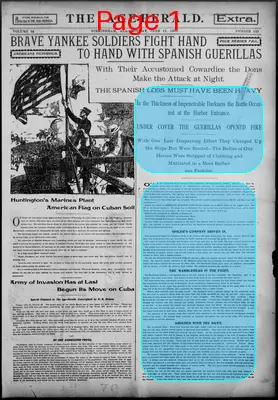
The Age Herald
Birmingham, Jefferson County, Alabama
What is this article about?
US Marines under Col. Huntington repelled Spanish guerrilla and regular attacks at Guantanamo Bay, Cuba, from Saturday afternoon to Sunday morning, June 12. Four marines killed, including Asst. Surgeon Gibbs; one wounded. Spanish losses unknown but likely heavy. Reinforcements arrived from USS Marblehead.
Merged-components note: The first component is the headline and subheadline for the detailed battle account in the fifth component, both describing the same engagement at Guantanamo involving Huntington's marines against Spanish guerrillas.
Clipping
OCR Quality
Full Text
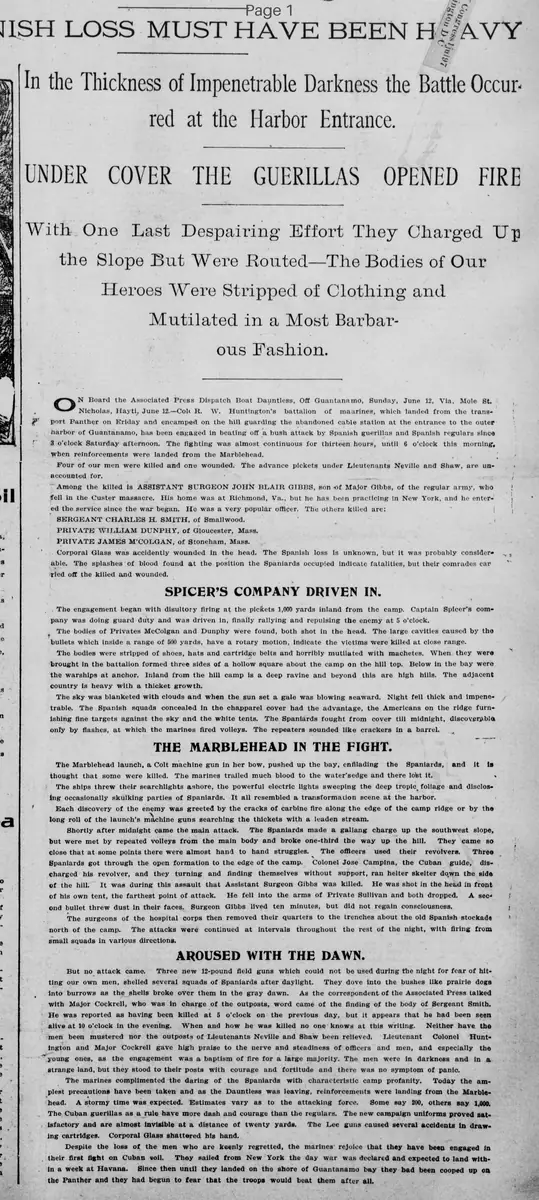
In the Thickness of Impenetrable Darkness the Battle Occurred at the Harbor Entrance.
UNDER COVER THE GUERILLAS OPENED FIRE
With One Last Despairing Effort They Charged Up the Slope But Were Routed - The Bodies of Our Heroes Were Stripped of Clothing and Mutilated in a Most Barbarous Fashion.
On Board the Associated Press Dispatch Boat Dauntless, Off Guantanamo, Sunday, June 12, Via Mole St. Nicholas, Hayti, June 12. - Col. R. W. Huntington's battalion of marines, which landed from the transport Panther on Friday and encamped on the hill guarding the abandoned cable station at the entrance to the outer harbor of Guantanamo, has been engaged in beating off a bush attack by Spanish guerrillas and Spanish regulars since 3 o'clock Saturday afternoon. The fighting was almost continuous for thirteen hours, until 6 o'clock this morning, when reinforcements were landed from the Marblehead.
Four of our men were killed and one wounded. The advance pickets under Lieutenants Neville and Shaw, are unaccounted for.
Among the killed is ASSISTANT SURGEON JOHN BLAIR GIBBS, son of Major Gibbs, of the regular army, who fell in the Custer massacre. His home was at Richmond, Va., but he has been practicing in New York, and he entered the service since the war began. He was a very popular officer. The others killed are:
SERGEANT CHARLES H. SMITH, of Smallwood.
PRIVATE WILLIAM DUNPHY, of Gloucester, Mass.
PRIVATE JAMES McCOLGAN, of Stoneham, Mass.
Corporal Glass was accidentally wounded in the head. The Spanish loss is unknown, but it was probably considerable. The splashes of blood found at the position the Spaniards occupied indicate fatalities, but their comrades carried off the killed and wounded.
SPICER'S COMPANY DRIVEN IN.
The engagement began with desultory firing at the pickets 1,000 yards inland from the camp. Captain Spicer's company was doing guard duty and was driven in, finally rallying and repulsing the enemy at 5 o'clock.
The bodies of Privates McColgan and Dunphy were found, both shot in the head. The large cavities caused by the bullets which inside a range of 500 yards, have a rotary motion, indicate the victims were killed at close range.
The bodies were stripped of shoes, hats and cartridge belts and horribly mutilated with machetes. When they were brought in the battalion formed three sides of a hollow square about the camp on the hill top. Below in the bay were the warships at anchor. Inland from the hill camp is a deep ravine and beyond this are high hills. The adjacent country is heavy with a thicket growth.
The sky was blanketed with clouds and when the sun set a gale was blowing seaward. Night fell thick and impenetrable. The Spanish squads concealed in the chaparral cover had the advantage, the Americans on the ridge furnishing fine targets against the sky and the white tents. The Spaniards fought from cover till midnight, discoverable only by flashes, at which the marines fired volleys. The repeaters sounded like crackers in a barrel.
THE MARBLEHEAD IN THE FIGHT.
The Marblehead launch, a Colt machine gun in her bow, pushed up the bay, enfilading the Spaniards, and it is thought that some were killed. The marines trailed much blood to the water's edge and there lost it.
The ships threw their searchlights ashore, the powerful electric lights sweeping the deep tropic foliage and disclosing occasionally skulking parties of Spaniards. It all resembled a transformation scene at the harbor.
Each discovery of the enemy was greeted by the cracks of carbine fire along the edge of the camp ridge or by the long roll of the launch's machine guns searching the thickets with a leaden stream.
Shortly after midnight came the main attack. The Spaniards made a gallant charge up the southwest slope, but were met by repeated volleys from the main body and broke one-third the way up the hill. They came so close that at some points there were almost hand to hand struggles. The officers used their revolvers. Three Spaniards got through the open formation to the edge of the camp. Colonel Jose Campina, the Cuban guide, discharged his revolver, and they turning and finding themselves without support, ran helter skelter down the side of the hill. It was during this assault that Assistant Surgeon Gibbs was killed. He was shot in the head in front of his own tent, the farthest point of attack. He fell into the arms of Private Sullivan and both dropped. A second bullet threw dust in their faces. Surgeon Gibbs lived ten minutes, but did not regain consciousness.
The surgeons of the hospital corps then removed their quarters to the trenches about the old Spanish stockade north of the camp. The attacks were continued at intervals throughout the rest of the night, with firing from small squads in various directions.
AROUSED WITH THE DAWN.
But no attack came. Three new 12-pound field guns which could not be used during the night for fear of hitting our own men, shelled several squads of Spaniards after daylight. They dove into the bushes like prairie dogs into burrows as the shells broke over them in the gray dawn. As the correspondent of the Associated Press talked with Major Cockrell, who was in charge of the outposts, word came of the finding of the body of Sergeant Smith.
He was reported as having been killed at 5 o'clock on the previous day, but it appears that he had been seen alive at 10 o'clock in the evening. When and how he was killed no one knows at this writing. Neither have the men been mustered nor the outposts of Lieutenants Neville and Shaw been relieved. Lieutenant Colonel Huntington and Major Cockrell gave high praise to the nerve and steadiness of officers and men, and especially the young ones, as the engagement was a baptism of fire for a large majority. The men were in darkness and in a strange land, but they stood to their posts with courage and fortitude and there was no symptom of panic.
The marines complimented the daring of the Spaniards with characteristic camp profanity. Today the amplest precautions have been taken and as the Dauntless was leaving, reinforcements were landing from the Marblehead. A stormy time was expected. Estimates vary as to the attacking force. Some say 200, others say 1,000.
The Cuban guerrillas as a rule have more dash and courage than the regulars. The new campaign uniforms proved satisfactory and are almost invisible at a distance of twenty yards. The Lee guns caused several accidents in drawing cartridges. Corporal Glass shattered his hand.
Despite the loss of the men who are keenly regretted, the marines rejoice that they have been engaged in their first fight on Cuban soil. They sailed from New York the day war was declared and expected to land within a week at Havana. Since then until they landed on the shore of Guantanamo bay they had been cooped up on the Panther and they had begun to fear that the troops would beat them after all.
What sub-type of article is it?
What keywords are associated?
What entities or persons were involved?
Where did it happen?
Foreign News Details
Primary Location
Guantanamo
Event Date
Saturday Afternoon To Sunday Morning, June 12
Key Persons
Outcome
us: 4 killed (gibbs, smith, dunphy, mccolgan), 1 wounded (glass); pickets unaccounted for. spanish: unknown but probably considerable, with blood evidence of fatalities.
Event Details
Col. Huntington's marines landed Friday and encamped near Guantanamo harbor. Spanish guerrillas and regulars attacked Saturday afternoon, fighting continuously for 13 hours in darkness. Marines repulsed attacks, including a midnight charge, with naval support from Marblehead. Bodies of killed marines mutilated. Reinforcements landed Sunday morning; further shelling dispersed remaining Spaniards.