Thank you for visiting SNEWPapers!
Sign up free
Literary
December 11, 1838
Southern Argus
Columbus, Lowndes County, Mississippi
What is this article about?
An essay advocating for mothers to diligently educate their daughters in industrious, religious, and simple habits to strengthen the republic. Emphasizes extended schooling, moral character, and domestic skills over fashion and premature social exposure, quoting figures like Fellenberg and Michelangelo.
Merged-components note: Merged split parts of the essay 'Duty of Mothers' by Mrs. Sigourney into single literary component.
Clipping
OCR Quality
98%
Excellent
Full Text
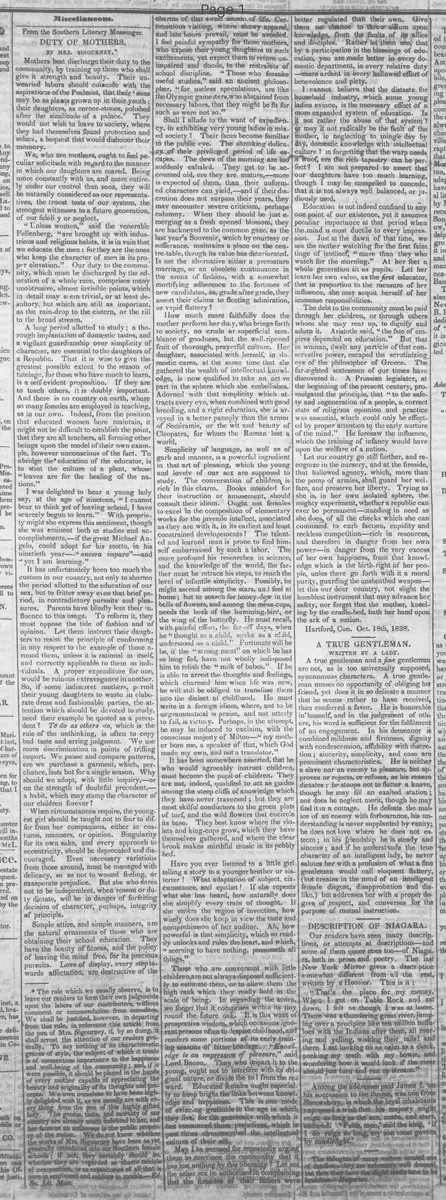
Mothers best discharge their duty to the community, by training up those who shall give it strength and beauty. Their unwearied labors should coincide with the aspirations of the Psalmist, that their 'sons may be as plants grown up in their youth; their daughters, as corner-stones, polished after the similitude of a palace.' They would not wish to leave to society, where they had themselves found protection and solace, a bequest that would dishonor their memory.
We, who are mothers, ought to feel peculiar solicitude with regard to the manner in which our daughters are reared. Being more constantly with us, and more entirely under our control than sons, they will be naturally considered as our representatives, the truest tests of our system, the strongest witnesses to a future generation, of our fidelity or neglect.
'Unless women,' said the venerable Fellenberg, 'are brought up with industrious and religious habits, it is in vain that we educate the men: for they are the ones who keep the character of men in its proper elevation.'
Our duty to the community, which must be discharged by the education of a whole race, comprises many unobtrusive, almost invisible points, which in detail may seem trivial, or at least desultory, but which are still as important, as the rain-drop to the cistern, or the rill to the broad stream.
A long period allotted to study; a thorough implantation of domestic tastes, and a vigilant guardianship over simplicity of character, are essential to the daughters of a Republic. That it is wise to give the greatest possible extent to the season of tutelage, for those who have much to learn, is a self evident proposition. If they are to teach others, it is doubly important. And there is no country on earth, where so many females are employed in teaching, as in our own. Indeed, from the position that educated women here maintain, it might not be difficult to establish the point, that they are all teachers, all forming other beings upon the model of their own example, however unconscious of the fact. To abridge the education of the educator, is to stint the culture of a plant, whose 'leaves are for the healing of the nations.'
I was delighted to hear a young lady say, at the age of nineteen, 'I cannot bear to think yet of leaving school, I have scarcely begun to learn.' With propriety might she express this sentiment, though she was eminent both in studies and accomplishments,—if the great Michael Angelo, could adopt for his motto, in his ninetieth year—'ancora imparo'—and 'yet I am learning.'
It has unfortunately been too much the custom in our country, not only to shorten the period allotted to the education of our sex, but to fritter away even that brief period, in contradictory pursuits and pleasures. Parents have blindly lent their influence to this usage. To reform it, they must oppose the tide of fashion and of opinion. Let them instruct their daughters to resist the principle of conforming in any respect to the example of those around them, unless it is rational in itself, and correctly applicable to them as individuals. A proper expenditure for one, would be ruinous extravagance in another. So, if some indiscreet mothers permit their young daughters to waste in elaborate dress and fashionable parties, the attention which should be devoted to study, need their example be quoted as a precedent? To do as others do, which is the rule of the unthinking, is often to copy bad taste and erring judgment. We use more discrimination in points of trifling import. We pause and compare patterns, ere we purchase a garment, which, perchance, lasts but for a single season. Why should we adopt, with little inquiry,—or on the strength of doubtful precedent,—a habit, which may stamp the character of our children forever?
When circumstances require, the youngest girl should be taught not to fear to differ from her companions, either in costume, manners, or opinion. Singularity for its own sake, and every approach to eccentricity, should be deprecated and discouraged. Even necessary variations from those around, must be managed with delicacy, so as not to wound feeling, or exasperate prejudice. But she who dares not to be independent, when reason or duty dictate, will be in danger of forfeiting decision of character, perhaps, integrity of principle.
Simple attire, and simple manners, are the natural ornaments of those who are obtaining their school education. They have the beauty of fitness, and the policy of leaving the mind free, for its precious pursuits. Love of display, every step towards affectation, are destructive of the
charms of that sweet season of life. Ceremonious visiting, where showy apparel, and late hours prevail, must be avoided. I feel painful sympathy for those mothers, who expose their young daughters to such excitements, yet expect them to return unimpaired and docile, to the restraints of school discipline. 'Those who forsake useful studies,' said an ancient philosopher, 'for useless speculations, are like the Olympic gamesters, who abstained from necessary labors, that they might be fit for such as were not so.'
Shall I allude to the want of expediency, in exhibiting very young ladies in mixed society? Their faces become familiar to the public eye. The shrinking delicacy of their privileged period of life escapes. The dews of the morning are too suddenly exhaled. They get to be accounted old, ere they are mature, more is expected of them, than their unformed characters can yield,—and if their discretion does not surpass their years, they may encounter severe criticism, perhaps calumny. When they should be just emerging as a fresh opened blossom, they are hackneyed to the common gaze, as the last year's Souvenir, which by courtesy or sufferance, maintains a place on the centre-table, though its value has deteriorated.
Is not the alternative either a premature marriage, or an obsolete continuance in the arena of fashion, with a somewhat mortifying adherence to the fortunes of new candidates, as, grade after grade, they assert their claims to fleeting admiration, or vapid flattery?
How much more faithfully does the mother perform her duty, who brings forth to society, no crude or superficial semblance of goodness, but the well-ripened fruit of thorough, prayerful culture. Her daughter, associated with herself, in domestic cares, at the same time that she gathered the wealth of intellectual knowledge, is now qualified to take an active part in the sphere which she embellishes.
Adorned with that simplicity which attracts every eye, when combined with good breeding, and a right education, she is arrayed in a better panoply than the armor of Semiramis, or the wit and beauty of Cleopatra, for whom the Roman lost a world.
Simplicity of language, as well as of garb and manner, is a powerful ingredient in that art of pleasing, which the young and lovely of our sex are supposed to study. The conversation of children is rich in this charm. Books intended for their instruction or amusement, should consult their idiom. Ought not females to excel in the composition of elementary works for the juvenile intellect, associated as they are with it, in its earliest and least constrained developments? The talented and learned man is prone to find himself embarrassed by such a labor. The more profound his researches in science, and the knowledge of the world, the farther must he retrace his steps, to reach the level of infantile simplicity. Possibly, he might ascend among the stars, and feel at home; but to search for honey-dew in the bells of flowers, and among the moss-cups, needs the beak of the humming-bird, or the wing of the butterfly. He must recall, with painful effort, the far-off days, when he 'thought as a child, spake as a child, understood as a child.' Fortunate will he be, if the 'strong meat' on which he has so long fed, have not wholly indisposed him to relish the 'milk of babes.' If he is able to arrest the thoughts and feelings, which charmed him when life was new, he will still be obliged to transfuse them into the dialect of childhood. He must write in a foreign idiom, where, not to be ungrammatical is praise, and not utterly to fail, is victory. Perhaps, in the attempt, he may be induced to exclaim, with the conscious majesty of Milton—'my mother bore me, a speaker of that, which God made my own, and not a translator.'
It has been somewhere asserted, that he who would agreeably instruct children, must become the pupil of children. They are not, indeed, qualified to act as guides among the steep cliffs of knowledge which they have never traversed; but they are most skilful conductors to the green plats of turf, and the wild flowers that encircle its base. They best know where the violets and king-cups grow, which they have themselves gathered, and where the clear brook makes mirthful music in its pebbly bed.
Have you ever listened to a little girl telling a story to a younger brother or sister? What adaptation of subject, circumstance, and epithet! If she repeats what she has heard, how naturally does she simplify every train of thought. If she enters the region of invention, how wisely does she keep in view the taste and comprehension of her auditor. Ah, how powerful is that simplicity, which so readily unlocks and rules the heart, and which, 'seeming to have nothing, possesseth all things.'
Those who are conversant with little children, are not always disposed sufficiently to estimate them, or to allow them the high rank which they really hold in the scale of being. In regarding the acorn, we forget that it comprises within its tiny round the future oak. It is this want of prospective wisdom, which occasions ignorant persons often to despise childhood, and renders some portions of its early training seasons of bitter bondage. 'Knowledge is an impression of pleasure,' said Lord Bacon. They who impart it to the young, ought not to interfere with its original nature, or divide the toil from the reward. 'Educated females ought especially to keep bright the links between knowledge and happiness. This is one mode of evincing gratitude to the age in which they live, for the generosity with which it has renounced those prejudices, which in past times circumscribed the intellectual culture of their sex.'
May I be excused for repeatedly urging them to convince the community that it has lost nothing by this liberality? Let not the other sex be authorized in complaining that the firesides of their fathers were better regulated than their own. Give them no chance to throw odium upon knowledge, from the faults of its allies and disciples. Rather let them see, that by a participation in the blessings of education, you are made better in every domestic department, in every relative duty—more ardent in every hallowed effort of benevolence and piety.
I cannot believe that the distaste for household industry, which some young ladies evince, is the necessary effect of a more expanded system of education. Is it not rather the abuse of that system? or may it not radically be the fault of the mother, in neglecting to mingle day by day, domestic knowledge with intellectual culture? in forgetting that the warp needs a woof, ere the rich tapestry can be perfect? I am not prepared to assert that our daughters have too much learning, though I may be compelled to concede, that it is not always well balanced, or judiciously used.
Education is not indeed confined to any one point of our existence, yet it assumes peculiar importance at that period when the mind is most ductile to every impression. Just at the dawn of that time, we see the mother watching for the first faint ling of intellect, 'more than they who watch for the morning.' At her feet a whole generation sit as pupils. Let her learn her own value, as the first educator, that in proportion to the measure of her influence, she may acquit herself of her immense responsibilities.
The debt to the community must be paid through her children, or through others whom she may rear up, to dignify and adorn it. Aristotle said, 'the fate of empires depended on education.' But that in woman, dwelt any particle of that conservative power, escaped the scrutinizing eye of the philosopher of Greece. The far-sighted statesmen of our times have discovered it. A Prussian legislator, at the beginning of the present century, promulgated the principle, that 'to the safety and regeneration of a people, a correct state of religious opinion and practice was essential, which could only be effected by proper attention to the early nurture of the mind.' He foresaw the influence which the training of infancy would have upon the welfare of a nation.
Let our country go still further, and recognize in the nursery, and at the fireside, that hallowed agency, which, more than the pomp of armies, shall guard her welfare, and preserve her liberty. Trying as she is, in her own isolated sphere, the mighty experiment, whether a republic can ever be permanent—standing in need as she does, of all the checks which she can command, to curb faction, cupidity and reckless competition—rich in resources, and therefore in danger from her own power—in danger from the very excess of her own happiness, from that knowledge which is the birth-right of her people, unless there go forth with it a moral purity, guarding the unsheathed weapon—let this our dear country, not slight the humblest instrument that may advance her safety, nor forget that the mother, kneeling by the cradle-bed, hath her hand upon the ark of a nation.
Hartford, Con. Oct. 18th, 1838.
We, who are mothers, ought to feel peculiar solicitude with regard to the manner in which our daughters are reared. Being more constantly with us, and more entirely under our control than sons, they will be naturally considered as our representatives, the truest tests of our system, the strongest witnesses to a future generation, of our fidelity or neglect.
'Unless women,' said the venerable Fellenberg, 'are brought up with industrious and religious habits, it is in vain that we educate the men: for they are the ones who keep the character of men in its proper elevation.'
Our duty to the community, which must be discharged by the education of a whole race, comprises many unobtrusive, almost invisible points, which in detail may seem trivial, or at least desultory, but which are still as important, as the rain-drop to the cistern, or the rill to the broad stream.
A long period allotted to study; a thorough implantation of domestic tastes, and a vigilant guardianship over simplicity of character, are essential to the daughters of a Republic. That it is wise to give the greatest possible extent to the season of tutelage, for those who have much to learn, is a self evident proposition. If they are to teach others, it is doubly important. And there is no country on earth, where so many females are employed in teaching, as in our own. Indeed, from the position that educated women here maintain, it might not be difficult to establish the point, that they are all teachers, all forming other beings upon the model of their own example, however unconscious of the fact. To abridge the education of the educator, is to stint the culture of a plant, whose 'leaves are for the healing of the nations.'
I was delighted to hear a young lady say, at the age of nineteen, 'I cannot bear to think yet of leaving school, I have scarcely begun to learn.' With propriety might she express this sentiment, though she was eminent both in studies and accomplishments,—if the great Michael Angelo, could adopt for his motto, in his ninetieth year—'ancora imparo'—and 'yet I am learning.'
It has unfortunately been too much the custom in our country, not only to shorten the period allotted to the education of our sex, but to fritter away even that brief period, in contradictory pursuits and pleasures. Parents have blindly lent their influence to this usage. To reform it, they must oppose the tide of fashion and of opinion. Let them instruct their daughters to resist the principle of conforming in any respect to the example of those around them, unless it is rational in itself, and correctly applicable to them as individuals. A proper expenditure for one, would be ruinous extravagance in another. So, if some indiscreet mothers permit their young daughters to waste in elaborate dress and fashionable parties, the attention which should be devoted to study, need their example be quoted as a precedent? To do as others do, which is the rule of the unthinking, is often to copy bad taste and erring judgment. We use more discrimination in points of trifling import. We pause and compare patterns, ere we purchase a garment, which, perchance, lasts but for a single season. Why should we adopt, with little inquiry,—or on the strength of doubtful precedent,—a habit, which may stamp the character of our children forever?
When circumstances require, the youngest girl should be taught not to fear to differ from her companions, either in costume, manners, or opinion. Singularity for its own sake, and every approach to eccentricity, should be deprecated and discouraged. Even necessary variations from those around, must be managed with delicacy, so as not to wound feeling, or exasperate prejudice. But she who dares not to be independent, when reason or duty dictate, will be in danger of forfeiting decision of character, perhaps, integrity of principle.
Simple attire, and simple manners, are the natural ornaments of those who are obtaining their school education. They have the beauty of fitness, and the policy of leaving the mind free, for its precious pursuits. Love of display, every step towards affectation, are destructive of the
charms of that sweet season of life. Ceremonious visiting, where showy apparel, and late hours prevail, must be avoided. I feel painful sympathy for those mothers, who expose their young daughters to such excitements, yet expect them to return unimpaired and docile, to the restraints of school discipline. 'Those who forsake useful studies,' said an ancient philosopher, 'for useless speculations, are like the Olympic gamesters, who abstained from necessary labors, that they might be fit for such as were not so.'
Shall I allude to the want of expediency, in exhibiting very young ladies in mixed society? Their faces become familiar to the public eye. The shrinking delicacy of their privileged period of life escapes. The dews of the morning are too suddenly exhaled. They get to be accounted old, ere they are mature, more is expected of them, than their unformed characters can yield,—and if their discretion does not surpass their years, they may encounter severe criticism, perhaps calumny. When they should be just emerging as a fresh opened blossom, they are hackneyed to the common gaze, as the last year's Souvenir, which by courtesy or sufferance, maintains a place on the centre-table, though its value has deteriorated.
Is not the alternative either a premature marriage, or an obsolete continuance in the arena of fashion, with a somewhat mortifying adherence to the fortunes of new candidates, as, grade after grade, they assert their claims to fleeting admiration, or vapid flattery?
How much more faithfully does the mother perform her duty, who brings forth to society, no crude or superficial semblance of goodness, but the well-ripened fruit of thorough, prayerful culture. Her daughter, associated with herself, in domestic cares, at the same time that she gathered the wealth of intellectual knowledge, is now qualified to take an active part in the sphere which she embellishes.
Adorned with that simplicity which attracts every eye, when combined with good breeding, and a right education, she is arrayed in a better panoply than the armor of Semiramis, or the wit and beauty of Cleopatra, for whom the Roman lost a world.
Simplicity of language, as well as of garb and manner, is a powerful ingredient in that art of pleasing, which the young and lovely of our sex are supposed to study. The conversation of children is rich in this charm. Books intended for their instruction or amusement, should consult their idiom. Ought not females to excel in the composition of elementary works for the juvenile intellect, associated as they are with it, in its earliest and least constrained developments? The talented and learned man is prone to find himself embarrassed by such a labor. The more profound his researches in science, and the knowledge of the world, the farther must he retrace his steps, to reach the level of infantile simplicity. Possibly, he might ascend among the stars, and feel at home; but to search for honey-dew in the bells of flowers, and among the moss-cups, needs the beak of the humming-bird, or the wing of the butterfly. He must recall, with painful effort, the far-off days, when he 'thought as a child, spake as a child, understood as a child.' Fortunate will he be, if the 'strong meat' on which he has so long fed, have not wholly indisposed him to relish the 'milk of babes.' If he is able to arrest the thoughts and feelings, which charmed him when life was new, he will still be obliged to transfuse them into the dialect of childhood. He must write in a foreign idiom, where, not to be ungrammatical is praise, and not utterly to fail, is victory. Perhaps, in the attempt, he may be induced to exclaim, with the conscious majesty of Milton—'my mother bore me, a speaker of that, which God made my own, and not a translator.'
It has been somewhere asserted, that he who would agreeably instruct children, must become the pupil of children. They are not, indeed, qualified to act as guides among the steep cliffs of knowledge which they have never traversed; but they are most skilful conductors to the green plats of turf, and the wild flowers that encircle its base. They best know where the violets and king-cups grow, which they have themselves gathered, and where the clear brook makes mirthful music in its pebbly bed.
Have you ever listened to a little girl telling a story to a younger brother or sister? What adaptation of subject, circumstance, and epithet! If she repeats what she has heard, how naturally does she simplify every train of thought. If she enters the region of invention, how wisely does she keep in view the taste and comprehension of her auditor. Ah, how powerful is that simplicity, which so readily unlocks and rules the heart, and which, 'seeming to have nothing, possesseth all things.'
Those who are conversant with little children, are not always disposed sufficiently to estimate them, or to allow them the high rank which they really hold in the scale of being. In regarding the acorn, we forget that it comprises within its tiny round the future oak. It is this want of prospective wisdom, which occasions ignorant persons often to despise childhood, and renders some portions of its early training seasons of bitter bondage. 'Knowledge is an impression of pleasure,' said Lord Bacon. They who impart it to the young, ought not to interfere with its original nature, or divide the toil from the reward. 'Educated females ought especially to keep bright the links between knowledge and happiness. This is one mode of evincing gratitude to the age in which they live, for the generosity with which it has renounced those prejudices, which in past times circumscribed the intellectual culture of their sex.'
May I be excused for repeatedly urging them to convince the community that it has lost nothing by this liberality? Let not the other sex be authorized in complaining that the firesides of their fathers were better regulated than their own. Give them no chance to throw odium upon knowledge, from the faults of its allies and disciples. Rather let them see, that by a participation in the blessings of education, you are made better in every domestic department, in every relative duty—more ardent in every hallowed effort of benevolence and piety.
I cannot believe that the distaste for household industry, which some young ladies evince, is the necessary effect of a more expanded system of education. Is it not rather the abuse of that system? or may it not radically be the fault of the mother, in neglecting to mingle day by day, domestic knowledge with intellectual culture? in forgetting that the warp needs a woof, ere the rich tapestry can be perfect? I am not prepared to assert that our daughters have too much learning, though I may be compelled to concede, that it is not always well balanced, or judiciously used.
Education is not indeed confined to any one point of our existence, yet it assumes peculiar importance at that period when the mind is most ductile to every impression. Just at the dawn of that time, we see the mother watching for the first faint ling of intellect, 'more than they who watch for the morning.' At her feet a whole generation sit as pupils. Let her learn her own value, as the first educator, that in proportion to the measure of her influence, she may acquit herself of her immense responsibilities.
The debt to the community must be paid through her children, or through others whom she may rear up, to dignify and adorn it. Aristotle said, 'the fate of empires depended on education.' But that in woman, dwelt any particle of that conservative power, escaped the scrutinizing eye of the philosopher of Greece. The far-sighted statesmen of our times have discovered it. A Prussian legislator, at the beginning of the present century, promulgated the principle, that 'to the safety and regeneration of a people, a correct state of religious opinion and practice was essential, which could only be effected by proper attention to the early nurture of the mind.' He foresaw the influence which the training of infancy would have upon the welfare of a nation.
Let our country go still further, and recognize in the nursery, and at the fireside, that hallowed agency, which, more than the pomp of armies, shall guard her welfare, and preserve her liberty. Trying as she is, in her own isolated sphere, the mighty experiment, whether a republic can ever be permanent—standing in need as she does, of all the checks which she can command, to curb faction, cupidity and reckless competition—rich in resources, and therefore in danger from her own power—in danger from the very excess of her own happiness, from that knowledge which is the birth-right of her people, unless there go forth with it a moral purity, guarding the unsheathed weapon—let this our dear country, not slight the humblest instrument that may advance her safety, nor forget that the mother, kneeling by the cradle-bed, hath her hand upon the ark of a nation.
Hartford, Con. Oct. 18th, 1838.
What sub-type of article is it?
Essay
What themes does it cover?
Moral Virtue
Liberty Freedom
Political
What keywords are associated?
Mothers Duty
Daughters Education
Republican Society
Moral Simplicity
Domestic Habits
Intellectual Culture
Female Teachers
Literary Details
Subject
On The Education Of Daughters And Maternal Duties In A Republic
Key Lines
'Unless Women,' Said The Venerable Fellenberg, 'Are Brought Up With Industrious And Religious Habits, It Is In Vain That We Educate The Men: For They Are The Ones Who Keep The Character Of Men In Its Proper Elevation.'
I Was Delighted To Hear A Young Lady Say, At The Age Of Nineteen, 'I Cannot Bear To Think Yet Of Leaving School, I Have Scarcely Begun To Learn.'
Simple Attire, And Simple Manners, Are The Natural Ornaments Of Those Who Are Obtaining Their School Education.
Let Our Country Go Still Further, And Recognize In The Nursery, And At The Fireside, That Hallowed Agency, Which, More Than The Pomp Of Armies, Shall Guard Her Welfare, And Preserve Her Liberty.
The Mother, Kneeling By The Cradle Bed, Hath Her Hand Upon The Ark Of A Nation.